Setting up a zip line

One last thought.

When setting up a rope zipline. Set the tether so you can reach the rope (not for the kids, they should not be able to reach the rope) so you can test it. Wear heavy gloves to break and go slow first and progressivly pick up speed so you can see how far you will go and how low you will hang.

Dave

PS. we want to see some of your pictures here!
 
Take a look at this Tyrolean traverse on the Lost Arrow Spire in Yosemite. You'll notice that the traverse is setup with two seperate ropes. I don't know what the upper, straight, line is for. There is redundancy in the climbers system. Not a bad idea to consider

http://www.seilwurf.de/hirsch/galerie/Yosemite/2.jpg

More info at Slackline:

http://forum.slackline.com/ Be sure to look in the picture section too.
 
[ QUOTE ]
how do you get a rope across a gorge that wide what was that 800 feet?

[/ QUOTE ]

I got to tag along years back when a mixed group of firemen and Law Enforcement officers were on their graduation phase of a weeklong rope, rigging and rescue course. They had to string a Tyrolean Traverse across Tallulah Gorge in N. GA...this is the gorge that Carl Wallenda walked across in 1970...the height was 700 feet and the distance across was at 1000 feet.

The crossing I saw was near the Wallenda site.

I have some pictures I'll try to scan and post. They used a rocket about 4:30 AM in a blowing thunderstorm and managed to send a small line across. This was used to string successively longer lines. They eventually set up 2 parallel systems and practiced evacuation of stretcher casualties back and forth across the gorge that day. I got some pretty good video of the pulling / pulley system they used to haul that stretcher. They took turns being the victim (strapped into the Stokes litter) and the medical attendant that rode on the parallel line and tended the casualty while the traverse was happening. It was a LONG ways down that day.
 
Dave, your pictures are incredible. Good info about the rope and rigging. The tensionless tie off is the method we have worked on so far, now we're moving on to trying to figure out the logistics of where to hang it. (i.e. how much of an angle should be created between the trees?) We know that the force on the rope changes a lot, we're just trying to be able to calculate it. (Particularly so we can make sure the rope and the anchor/tree can withstand the forces.)

TreeCo: Some of the kids can climb on their own, others are completely dependent on us to get them up. For the weaker kids, we use a 5:1 pulley system. The last picture on this page shows a climber getting out of his chair. Because of the way that we capture the progress of the pulley ropes, we'll use a separate tag line for braking and retrieving the pulley.

Kevin - Re: bringing up the chair. One of the advantages of doing tree climbing with these kids is that they get to experience something different than they usually do. They can also be like the able-bodied kids; if they have an able-bodied friend or sibling also climb alongside them, both climbers are in the same gear and experiencing the same sensations. Plus, a lot of the kids like looking down on their wheelchair - kind of a "leave it all behind" feeling.

Patrick
 
I didn't bring my camera to the last day in the field with the students at Humber in March, we did what we always try to do on the last day. Set up the speedlines and start running the bodies. Great fun.

We always, no wait a minute, ALWAYS, run a secondary speedline as a backup. Teaching environment, so nothing goes wrong, at all. We had 2 200' 1/2" Samson Stable Braid zip lines anchored off separate points with a redirect at a common point. We pulled the students into the tree, tied into a conventional dDrt, but we used a GRCS on the tail to aid the ascent. One of the teachers sat at the transition/landing point to ensure a safe transition. A haulback line was set to prevent high speed descents and to get the gear back up to the landing zone. After a couple runs we realized it wasn't necessary as a brake. I'll try to scam some pics off the students.
 
[ QUOTE ]
... trying to figure out the logistics of where to hang it. (i.e. how much of an angle should be created between the trees?) We know that the force on the rope changes a lot, we're just trying to be able to calculate it. (Particularly so we can make sure the rope and the anchor/tree can withstand the forces.)

[/ QUOTE ]

I would guarantee you that if you are only putting one or even two people on the rope and not tensioning the system with more than one person on a two to one MA. You are not going to overload the line and I would not have this as a concern.

We arborists have to worry about this more because we are dumping big pieces (700-1000 lbs) of wood on lines that have been tensioned sometimes with a truck!

Dave
 
I just wanted to thank everyone for the interesting comments, and especially Dave Spencer (thanks for the calculations!) and TheTreeSpyder for your help. We're contacting ACCT to get more info and trying it out on our own (low and slow, of course). I'll post some pictures when we get the kids up.

Thanks,
Patrick
 
Let\'s have some fun!

In about a week, me and some coworkers will be building a zip 300-600 feet long (exact measurements taken later today). Care to help me refine the plan?

The span is a cove of a lake. On what we can call the left side, there is a steep hill covered with trees. Across on the right side, the bank is not quite as steep and there are several good pines to choose from.

The zip line itself will be maybe a 7/16ths double braid rope (probably a spectra-type line- high strength, low stretch). One end will be spliced. The spliced end will be attached to a whoopie sling around a tree up on the hill on the left side. This is where people will clip in and begin there descent.

On the right side, we'll be using the tensionless anchor- a couple wraps around the tree, locked off at the ground. The right side will be lower than the left side, but there will be enough slack in the rope that the low point will be about 3/4ths across the span.

We are using the ISC spring lock block arborist rigging block. Everything else we have available is designed for use on steel cable. The zipper will go down and at the appropriate time, pull the handle on the snap shackle/halyard snap, allowing them to fall into the water. A haul line will be used to pull the pulley back and get the next person set up.

There are many more details, but I have to go teach a class right now, so that'll have to wait!

What do you think so far?

love
nick
 
Re: Let\'s have some fun!

[ QUOTE ]
The zipper will go down and at the appropriate time, pull the handle on the snap shackle/halyard snap, allowing them to fall into the water.

[/ QUOTE ]

Re: the release mechanism...how will it be set up to insure that the zipper does not get hit in the face with anything?

If the shackle/halyard snap is a waist level and they "pull the ripcord" from the wrong position are they in danger?

Also, what will prevent them from pulling the release while still over land?...or shallow water?

I assume they will be wearing a PFD...be sure it does not cause its own problems.
 
Re: Let\'s have some fun!

PFD is not mandatory. There will be canoers and kayakers (all certified lifeguards) in the water near the landing zone. PFD usage is at the discretion of the zipper.

Preventing an early pull? When you zip, your hands will be on the rope connecting you to the pulley. Midway down, let go and grab the release.

Ok, gotta go again and we'll talk more about not getting smacked in the face. I haven't thought about that one yet!

love
nick
 
Re: Let\'s have some fun!

You could set a tag line from the anchor point to the release pin ( say zing-it) so all zippers land at the same location without having the hazard of releasing too early or late.
 
Re: Let\'s have some fun!

I don't think the tag line would work. The snap halyard we're using Click here to see it requires a downward pull. I don't think you could get that tag line to pull the right way.

I think the best way to fix the "getting smacked in the face" affect is to just tell people to lean back. I don't think it'll be a prob, but there is potential for something bad to happen there.

My biggest question is how much tension do I want on the zip line. I'm sure I don't want it quite taut, as the right side will be lower, but we want the slack in the rope to give you an uphill effect when you get to the end, so that's what slows you down.

there's still some thinking to do, but it's getting closer to ready!

love
nick
 
Re: Let\'s have some fun!

depending on the steepness of the ride, be cautious of speed and the potential to skip across the water. Hate to land in a good spot only to bounce onto the shore.

To avoid the face smack, have the snap shackle at face level. Shackle goes down, conection goes up, nothing traveling towards face.

I always worry about hanging from something that is supposed to come undone easy. If you are with experienced or semi experienced people, you could have a loose safety tether that they can unclip as soon as they pass over water.

The tag line could be a hazard if the line got tangled around a foot, leg or worse, line goes tight and it's not pulling on the shackle, its pulling on you.

WE WANT PICTURES!!!

Dave
 
Re: Let\'s have some fun!

Dave, thanks for the input. The original plan was to have the pulley overhead, a maybe 3'-4' sling from pulley to the harness, and the snap shackle at the harness so the shackle would come with you. We originally planned on hanging a carabiner from the end of the sling and clipping the shackle to the carabiner, under the premise that the shackle ought not be clipped directly to rope (super tight bend radius). After further thought, I'm thinking we should just clip the shackle straight to the rope, so now that the shackle is coming into the water with you, all that stays is soft 1/2" double esterlon rope, (spliced, so no big knots to hit your face!). I think that might work.

Pictures? Of course! I think that goes without saying.

We are going to have a retrieval line clipped to the pulley. It will run parallel to the zip line, via a redirect (small pulley). Someone will be in charge of standing by the zip platform and keeping a tiny bit of tension on retrieval so there will be no tangles.

Guys (and gals), keep bringing up potential hazards that I'm not seeing.

How young of a person would you let do this (assuming it was your kid and you were giving consent).

love
nick
 
Re: Let\'s have some fun!

[ QUOTE ]
depending on the steepness of the ride, be cautious of speed and the potential to skip across the water. Hate to land in a good spot only to bounce onto the shore.

The tag line could be a hazard if the line got tangled around a foot, leg or worse, line goes tight and it's not pulling on the shackle, its pulling on you.

WE WANT PICTURES!!!

[/ QUOTE ]

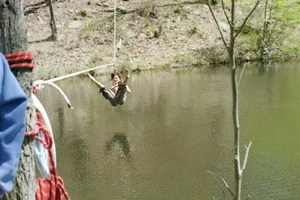
We had a zip line set up so that if you didn't let go you ended up in the water anyway...to get a longer ride you had to hold your legs up. This one (my son, Alex) had the strength and form to make it look good. Some guys just let the water stop them.

But if someone was a lightweight, they got a longer ride...and it also took them closer to the shore.

If people have to hold on (like ours did) make sure they have the upper body strength to do it...we made our folks prove they did with a few pull ups. You'd be surprised at the number of people that cannot support their body weight with their grip and arm strength.

Ours was not too high above ground but did still travel over rocks on a big slope...not the preferred PPE kind of setup, more old fashioned, kind of impromptu, I guess.

You can poke through some pictures at
http://layton.smugmug.com/gallery/686260
and see a few more picts.
 

Attachments

  • 28224-anotherzip-Alex(2).webp
    28224-anotherzip-Alex(2).webp
    94.7 KB · Views: 117
Re: Let\'s have some fun!

[ QUOTE ]
Dave, thanks for the input. The original plan was to have the pulley overhead, a maybe 3'-4' sling from pulley to the harness, and the snap shackle at the harness so the shackle would come with you. We originally planned on hanging a carabiner from the end of the sling and clipping the shackle to the carabiner, under the premise that the shackle ought not be clipped directly to rope (super tight bend radius). After further thought, I'm thinking we should just clip the shackle straight to the rope, so now that the shackle is coming into the water with you, all that stays is soft 1/2" double esterlon rope, (spliced, so no big knots to hit your face!). I think that might work.

Pictures? Of course! I think that goes without saying.

We are going to have a retrieval line clipped to the pulley. It will run parallel to the zip line, via a redirect (small pulley). Someone will be in charge of standing by the zip platform and keeping a tiny bit of tension on retrieval so there will be no tangles.

Guys (and gals), keep bringing up potential hazards that I'm not seeing.

How young of a person would you let do this (assuming it was your kid and you were giving consent).

love
nick

[/ QUOTE ]

Keep in mind that there will be a lot of snap and movement upon release. The highline will be like letting go of a bow string and will move several feet away from you instantly. even soft rope can whip you. There is also a natural tendency to lean forward (not back) when releasing to keep your body in a good slam position, unfortunatly the way to do this is to hold the rope in front of your chest. We learned this after getting a few small hand burns doing a night rappel off of a 60 ft bridge over water with 30 ft of rope!(purposly) I think a highline would be worse due to more stretch / snap.

I believe that the snap shackles are designed to have a metal connector. I remember a long time ago releasing one (can't remember what I was doing but it was not critical) and it was connected to webbing and it got snagged and did not release properly.

Nice to hear how much thought you are putting into this :)

Dave
 
Re: Let\'s have some fun!

[ QUOTE ]
Keep in mind that there will be a lot of snap and movement upon release. The highline will be like letting go of a bow string and will move several feet away from you instantly. even soft rope can whip you. There is also a natural tendency to lean forward (not back) when releasing to keep your body in a good slam position, unfortunatly the way to do this is to hold the rope in front of your chest.

[/ QUOTE ]

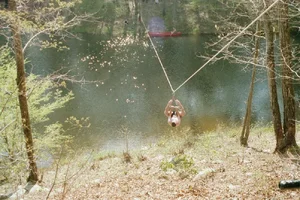
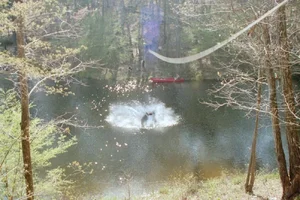
Dave is right about the snap of the support rope as you release...look at theses 2 picts...there is probably close to ten feet of snap up when the line is released...any errant cordage or tethered metal parts could cause a real problem. Be sure you know where all the system parts are going to go.
 

Attachments

  • 28236-Billzips-goodform(2).webp
    28236-Billzips-goodform(2).webp
    184.2 KB · Views: 119
Re: Let\'s have some fun!

And here is the second...the release. Note how high the zip line is now. We attached retrieval ropes AFTER the ride was over.

Another thought. I came upon a fellow in a rockclimbing area once who was rigging a zip line by himself. He had the top anchored to a stump on top of a boulder about 40 feet up. He had the end of the rope tied to a rock outcropping about 120 feet away and about 20 feet high...looked like fun. He had his pulley rigged and everything.

I asked him what would happen when he got to the end of the line. He looked at me funny and said, "oops".

I helped him put a double butterfly about 15 feet out from the bottom anchor. It served as a leg of his "transport tightening system" to tighten the tope, but most importantly it served as a stop.

We watched his maiden run...fast and smooth until he hit the knot. He monkey flipped around and about...really fun to watch. Probably disconcerting from his viewpoint, but better than crashing into the rock. /forum/images/graemlins/crazy.gif

You can position your "pull knot" for tightening the system so that is prevents anyone from going too far if that is a concern.
 

Attachments

  • 28238-Bill-goodlanding(2).webp
    28238-Bill-goodlanding(2).webp
    136.3 KB · Views: 107
Re: Let\'s have some fun!

We are not going to be able to rely on any stopper to keep us from slamming into the right tree. The pulley we're using (click HERE to see it) is sorta big, and the zip line is going to be 3/8ths or 7/16ths line. The pulley will slide over almost any reasonable knot we tie in this line. We are going to rely on physics to stop us!

There is a 270' zip line where I work and only the heaviest of people ever make it to the stopper at the end. They usually all just slow to a stop, then roll back to the low end of the cable. We have taken super precise measurements and are going to replicate the rise of our home zip line. We will make the one we build a bit less dramatic than our home one (to lessen the chance of tree slammage) and we are going to zip the first few with more slack than we think we need.

I never thought about the snap-back. We'll be using a high-modulus line, so the effect will be minimized, but I admit that I've never used a high-mod line in this manner, so there still could be much more snap-back than we'd like.

Point taken about the desire of the "falling" human body to be upright. I'll talk about this with my crew.

Tell me what you think about this.... I splice a new lanyard to go from the pulley to the zipper. I buy one of those long foam pool toys like a 4' long, 6" thick stick, cut off maybe 2' of it, slip this on to the lanyard, then splice in a small aluminum ring to the bottom of it. Clip the shackle onto the ring. Foam would be much more pleasant to hit than would the rope or ring! I really like that idea!

love
nick

love
nick
 

New threads New posts

Back
Top Bottom