Self-rescue from a bucket

Location
Northeast
One thing I have always wondered about is the plausibility of self-rescue in the event of being tossed out / falling out of a bucket. The self-rescue "kits" I have seen are simply minimalist rappel systems designed for an active exit.

Do you know of a system that can get you back to the bucket or onto the ground while you are dorsally suspended from a 4' absorber lanyard?
 
My tie in system is my climbing rope and friction hitch. More than a few times I've jumped out of the bucket to finish some trimming on the far side of the tree. When working in the bucket I keep it pretty snugged up but if I've got to reach I feed some rope through my friction hitch just like when rope climbing a tree and pull it snug after. I've never fallen out of a bucket but have climbed out hundreds of times. Should I fall from the bucket I would not try to climb back in......I'd just lower myself to the ground.
 
120ft. climbing rope in a milk crate in the other side of a two man bucket. Also carry a bull rope and a port-a-wrap and a 30ft. piece of 5/8 bull rope for swinging large pieces of trees that I can't reach into my reach zone on removals.
 
As a climbing crew leader, I don't get to use the bucket truck on a daily basis. When I do get to use it, often it's to climb out of in order to reach the taller parts of trees. While I'm getting my ride up, I tie in on the boom with my climbing line and hitch attached to my saddle bridge. I'm not in the basket for very long usually. But, I'm curious if this is an approved method. Since I'm not tied in on a dorsal ring, is it an accepted method of fall arrest?

My company also does Christmas light installation in the winter. Usually while working on roofs, I'll tie in the same way using my saddle bridge. I know that's not approved. I keep my life line taut at all times. Because of this, I prefer to think of it as work-positioning instead of fall-arrest. However, I don't know if this is correct. Can anyone shine some light on this for me?
 
Zev,
Hows it going? I think it would be tough hanging from a dorsal attachment point. If you always kept a daisy loop hanging from the anchor point on the boom you might be able climb back up like a ladder. Best bet is ground guy from lower controls getting you down. Chewy ansi requires dorsal harness with shock absorbing lanyard. Everyone i know uses there positioning lanyard, but a fall arrest might cause a back injury. Corey
 

Attachments

  • 319320-ladder.webp
    319320-ladder.webp
    3.2 KB · Views: 77
It has been a long time since I've used a bucket so I may be wrong here, but aren't we allowed to use a waist belt for bucket work?

If so, why can't you set it up so that your boom tie in and bailout gear is attached to it so you can simply rappel?
 
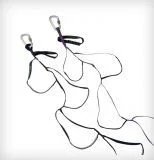
One thing they have is a self rescue ladder that will deploy from the boom itself that would allow the user to climb back into the bucket safely.
 
Webbing ladders are usually attached to the same anchor point as the lanyard. It is then run parallel and attached to the lanyard in a small pouch. That way if a fall occurs it automatically deploys.

Tony
 
The only problem I see with the daisy chain system is actually your deceleration lanyard. When you fall out, how far does that lanyard extend? A few years back we did an aerial rescue class with NATS and bucket self-rescue was one of the things we played with. We hung a guy from he bucket (no fall) and the daisy chain seemed to be just long enough for the un-deployed deceleration lanyard. The other system we worked with was a mechanical advantage system. It was all wrapped up on the boom and with a fall you just had to pull the deployment cord (which went with you when you fell), and you had a longer system. Yes you had to be flexible enough to attach it but it worked and it had much more length.
I think your best self-rescue techniques is prevention, a short lanyard that keeps you in the bucket, and you dont have to worry about getting back in.
 
The systems we used at that training were made by Buckingham. The webbing ladder and the deceleration lanyard are a matched set. That way it is long enough when the lanyard expands to slow the fall.

If anyone is considering putting together their own system keep this in mind.

I have also seen some very effective systems that go with the operator, but tail a string that is pulled to deploy the ladder.

Using a very short tether in the bucket is one option. It is the only way to go if you just use a belt and not a dorsal attachment system. Think dog leash. One of it's limitations is if the operator is jettisoned catapult style.

I totally agree that no matter the system an ounce of prevention is worth a pound of cure.

Any of the rescue/fire fighter rapid escape systems will work for evac in case of mechanical malfunction. Just practice and be familiar with them before you need them.

Tony
 
Some climbing (work positioning) harness are Rated for fall arrest as well. The Ergovation comes to mind with the proper shoulder straps. There are others. Not all climbing harness are this way. It is the exception.

The only way a harness can be rated for fall arrest with a deceleration lanyard is with a rated dorsal attachment. Remember, if you leave the bucket prematurely it will be near a factor two fall, akin to climbing above your tie in point.

I imagine you could use the bridge of your saddle and a short, fall restriction lanyard, but it would have to be short! Seems silly though.

Of course the proper lanyard must be connected no matter the system
smirk.gif


Tony
 
Tony, I was under the impression that the bridge attachment was now acceptable. I own an ergo because of the previous standard, but I thought it had changed. I could be wrong, it's happened before!!! :)
 
Thanks for the input, everyone!

I like the ladder idea. Found the Buckingham version here, if interested: http://www.buckinghammfg.com/index.cfm?f...FTOKEN=75994018

Hadn't thought about being pre-connected to the descent system - that makes alot more sense than just using it as an exit in event of boom failure.

I don't have a copy of the safety Z. The TCIA Aerial Lift Training guide states that a body belt is acceptable. Can someone summarize the section that explains what types of fall protection / restraint are accepted?
 
For the guys that happen to travel from Europe to the USA or vis versa, the USA I believe is the only country that says you have to attach to the dorsal point for bucket work. That is soon to be changed from what I hear (such a bad rule, have you ever tryed hanging from that point!!).
 
Tom,

I do not know either. I have not reviewed the standard since the newest revision came out. The problem as I see it is even with a deceleration lanyard it is still a near factor two fall. The potential for injury would be greater than the same fall same lanyard connected to a dorsal attachment.

I'll do so,w checking. You got me curious.

Fairfield,
If not to the dorsal, where else would you attach? I am talking fall arrest not fall restrict.

I have hung from the dorsal attachment many times for training/ demo. For a period of my life I was paid to fall out of airplanes and let a big nylon sack delcelerate me to the ground. While that was not a true dorsal attachment, it was pretty close and the harness itself made even a cheap one used for aerial lifts look like a Saville Row suit. (customed tailored mind you!) A properly adjusted harness, worn properly is not that bad to hang from. Not exactly tea time, but better than the alternative
smirk.gif


Tony
 
I see a big problem with climbing back into the bucket after the deceleration lanyard has been activated. If injured in the fall and unable to climb all the way back into the bucket a second fall will be long and the deceleration will already have been used. Being in a state of shock the operator may start the climb back before realizing they've been injured bad enough to not be able to complete the climb, may pass out, etc. Of course if the reason for the fall is a failure of the leveling system a climb back up doesn't do any good and you end up hanging by your dorsal attachment.

Tying in at the bridge inables the operator to have a much shorter lanyard with the ability to shorten it up or lengthen it at will. I keep mine as short as possible and use it much like it was my tie in point in a tree. In other words, I can't lean way over without lengthening it, and when I'm done leaning I shorten it up.

Treat the bucket tie in like a tree tie in when it comes to how much slack you allow in the system. If you're worried your climbing hitch may not catch when suddenly loaded put a knot in it a few feet below your hitch.
 
[ QUOTE ]
I see a big problem with climbing back into the bucket after the deceleration lanyard has been activated. If injured in the fall and unable to climb all the way back into the bucket a second fall will be long and the deceleration will already have been used. Being in a state of shock the operator may start the climb back before realizing they've been injured bad enough to complete the climb, may pass out, etc.


[/ QUOTE ]

I never thought of it like that, it makes a whole lot of sence. At your most vulnrable moment (your mind would be far from clear) you make it worse by climbing back up. You are probably better off waiting for your ground crew to get you down. If you dont have a ground crew, well you got to do what you got to do.
Has anyone made that fall into a deceleration lanyard? And wish to share thier story? How did you feel at the bottom? How did you get out?
 
Has anyone tried it? Man that seems like an advanced move. You'd almost have to invert if you could. And while injured...naw man, never mind. Overide on isle 9 please!
 

New threads New posts

Back
Top Bottom