Seeking advice, trying to preserve a huge burl

lots of great advice. There is a cavity in the top at the cut. Does covering it, temporarily( I'm thinking tin maybe), make sense? Ideally, flushing it, binding it(to keep from checking), keeping it indoors would be the choice. Then placing it somewhere after sealing as an outdoor piece is kind of the hope. Most likely, commissioning some help. The best part is I have the "go ahead" and "blessing" from the CEO.
ps. This is why I love TreeBuzz
Eventually, after drying, Fill the Void w/ epoxy ? ? ?
See thread above ?
 
A friend of mine was a world-renowned wood carver and biology professor who was well known in both fields. He had a studio in his back yard and a flitch drying shed attached to it. He would coat the cut surfaces of the flitches with paraffin and weigh them when he first put them into the shed. The shed was lined with plastic and sealed as tightly as possible. He would then run an ordinary dehumidifier in the shed nonstop and weigh each flitch every month until the weight change became almost nonexistent. Thats when he knew they were ready. One time I sold him several Sugar Maple pieces that eventually went to carvers all over the world.
 
I personally really appreciate the natural aesthetic of burl in its organic form with the bark removed….. This piece is so large, its nearly impossible to put on display…. I think removing the bark, and turning it into 3 maybe 4 (or more) large thick slabs that could be then turned into a very large planter (internal decay already), or a pedestal for more art.
 
I have turned some big bowls from green wood, but burls always crack if you don’t dry them first. My advice would be to dry the whole burl in one piece with the bark on. Forget about it for a few years. Then, if there are deep cracks, fill them with a mixture of bark from the same tree and epoxy resin. I used a drill to create small bark shavings to mix with epoxy and fill voids.
 
Horse might be out of the barn, but is there any spar wood not disposed of yet that could serve as source material for a carver. A sort of heads up on that option.

edit - with intention entire burl used as base for "tree" or other sculpture
 
Last edited:
Had a similar sized burl from a willow oak years ago. A woodturner, I thought I'd hit the mother lode. A hint that I hadn't was in cutting the thing off the tree (regular tree-removal). Stihl 084. Cut a couple feet, then sharpen. Loaded with silica. Finally got it free and it was a massive swirly onion burl. Made one bowl, maybe 11 inches diameter. Broad swirls and really not worth the effort -- constant sharpening. The rest was firewood. I hope your burl is much nicer.

On drying, if this is a tight burl, remember that the normal stresses in drying straight grain wood don't necessarily apply. The drying tension is in all directions. Still worth processing as soon as possible. For bowl blanks, roughing out thick and possibly boiling, if cost-effective, coating the outside and rim with anchor seal. The blanks will dry quickly with a lot less movement. For flat stuff, the process mentioned above sounds good.
 
I've heard "anchor seal" a few times now going to look into. Lots of great input. I really appreciate everyone's opinion. Especially those with/or having had some similar experiences. I'm hoping for the best. I think worse case (still good imo)
is multiple pieces. Preserving whole seems tough but can be done. I'm all over the place, the truth is finding time, a challenge I'm sure we are all familiar with.
 
I've heard "anchor seal" a few times now going to look into. Lots of great input. I really appreciate everyone's opinion. Especially those with/or having had some similar experiences. I'm hoping for the best. I think worse case (still good imo)
is multiple pieces. Preserving whole seems tough but can be done. I'm all over the place, the truth is finding time, a challenge I'm sure we are all familiar with.
Also Look into polyethylene glycol. It is sometimes called PEG. I've seen this several times.

Try search w/ "polyethylene glycol".
 
Last edited:
ideal... there in place forever
acceptable.... a few years, if cant, cut it up give to turner friend , make some cool pieces
unacceptable... not try anything, watch it crumble away. (especially if I cut it at the ground and relocate it)
 
Anchorseal is a water-based wax emulsion that sticks to anything. Melted wax is the foolproof standard, but if the wood is at all cool and wet, you have to warm the surface to make it soak in and stick. I have pear flute blanks that I tried this with. Relatively small, I'd just hold an end in the pot of liquid wax to make sure that the end warmed up well and the wax would be there forever.

Anchorseal just paints on wet and looks like white glue. Dries translucent. Bailey's sells a similar product that some production turners prefer.


My local AAW chapter used to buy a 55 gallon drum and we'd pay (years ago) about $7 per gallon. They haven't done this recently, far as I know -- possibly fewer people interested or possibly a conflict of interest with the woodworking retail store where the club meets.
 
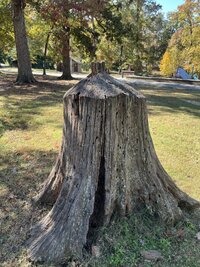
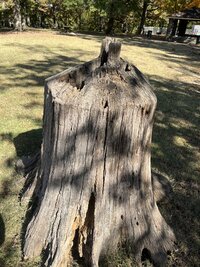
I saw this old stump today at a park.

IMG_7464.jpegIMG_7465.jpeg

I’m confused at the cut on this stump and why it was left like this in place but it sure appears to have aged in place really well. It is on kind of a dry spot, probably lots of sun. I’m gonna guess it’s a post or white oak based on the surrounding trees but given its current state that’s purely a guess. Anyway it reminded me of this thread.
 

New threads New posts

Back
Top Bottom