Jackohh1412
New member
- Location
- Bay Area
Thanks for the reply @moss

Follow along with the video below to see how to install our site as a web app on your home screen.
Note: This feature may not be available in some browsers.
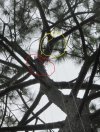
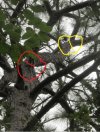

That tree has had the tops broken many times. Are you in a “weather alley”? Looks pretty sturdy, fun climbing tree.Here's some marked pics of the two TIPs with solid lowers in red and the shaky new ones in yellow.
View attachment 77989View attachment 77990
Maybe I should have used green for the solid ones, huh?
The first one would give me a 75' climb in the clear all the way up. The second would give me a 65' climb with a few contact points as I climb. The bookmarks in the pics are 200# braided twine.

"Just recreational climb" I'll let that slide but for fun or dollars, either way you will be just as dead.I've set up two tie-in points recently on what looked like sturdy crotches on healthy pine trees, but when I started climbing I could see the foliage further up shaking quite a bit each time I advanced. Part of me says it's no problem, but the other part that says NO WAY wins out. In both cases the lead is at least four inches in diameter at the TIP angling slightly away from the vertical line of the lower trunk. That would have given me a little more clearance from the trunk and lower limbs, and made climbing easier.
It's just recreational climbing, but I'd like to enjoy setting up and using some more TIPs. How do you go about convincing yourself a TIP is safe when you can see the foliage shaking as you climb?
What an amazingly simple, easy to do test of your anchor point. Love it. I can't wait to try this. Richard, you are an incredible asset to the climbing community!"Just recreational climb" I'll let that slide but for fun or dollars, either way you will be just as dead.
So I use a 2 person static load test, I'll reference the videos below. If you are alone the check can be made by using the lanyard you have or the tail of your line, nothing extra to bring. It only takes a couple of minutes and may save a life.
On Firs and Pines, I will also ascend rope walking but with a double wrapped lanyard until I get to the lower limbs and can back up with normal lanyard use.
I have used 2 ways to tie that loop. One, just pull the first halfhitch out to form a loop and finish with a second half hitch or as in the video a half hitch on a bight, it is a little easier to un-tie.
It is easier to set up than a GoFundMe! Yet we find ourselves donating to another fund a month or so ago for an anchor failure and 50 foot fall.What an amazingly simple, easy to do test of your anchor point. Love it. I can't wait to try this. Richard, you are an incredible asset to the climbing community!

Respectfully but adamantly disagree.Bounce test. Put all your weight on the rope and “bounce” on it to put more force on your TIP before you ascend.
Respectfully but adamantly disagree.
For all the reasons I've mentioned in those videos but most of all, limbs generally don't break that way.Why is that?

Here's some marked pics of the two TIPs with solid lowers in red and the shaky new ones in yellow.
View attachment 77989View attachment 77990
Maybe I should have used green for the solid ones, huh?
The first one would give me a 75' climb in the clear all the way up. The second would give me a 65' climb with a few contact points as I climb. The bookmarks in the pics are 200# braided twine.
For all the reasons I've mentioned in those videos but most of all, limbs generally don't break that way.
Definitely better than nothing, but IMO not as good as a doubled static test. That "cycles to failure" stays in the back of my mind. I've seen too many solid-looking EAB killed ash that just failed at the main stem on a calm day. I am definitely a fan of the static test described by Richard in his videos. It's especially attractive to me because most of my work is done solo, and it's so easy and quick to set up.Okay, well I respectfully think that it has its place. I’m not saying it’s fool proof or guarantees anything, but it’s better than nothing.
I know of someone who started climbing and the limb broke because it wasn’t strong enough to support his weight. Ended up getting seriously injured.
So if you can’t get a birds eye view, putting some pressure on it is better than nothing in my opinion.
It also potentially allows you to break any small pieces of deadwood you might be hung up on which could fail when you start climbing.
My problem with a bounce test is you have no idea what force you applied nor can you specify how much bounce, also trees are designed by nature to resist sudden forces. The bend and bend and hold as long as they can until finally the lignin cellulose complex structure just can't hold any longer. Some will say breaks can be sudden but it's usually because we haven't observed the forces that have been going on.Okay, well I respectfully think that it has its place. I’m not saying it’s fool proof or guarantees anything, but it’s better than nothing.
I know of someone who started climbing and the limb broke because it wasn’t strong enough to support his weight. Ended up getting seriously injured.
So if you can’t get a birds eye view, putting some pressure on it is better than nothing in my opinion.
It also potentially allows you to break any small pieces of deadwood you might be hung up on which could fail when you start climbing.
Does this take close calls to acquire? Non-fatal accidents (e.g., smashing a target)?Judging what is safe movement and what isn't just takes time and experience.


