safely working in sucker tops

I am currently working in elm trees that have been topped years ago. I need to deadwood some tops above a good tie in point. The climate here is dry so there is very little rot.
There are only single branches coming from the topping cuts.
the connection above the topping cuts seem fairly strong. some of them have even totally covered the topping cuts These trees have mostly epicormic shoots so there are not very many foot holds. So the situation is I need to climb above the old topping cuts to cut out the dead stuff.
Any tips and advice on safely doing this would be helpful.
I do use the pole saw were i can.
 
It's hard to get a picture of your situation. What's the diameter at the topping cut? Do you not trust the connection point of the regrowth? If not is there access for an aerial lift? Can you use multiple TIPs? If you have pictures it would make it easier to have an idea of what you are dealing with.
 
use multiple points, use loop runners and biners if really thin regrowth, use 4 or 5 regrowth sprouts if you have too.

If regrowth has a few crotches and not too thin, then use something like a long rope guide through all the crotches.

I hate that kind of work, but seem to do plenty of it.
 
When I'm in the situation you describe, I tie into the optimum primary leader below the tertiary growth, then feed myself slack as I climb upwards into the iffy stuff to gain additional TIP's, but never abandoning that original primary wood TIP until all the tertiary crap is done.

I figure breaking out of a tertiary TIP is one thing, but actually hitting the ground is another, to be avoided at all cost and inconvenience.

jomoco
 
I agree with keeping the optimum TIP and working from there. If other TIPs aren't available, could you use slings as foot holds to climb up the tops? Secured with your lanyard of course. Although Xman's idea sounds pretty workable too, depending on the situation.
 
[ QUOTE ]
use multiple points, use loop runners and biners if really thin regrowth, use 4 or 5 regrowth sprouts if you have too.

If regrowth has a few crotches and not too thin, then use something like a long rope guide through all the crotches.

I hate that kind of work, but seem to do plenty of it.

[/ QUOTE ]
Word!
 
[ QUOTE ]
[ QUOTE ]
use multiple points, use loop runners and biners if really thin regrowth, use 4 or 5 regrowth sprouts if you have too.

If regrowth has a few crotches and not too thin, then use something like a long rope guide through all the crotches.

I hate that kind of work, but seem to do plenty of it.

[/ QUOTE ]
Word!

[/ QUOTE ]

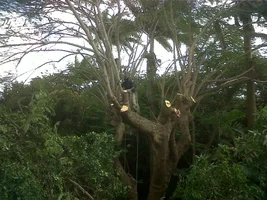
X3. Here is a previously topped removal. Snakes everywhere, one ugly tree. Topping has been practiced here forever and I get to prune and deadwood a good few. Hate it, glad this one came down.
 

Attachments

  • 333944-IMG01641-20120114-1244.webp
    333944-IMG01641-20120114-1244.webp
    484.1 KB · Views: 184
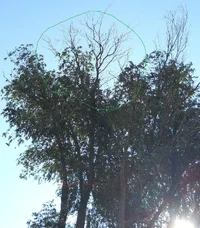
Here is the tree I am talking About especially the one marked. The stuff that I need to remove is circled. The old topping cuts are marked in red. The connection appears rather poor. We are trying to save these trees for the shade. The house is uninsulated.

I would like to hear about any close calls with sucker tops.

I appreciate all the good advice.
 

Attachments

  • 333971-DSCN0355.webp
    333971-DSCN0355.webp
    446.3 KB · Views: 238
Someone topped those trees there, good grief!!! I climb above topping cuts here ofen but thats a different kettle of fish. Different trees with a 12 month growing season. I think this has to be your call as you can see first hand what it looks like. I stay away from advice and share my experience instead. I particularly would hate if someone got hurt or worse using my ADVICE.
 
I think I will top that one limb down to were i can reach it safely. Not worth getting hurt over.

These trees are sixty years old. Never been watered. We do not get much precipitation here either.
crazy.gif
 
I climb nasty topped elms regularly in bend. Hard to tell how big the new growth is in the pic, but I will climb some pretty tiny stuff... I usually inspect the attachment to where the old topping cut was made and make a decision from there. My only dislike of multiple tie-ins on small diameter leads is how much everything flexes, but it's a good option!
 
What is the tree in question? That can play a part in whether it is climbable.

If the union between the Old and new growth has no decay or cracks then I say climb it. From the picture it looks strong enough.

Swingdude, that tree looks like it would have been very beautiful had it not been topped. To bad.
frown.gif
 
Oh wow, I was picturing very thin sprouts. From the picture looks like you got big fairly sturdy choices, shooot you even have crotches in that stuff. Your deadwood goes plenty low too, so I don't think it will be tiny tips.
 
Swingdude, that tree looks like it would have been very beautiful had it not been topped. To bad.
frown.gif


[/ QUOTE ]

Breezy you are a hundred percent correct, that tree would have been a super beauty. It is such a beautiful flowering specimen.
 
Climbing and tying into secondary growth well above topping cuts in poplars is pretty common in Calgary. I'd say there's a good chance if you are climbing poplar you will tie in well above old topping cuts.
Your elm looks pretty decent from the pics. But you do need to look at the unions and decide. These unions are often plenty strong enough.
I think that if I had to do an iffy one now, I would use SRT and direct my line over a bunch of crotches if it was available to do that in the situation at land, rather than relying on just one.
Even though large regrowths are usually fine if there is no rot, it sucks ti have to wonder about them even a little while relying on them.
 

New threads New posts

Back
Top Bottom