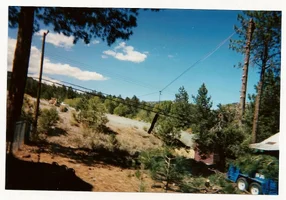
running bowline backed up with marl

I was thinking about a job I was watch years back . These fellas were removing a fairly large pine, ropping down some 16'6" logs . Using a 1" bull line and tagging it over with a re-direct pully from another tree.

The 16'6' logs were about 30 " in dia, good size to be rigging to itself. The climber would flip up hauling the 1" bull line with him , put in a face, set his block below, then three marls and a running bowline. He then would put his back cut in to desired hinge and flip on down the tree.
They would then proceed to to tip the 16 with a vehicle attached to the tag line.

All this for a small question. Do you think it was really necessary to use three Marls on this ?. I guess thier thinking was, if one slipped off the other would catch.However , if the rope broke , it wouldnt have made a difference how many they put on . I dont think it was for strength purposes now that I think about .So maybe I anwered my own question. Who knows.

Sorry this should have been in the rigging and ropping section forum.
Thanks
Greg
 
i've always thought of it in the re-verse sense; that the running bowline backed up the marl or half hitch etc.

The first bend being loaded the most (force reduced to successive bends); would give the most leveraged force to the line. But the stretch (to thining break)wouldn't happen there; so the stretch point before this most leveraged position/ bend would be breaking point in evenly balanced line of Zer0 or like imperfections.

i think if the spar is to sit pairallell with the line; the connecting knot will then sit leveraged(perpendicular). Bowline, Timber etc. are maid to be inline pulls(not for direct connect perpendicularily); so spar must sit perpendicular to line(so knot lacing sits inline) for them to be safe. The addition of a half hitch or marl allows the same lacings to be secure when pull is pairallell and not perpendicular to spar. This is why Ashley makes 2 seperate, distinct chapters out of knot lacings for pulls pairallell or perpendicular to spar.

i think unless very unwiedly, slippery etc. that 1 marl or half hitch preceding to change lacing to one that will grab a spar pairallell with line should be sufficient, especially in rough textures without reducing taper(unless under intermittent loading from random directions like a boat tethered to dock, riding the tide). i usually cut mini humboldts if there aren't any natural inperfections to place the 2 grabs marl/bowline at (another feature of the strategy is the double grab).

i prefer 2 grabs spread apart, but both above the CG; so as that forcepoint empowering them to both pull close positively. Spread, to give a more positive handling and motion; with that long tensioned line (of force) on the side. More marls / half hitches giving more grabs, but reducing force to finishing bowline to empower it to do it's job(?) like a roundturn on mount before buntline, lobster, scaffold etc. redcues the empowering lock of the final lacing (clove, cow, anchor respectively). In short pieces, especially shorter than wide; even this can be somehwat chancey IMLHO.

Have to be real paranoid to really bury self in more preceding marls and half hitches; Unless consititution of spar (crack or decay etc.) is in question; and we are trying to limit loadign down spar, and catch any chance breaks also.


Orrrrrrrrr something like that!
/forum/images/graemlins/crazy.gif
 
No answer to your question, Greg, as I think you've got it figured out.
BUT, wow, that is some mighty heavy material to be lowering! What were they using for friction, a Hobbs? Those sections had to weigh 3000 lb or more, which would take some amazingly good lowering skills to keep the peak forces at under 15,000...
 
You're right there, Roger. It would've been something to see first hand. A video moment for sure. I could only imagine the sheer punishment to the rigging. Remenisent of the Drop Test Video and bordering on the edge of safety and risk.

Graeme McMahon's feat of blasting those 2 ton limbs off a mountain ash and catching them melted the ropes into the wood. Next!

Jerry B
 
Did this actually happen! Video moment is right 16ft sticks and ALMOST 3FT. diameter rigged off the same tree and your standing on it during the cut. wow! we really want to test the limits of rope and hardhat chinstraps.Only this COWBOY is a standin crash test dummy.Dont get me wrong on impact I would love to have the video of me surviving the slaming of trunk ,face,ragdoll effect.YEE HAA!!!
drop test video is absoultely in order DOSENT MATTER WHICH KNOT WE WOULD USE OR ATTACHMENT FOR DROP CATCH IT'S BAD NEWS.Get a crane or helicopter for this move.Or rigg it off another tree that you are not in.........ROBDOG
 

Attachments

  • 45611-DEADWOODINGPONDEROSAS007.webp
    45611-DEADWOODINGPONDEROSAS007.webp
    140.5 KB · Views: 113
i agree with the Rog, Beranek and Dawg; further add that rigging and catching such a spar to self is clear outta my league.

Mike; i think that elasticity is gotten from the line, by how much force is on it. The amount of force after the first marl seriously reduced, therefore the elasticity past that point reduced as well. Then, the remaining elasticity would be minimum, or risk rope stretch off load? i think that more line gives more elasticity is what you are trying to say; but i think the tendency would be for even more reduction of force past each marl; thus perhaps less elasticity overall for same distance of marling run?

Might be situation dependant by how large a diameter the spar was, i think all force graphs are curved; so that in a more philosophical /quantum physics view; we just look at probablilites of an event outcome(realizing anything is possible in the magic of mechanix), not this exact spot on regular, calculated physics result demanding a certain specific outcome.

Another thing is how tight the marls are set. A half hitch is a turn placed perpendicular to the spar, then pulled pairalllell to it. A marl is an overhand knot around/ perpendiuclar to spar, then pulled pairallell. A marl therby has extra grip, but takes more conscientious effort to set properly tight; to get this more secure grip, or can have higher chance of slip i think in some situations! This could be one point were a series of not well set marls could give more elasticty, by the force not snubbed out in the first one etc. Once again theorizing anything is possible, outcomes depending on specifc viewed item's relation ship to other event(s); all graphs are curved thru this range of possibilites, not linear defining only 1 outcome possible.
 
Spydy, I agree with letting the marls loose on a large piece. I think we're thinking along the same lines. I also agree that it takes more force to set so a smaller piece would be best properly set manually for security.


Mike
 
Aside from the fact that this load is bigger than anything I'd ever want to lower, I think it is better normally to use half hitches rather than marls to spread out the load, as they reduce line strength less due to the less tight bend radius formed. Right, guys?

Your point is interesting, spydy, about attempting to introduce some elasticity by setting a few marls kinda looose...
 
Roger , they were using a makeshift Hobbs.... It was basically a car drum welded to a chunk of steel with a heavy binding strap.

unbelievble the drum held up...I was totally surprised....And crap flew everywhere when it slammed against the trunk. There was no runing of the bull line ...Total shock load...have to wonder how many times a 1" line can handle that before snapping .

Pretty ballsy move in a fairly high traffic area. I guess they had been doing that technique for a while to save on renting a crane. However, I dont see them around anymore, so maybe they lost a log through someones house and went out of business....hmmm .

Thanks
Greg
 
Didn't spidy put out a chart awhile back what a rope can take. IT was something about Weight and howmany times it can handle the load. Its to much to search through his posts.
I was asked to hang a 40ft top ounce in a very stout white pine to hurry the job along. I tell you I laughed for awhile on that one. I got a better idea how about I climb higher and you learn to bid a job right.
 

New threads New posts

Back
Top Bottom