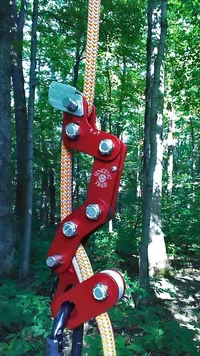
Rope Runner

Pretty is really all any anodized finish is. They are actually there to impede corrosion, we just add color for the pretty effect. The anodizing process in simple terms is really just a controlled corroding of the aluminum. In stead of having it oxide naturally in life, it is forced to form a very thin oxidization layer to protect it self from the process. While that layer is still soft it can be colored or can be left clear (more like a milky white). Hard anodizing is similar but with a few more toxic chemicals thrown in. My guess would be Kevin is using type 1 only because I think he is doing it himself and it is a far easier and safer process for people and the environment. These are tools that get used everyday so leaving the surface natural would be fine Rich. The only folks that might see any issue would be those who lived near the salt water and left the RR sit for a few weeks without rinsing it in fresh water first. Kind off the same thing you do with an aluminum boat propeller.
 
Last edited:
The only folks that might see any issue would be those who lived near the salt water and left the RR sit for a few weeks without rinsing it in fresh water first. Kind off the same thing you do with an aluminum boat propeller.

So there you go.......an aluminum anode and a propeller is what we need to add to it, we can fly then!
In fact Hugues, if your are reading this, that maybe a good idea for your Rope Runner when you get it to keep it from rusting like your HH and Uni ;)
 
My mistake on the anodizing. I must have only dealt with hard anodizing in the past.

Added a "bump" similar to yoyoman's and only had a chance to try it in the basement. It helped but didn't go as far as I would like.

I added monkeylove's tubes for comfort and the combination was considerably more comfortable in my brief basement trials but I couldn't get the rope on and off without removing the tubing.

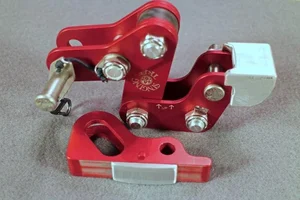
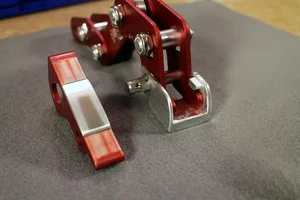
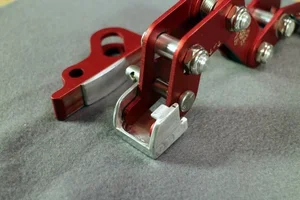
So....I hacked out an aluminum 'pad' that is easy to take on and off, yet securely attached by the Slic Pin. Seemed nice during basement trials. Hopefully I'll get out to give it all a good test tomorrow.

IMG_0489pe (Small).webp IMG_0481 (Small).webp IMG_0485 (Small).webp
 
I gave the mods a good try out today. Up 85', back to ground and up and down 30' several time trying different adjustments on the adjustable bollard.

These changes have greatly eased the perceived pressure required to release the RR and make 'jump free' starts and control from inching down to so fast it scares me back to inching quite nice.

The finger pad prevents the uncomfortable digging in on my soft desk jockey fingers and appears to be the answer I was looking for. Much better than the Plasti Dip I had previously tried.

IMG_20140924_171239_695 pe (Small).webp
 
Yale Aztec 11.7mm (the cell phone photo color is off). It's a color variation of Poison Ivy and Blue Moon. What I'm finding with my 11-11.7mm ropes is that they start off fine with the bollard wide open, but after descending a few times, they flatten out and the stops start to progressively become longer and longer coasting stops. I've had the situation progress to where I would "coast" all the way to ground. While not fast enough to be dangerous, it is still a very interesting occurrence.:D
 
Bollard position is probably the most important tweek. I think Rich suggested that you can also push the bird up to help it lock a little more. Might help the creep, but I only fly Vortex so wide open bollard is all I have tried.
 
Yale Aztec 11.7mm (the cell phone photo color is off). It's a color variation of Poison Ivy and Blue Moon. What I'm finding with my 11-11.7mm ropes is that they start off fine with the bollard wide open, but after descending a few times, they flatten out and the stops start to progressively become longer and longer coasting stops. I've had the situation progress to where I would "coast" all the way to ground. While not fast enough to be dangerous, it is still a very interesting occurrence.:D
I also had the same experience today. Came down out of a big red oak and at about 30' from the ground I wanted to stop to make a cut and continued to descend, not fast, but enough. I'm using Poison Ivy/Calamine/Poison Hivee....I had the bollard wide open. Maybe tweaking it a bit more will help.
 
I also had the same experience today. Came down out of a big red oak and at about 30' from the ground I wanted to stop to make a cut and continued to descend, not fast, but enough. I'm using Poison Ivy/Calamine/Poison Hivee....I had the bollard wide open. Maybe tweaking it a bit more will help.

Yes, you can adjust the coasting out. The compromise is that it becomes harder to release after a stop.
 
It works on all of these ropes.
New England Escalator
New England DragonFly 11mm
New England Tachyon 11.5mm
Yale Imori 12mm
New England KM-III 7/16"
Sterling HTP Static 10mm
Sterling HTP Static 11mm
Teufelberger Platinum 11.5mm
Yale Kernmaster Safari 11mm

Yale Poison Ivy® Line, 11.7mm.......and almost 9mm HTP.

...and I'm still not sure what my favorite is........I find it a mater of adjustment.

Comment about the rubber tubing and other things on top of the bird.
I put my hands above the friction hitch or any mechanical device when I climb, I think it is unreasonable not to.
Knowing the risk in doing this is important.
Knowing that risk, I practiced many times overcoming the NATURAL tendency and panic mode of holding the rope and sliding down the line.
Like riding a bicycle, if you want to turn right, you turn your handle bars to the left, then lean right. It is not natural, that is what learning to ride a bike is all about.
One day I was practicing foot locking, don't ask why, it is not for me and my knees, does come in handy for a bounce check though.
So I slipped and started "the slide", in just my reaction time and muscle memory to get my hands off the rope I traveled a good 10' and heated my nitril gloves.
Point is, the bigger that bird and the more stuff you put on on it, the more difficult it may be to get your hands free in a time a NEED.
Better to me to tweek and hump-T-bump to get the friction right so you don't have to mess with the bird.
 
Works good with Vortex also. I also do not have the flattening issue that seems to come on some rope. I mean I do but it never stays long and has not really ever caused an issue. When I get a moment Rich I will machine up a concave face and send it down. I am curious if that helps with the flattening. It will still be flat due to the Bird but on descent the rope passes through the pulley and concave face so it seems to round it back up some.
 
Very interested in some of those variations. I'm seeing a good bit of wear on the friction bar. I'm not at all concerned about the wear on the bollards, actually like them, as the concave seems to give a more predictable friction.
 

New threads New posts

Kask Stihl NORTHEASTERN Arborists Wesspur TreeStuff.com Teufelberger Westminster X-Rigging Teufelberger
Back
Top Bottom