Root Crown Excavations: Why?

opposablethumb

New member
Location
Mid-Atlantic
Captain Question here trying not to derail Tom D.'s RCX tool thread...

From reading about all the tools you folks use for RCX's, it sounds like their is a considerable amount of hacking, cutting, and dirt flying going on.

Aside from inspecting for decay on a potentially hazardous tree, why do you do them?

What are you cutting and chiseling when you do them?

What sort of information are you gathering?

What sorts of trees are you doing them on? Old? Young? Healthy? Sick?

I'm kind of embarrassed that I have no idea what this business is all about.

Educate the bonehead!
bangtard.gif
 
RCX is a good thing to do when checking the health of a tree. It will tell you the condition of the buttress, depth of planting, whether there are any Stem-girdling roots, whether the burlap, twin and/or basket were left on and whether or not the roots ever left the planting hole.

The cutting is to remove or terminate SGR's, crossing roots and even crossing roots from nearby trees. It is also to remove residual Burlap, Twine, Baskets, stones, bricks, edging and adventitious roots. Further digging can be for radial trenching, vertical mulching or determining the spread of the roots.

Of course these are not necessarily the only reasons for cutting.
 
The Air Spade can also be used in construction applications. On construction sites where you are trying to preserve existing trees, many times the homeowner will be adding irrigation, lighting or running new conduit around trees. We will cut the trench using the air spade and run the conduit under the roots leaving them intact.

There are lots of uses for it but there are limitations on what the tool can do. In our area we have a heavy clay soil. If there is not good soil moisture, its like blowing air on a brick. If you are air spading around windows, parked cars, hardscapes etc., your setup time can take awhile to ensure nothing gets broken or dinged. Make sure the client pays for that time! I learned this the hard way.
 
During the last building phase on campus 700 3" trees were planted. ALL...ALL...of them need RCX. I can either see SGRs, mulch too deep or planted too high. In time, I'll be doing them all.

The tree that I'm starting on is an old one that is in decline. The other arbos who have looked all suspect root decline. Once I have it excavated I can tell. My plan is to air-til in composted material to give the tree some nutrition.
 
Many trees planted in the landscape over the last 50 or so years have the potential to develope girdling, kinked or j-roots or have ropes or wires and anything else you can imagine at the junction.

If You find a tree with the root flare not pronounced similar to the way your feet are positioned and the area is 30% or greater of little to no root flare, then it is suggested to perform a root collar inspection and remedy if warranted.

It is important to know this because that tree could fail and you could be held responsible for the damage.

Some of the other reasons it is done is root rot inspection, aeration,fungucide application etc

Primarily if tree enters the ground like a post or it is flat on a side, cracking etc. Best to charge them for the time to check it out before you move on to other cultural practices.
Every tree begins at the ground, like every house relies on a foundation.

There is times every year where I spend as much time in the soil and roots as I do in the crown on harness.

Some good money in it and soil is usually cool in the shade on those hot summer days. Which is one of the better times to perform anything really agressive.
 
Good stuff.

Now I want an airspade.

Dang you, arborists!!

Why isn't this subject/practice given more treatment in publications?

Seems like an ANSI standard or BMP would be a good thing to develop on this subject.
 
Now I want an airspade.

g or some other model of air tool...

Dang you, arborists!!

g sorree,,,but hand tools and hose work too.

Why isn't this subject/practice given more treatment in publications?

g like many topics, just look--search the journal archives; that's most of the research I did for Page 8 here: http://www.tcia.org/PDFs/TCI_Mag_July_07.pdf

Seems like an ANSI standard or BMP would be a good thing to develop on this subject.

I tried to get root pruning included in the pruning standard but that did not fly. now there is a new standard in the works on rootzone management (not to be confused with soil management).
crazy.gif
 
[ QUOTE ]

I tried to get root pruning included in the pruning standard but that did not fly. now there is a new standard in the works on rootzone management (not to be confused with soil management).
crazy.gif


[/ QUOTE ]

Thanks for trying. That's odd that it didn't fly...Glad to hear a standard is coming down the pipes.
 
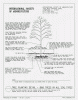
RCX is really all about complying with existing ANSI standards: The trunk flare SHALL be at grade, mulch SHALL NOT touch the stem. Sometimes excavation is not needed to examine the root crown; another reason this is more about examination and not about excavation.

Tom's got the right idea as a manager of trees to do what he needs to view this most important part of the tree. On your parking lot oak, no root cutting was called for. The key contact to make on this seems to be the landscape architect who spec planting and mulching--do they call for flare to grade and stem kept clear?

If not, they may need to update. Fwd them the attached and let them know it's current, science-based info, except that pruning only dead and broken branches at planting time is most often recommended.
 

Attachments

  • 272490-PlantingDiagram.gif
    272490-PlantingDiagram.gif
    22.6 KB · Views: 41

New threads New posts

Back
Top Bottom