Follow along with the video below to see how to install our site as a web app on your home screen.
Note: This feature may not be available in some browsers.
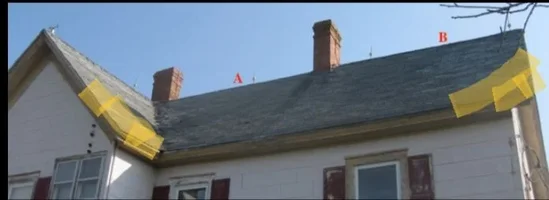
no, although as you say there is enough rope from anchor A to allow you to fall, the anchor B will prevent you from having that pendulum effect. Remember that in my senerio you are tied into both anchors at once. picture that you are working 15 feet horizontally from anchor A, should you slip you can fall in an arc until you are 15 feet directly under A. But if you are tied into A and B (lets just say the 15 feet horizontal of A puts you roughly 5 feet below B) then when you start to fall the rope tied to B will prevent you from falling in that arc pattern.
Let me know if that doesn't make sense, I can draw it out. Often times pictures are truly worth 1000s of words.

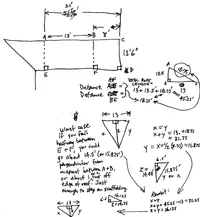
I think your getting what I'm saying, and not to beat a dead horse, but you shouldn't be able to fall straight down between point E and F if you have the slack out if the rope.Thanks again, Jehinten. I think I get what you mean. That's an interesting idea I hadn't even considered. I'll have to draw it out and see what I think. Thank you.
ETA: I did a crude sketch and figured it out (might have made a mistake the first time, but when I revisited it, my answer was close to my first answer). It appears that if I did what you recommend, the worst that could happen (if I fell halfway between A and B), would be that I could fall a foot or a foot and a half beyond the eave, but the scaffolding would probably save me there.
View attachment 59408

I'm thinking that to get boards down in a sane way, tie a rope at center of board, run that rope up to roof anchor at ridge (using its d-ring as pulley), back to a prusik loop on my climbing harness. Then move my "body" prusik loop down a foot on my static rope, then take a step down while belaying the board downward from prusik on my harness, lather rinse repeat until at eave, then transfer/throw board onto scaffolding.