Roof job - FA Rope questions

In the book On Rope a fall load...I know, the units incorrect physics isn't right..of 2,700# will result in organ damage. That's when the water balloons inside our body start to burst.

YOu're not likely to generate those numbers on a roof unless you do a free fall drop. Dynamic loads are pretty complex. Keep as much slack out of your system at all times. Our rope is a fifth limb...put it to work don't drag it along.
 
Thanks, Brocky and Tom, I'll have to look at my copy of OR...didn't remember that part of it.

Leaning more and more toward using the static non-stretchy rope...would probably never have more than a few feet of slack, and none when using it for WP or out near rake edge or ridge. I suspect the roofing guys use a non-stretch rope.

Next question: I'll use a rock climbing diaper harness, and plan to add something across chest to reroute rope (but life support will be through the harness, not the chest part). Is the upper body addition something that I can tie/rig/sew myself using nylon webbing or rope? I have some 2" seat belt nylon and other webbing...and 3/8" nylon braid and other cordage...
 
Last edited:
Yeah I see guys wearing the FA harnesses but they're barely in the same time zone as the rope (if it's even out of the truck)... on steep stuff, I see guys using it, though...but I'm not a roofer...and will probably be lazy about moving my roof jacks up (and I don't have enough of them to cover even one side anyway)
 
If working on a high edge you really think you are going over, I would use a descender, with a prusik backup for positioning, and descend off roof and start again. Sometimes you will damage a roof eave by trying to scramble back up.

If you are just slipping and want to haul yourself back up onto the roof if partially off use a second prusik or a hand acender to assist you to pull yourself back up over the roof edge...
 
I could have sworn that someone in this thread recommended that I use an auxiliary upper-body harness to redirect my lifeline / prusik loop so that if I fell I wouldn't be inverted...but I just re-scanned the whole thread and I'm not finding it.

Do you guys think I should use an upper-body harness to route my lifeline closer to my chest, or am I OK just clipping my prusik to my rock-climbing harness for a lifeline (and work positioning)?

If I should use an upper-body harness, would this be OK?

Apologies if I'm wearing out my welcome with this thread...just trying to get everything ready to pull the trigger on this job (welding up a laddervator gizmo now so that I don't have to carry 16 tons of shingles up a ladder)...
 
I could have sworn that someone in this thread recommended that I use an auxiliary upper-body harness to redirect my lifeline / prusik loop so that if I fell I wouldn't be inverted...but I just re-scanned the whole thread and I'm not finding it.

Do you guys think I should use an upper-body harness to route my lifeline closer to my chest, or am I OK just clipping my prusik to my rock-climbing harness for a lifeline (and work positioning)?

If I should use an upper-body harness, would this be OK?

Apologies if I'm wearing out my welcome with this thread...just trying to get everything ready to pull the trigger on this job (welding up a laddervator gizmo now so that I don't have to carry 16 tons of shingles up a ladder)...

If you are working on the roof I find waist attachment better as you will be restricted in movement if use high chest attachment or tend point.
 
TL;DR - Please see question in red below:

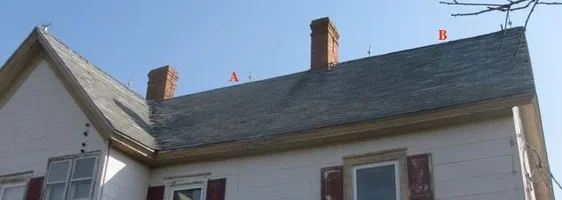
OK, I have most of the scaffolding up, and attached roof anchors at A and B in photo below:

59380

Salesman at lumber yard, who has done roofs, said he would just use "nailers" (2x4s nailed across rafters to hold onto) about halfway up, with just one layer of roof jacks nearer the eave, if that. (He's a kid.)

I'm thinking of doing it that way (with one layer of roof jacks and boards) but I don't like having just two TIPs about 15' or so apart above, so I was considering tying a rope from A to B with 3 or 4 Alpine loops inline between them, to use with carabiners to redirect my top rope (which will probably go over ridge and be tied to a tree or truck on other side of house.) I could use chimney(s) to redirect, but they're 130 yrs old with sand-lime mortar, I can imagine falling and bringing down a brick stack on top of myself...

Does this sound reasonable?

Sorry if this is really basic stuff (I'm not a tree guy, just a wannabe) but thanks again for all the help.
 
TL;DR - Please see question in red below:

OK, I have most of the scaffolding up, and attached roof anchors at A and B in photo below:

View attachment 59380

Salesman at lumber yard, who has done roofs, said he would just use "nailers" (2x4s nailed across rafters to hold onto) about halfway up, with just one layer of roof jacks nearer the eave, if that. (He's a kid.)

I'm thinking of doing it that way (with one layer of roof jacks and boards) but I don't like having just two TIPs about 15' or so apart above, so I was considering tying a rope from A to B with 3 or 4 Alpine loops inline between them, to use with carabiners to redirect my top rope (which will probably go over ridge and be tied to a tree or truck on other side of house.) I could use chimney(s) to redirect, but they're 130 yrs old with sand-lime mortar, I can imagine falling and bringing down a brick stack on top of myself...

Does this sound reasonable?

Sorry if this is really basic stuff (I'm not a tree guy, just a wannabe) but thanks again for all the help.

Be careful of the loads you are applying to those anchors if stringing a tight line between and having a running anchor along it.

If tied off tight, and you tie running anchor, when you slip the force applied to the TIP A or B could be higher than if tied just to one of the TIPS A or B (without a running anchor). So depending on construction of TIP's you could overload them.
 
Thanks, Chaplain242. Good to know. That convinces me even more to get those anchors better anchored. I drove about 8 or 12 - 16d nails into each one, but sometimes it didn't feel like I was hitting much, though I couldn't see any nails in the attic through the deck. Going to find a way to get 2 lag screws through each anchor, and into those 130-yr-old yellow pine rafters...
 
Your likely better off with a tie in on each instead of tying both anchors together as @Chaplain242 explained it raises the amount of force on each anchor. Although tied in twice is twice the rope and connecting hardware it will offer a redundancy as well as better work positioning in certain areas. Truth be told its probably more than necessary for the job, but if it is what you need for peace of mind and to be able to do the job then that is what it takes.

Also now that I see that you have scaffolding set up along the roof edge, I would limit the length of rope to no longer than necessary to reach from point A to the bottom right corner and from point B to the bottom left corner. This will give you less rope to manage and should you fall you wont need to repel to the ground, because you can climb down the scaffolding. Instead of cutting your rope you can attach one end to "A" and one end to "B" with the tails long enough to work on, the belly of the rope between the tie in points will be slack so no extra forces, and can be laid out on the opposite side of the roof as the work being done to keep it out of the way.
 
Thanks, Chaplain242. Good to know. That convinces me even more to get those anchors better anchored. I drove about 8 or 12 - 16d nails into each one, but sometimes it didn't feel like I was hitting much, though I couldn't see any nails in the attic through the deck. Going to find a way to get 2 lag screws through each anchor, and into those 130-yr-old yellow pine rafters...

I wouldnt use nails or lag screws long term. I would drill through and put nuts/washers on the back of a rated eyebolt if permanent mounting. Depending where you live there could be legalities to comply with also. If permanently mounting with Eyebolt you could also fit an eyenut (if available) to add an extra tie into internal roof structure for redundancy.

Some of us live in districts that would require a government approval and annual inspection to fit a permanently mounted Tie in Point. However even if you dont it would assist to have some redundancy in the construction (even if just a sling wrapped around internal structural members of the roof then attaching to your TIP hardware.
 
I would limit the length of rope to no longer than necessary to reach from point A to the bottom right corner and from point B to the bottom left corner.

Thanks, Jehinten. Do you mean "from point A to the bottom left corner and from point B to the lower right corner"? ("A" is on the left and "B" is on the right.)

(Enough rope to go from A to the lower-right corner would also allow me, if I fell, to almost hit the ground, or pendulum into the windows of the first-story porch...if I didn't get fouled in the scaffolding first...)

Chaplain242 - Thanks on the anchors. I agree. They will be temporary, though, and ripped up when finished this job, since I don't plan going up there again in this lifetime. (I just use a static rope over the ridge and anchored to a tree and a truck to clean the chimney.) But I will anchor them better...again, most work will be done with top rope anchored to truck on other side of house, so anchor points are more of "redirect" points than actual anchor points, I guess...terminology mistake on my part (I probably shouldn't have called them "TIPs"...)
 
Thanks, Jehinten. Do you mean "from point A to the bottom left corner and from point B to the lower right corner"? ("A" is on the left and "B" is on the right.)

(Enough rope to go from A to the lower-right corner would also allow me, if I fell, to almost hit the ground, or pendulum into the windows of the first-story porch...if I didn't get fouled in the scaffolding first...)

no, although as you say there is enough rope from anchor A to allow you to fall, the anchor B will prevent you from having that pendulum effect. Remember that in my senerio you are tied into both anchors at once. picture that you are working 15 feet horizontally from anchor A, should you slip you can fall in an arc until you are 15 feet directly under A. But if you are tied into A and B (lets just say the 15 feet horizontal of A puts you roughly 5 feet below B) then when you start to fall the rope tied to B will prevent you from falling in that arc pattern.

Let me know if that doesn't make sense, I can draw it out. Often times pictures are truly worth 1000s of words.
 
no, although as you say there is enough rope from anchor A to allow you to fall, the anchor B will prevent you from having that pendulum effect. Remember that in my senerio you are tied into both anchors at once. picture that you are working 15 feet horizontally from anchor A, should you slip you can fall in an arc until you are 15 feet directly under A. But if you are tied into A and B (lets just say the 15 feet horizontal of A puts you roughly 5 feet below B) then when you start to fall the rope tied to B will prevent you from falling in that arc pattern.

Let me know if that doesn't make sense, I can draw it out. Often times pictures are truly worth 1000s of words.
Correct me if I'm wrong....so your sayying to be tied into both anchors independently. 2 separate ropes being most ideal. Pretty sure I got ya and that you got a good idea
 
Correct me if I'm wrong....so your sayying to be tied into both anchors independently. 2 separate ropes being most ideal. Pretty sure I got ya and that you got a good idea
yup, exactly. essentially DSRT but since neither rope will ever see your full weight a regular friction hitch on each would likely work.
 
yup, exactly. essentially DSRT but since neither rope will ever see your full weight a regular friction hitch on each would likely work.
That or I can't see why he couldn't go MRS if he wanted too?
But I do think he'd be fine without a rope wrench on a SRS being tied in twice....or many other multicender devices.
I've got 2 grigri2's with the OP's name on them! One brand new never used and one very lightly used on some rec climbs. Lmk if ur interested
 

New threads New posts

Kask Stihl NORTHEASTERN Arborists Wesspur TreeStuff.com Teufelberger Westminster X-Rigging Teufelberger
Back
Top Bottom