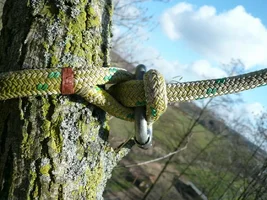
Rigging "shortcut"?

Re: Rigging \"shortcut\"?

I would never say that anyone should needlessly subject their equipment to undue stress.

A biner is more than capable of taking a shock load. IF you intend on neg blocking aka repeated shockloading than I think its obvious a biner isnt as fine a choice as a knot. Either way you have rope, knot, biner, load. When experiencing high loads, whether from large weights or big drops it makes sense to remove a link and go rope, knot, load.

Just trying to make sure we all have 'good science' behind our beliefs.
 
Re: Rigging \"shortcut\"?

Nicely put. The recommendation about replacing after a biner arrests a fall is definitely the companies watching their own asses. I have rock climbing carabiners that I have fallen on literally thousands of times. They are clearly designed for that purpose but they still recommend in the manufacturers literature that you replace the biner after it arrests a fall. Pay attention to the WLL just like you would with anything else, be careful about side loading and when in doubt, take smaller pieces and you should be fine with a carabiner.
 
Re: Rigging \"shortcut\"?

[ QUOTE ]
I would never say that anyone should needlessly subject their equipment to undue stress.

A biner is more than capable of taking a shock load. IF you intend on neg blocking aka repeated shockloading than I think its obvious a biner isnt as fine a choice as a knot. Either way you have rope, knot, biner, load. When experiencing high loads, whether from large weights or big drops it makes sense to remove a link and go rope, knot, load.

Just trying to make sure we all have 'good science' behind our beliefs.

[/ QUOTE ]

That's it that is all I am trying to say. For loads below the anchor point with no slack, a connecting link is great strategy. For all else it lacks on many fronts.

What a piece of equipment will withstand and what it is designed to be subjected to can and are very different.

Just because in a head on collision your airbags will deploy, seat belt will restrain and crumple zones crumple is no reason to go looking for something to ram you vehicle into!

Tony
 
Re: Rigging \"shortcut\"?

Norm, are you negative blocking with that system, with the loops girth hitched around the pieces above, dumping them over?

Never had any experience negative blocking with a girth hitch...let alone the thought of using a ladder snap. Very curious if you've had good results. Others have mentioned this scheme and I am curious if:

1. the piece rolls or slips out with a girth hitch (if that is how these pieces are rigged) in negative blocking.

and

2. if a standard 50kn safety steel biner isn't sufficent to tame the forces of most blocking situations since, as 223 has shown, these are meant for this kind of force application. A ladder snap...why not a rigging shackle? First saw Sean Gere use a rigging hook.


rigging hooks
 
Re: Rigging \"shortcut\"?

334374-8954p16om5oql56ivk3n1uif1a231olj5.jpg
Still works great for not to big and oversized loads ;-)
 

Attachments

  • 334374-8954p16om5oql56ivk3n1uif1a231olj5.webp
    334374-8954p16om5oql56ivk3n1uif1a231olj5.webp
    132.4 KB · Views: 42
Re: Rigging \"shortcut\"?

I guess the point I'm trying to make is that you're getting hung up on legalese. The DMM Impact block says that it is designed for lifting and winching. Nowhere does it say that it is safe to be used for negative rigging but I don't think that anyone would argue that one of the blocks main purpose is negative rigging.
My point bringing up rock climbing is not that arresting a rock climbing fall and rigging are one and the same (they aren't, though pretty similar) but to point out the difference between the actual intended use and the use outlined in the lawyer approved literature. No engineer for a rock climbing company is going to tell you that carabiners are supposed to be retired after you fall on them (unless of course the companies lawyer is in the room) but nonetheless, the literature tells me that I should. Basically they are covering their in case you overload the equipment and try to blame the company. We live in a litigous world and everyone wants to cover their own . When you cable a tree do you guarantee that it will not fail? No, because the tree could fail, it could be totally unrelated to the work you did and you could still be sued DO you ever one hand a top handled chainsaw (and I mean ever)? Cause if this is a practice you have ever used, however rarely, you are going against the manufacturers specific guidelines. The point is that manufacturers must cover themselves against those who will make poor judgement calls and then look for someone else to blame.
Its doubtful that any of this will change anyone's mind but I already typed it all out so I might as well post it.
 
Re: Rigging \"shortcut\"?

On heavy pieces, I've found the marl to be more prone to wear (i.e. abrasion damage) than a simple half hitch.

I would suggest a half hitch if this were a bigger piece (or for a smaller rope).

327613-RingandSling128.jpg
 
Re: Rigging \"shortcut\"?

[ QUOTE ]
Norm, are you negative blocking with that system, with the loops girth hitched around the pieces above, dumping them over?
Never had any experience negative blocking with a girth hitch...let alone the thought of using a ladder snap. Very curious if you've had good results. Others have mentioned this scheme and I am curious if:
1. the piece rolls or slips out with a girth hitch (if that is how these pieces are rigged) in negative blocking.
and
2. if a standard 50kn safety steel biner isn't sufficent to tame the forces of most blocking situations since, as 223 has shown, these are meant for this kind of force application. A ladder snap...why not a rigging shackle? First saw Sean Gere use a rigging hook.
rigging hook

[/ QUOTE ]

No, I don't use that system for negative rigging. Switch over to a DB rope and knots. I knotless rig when it is the most efficient method for me. Not every tree.
1. A piece of wood can and will absolutely fall out of a loop 'girth hitched'. I've had it happen to me.
2. Cycles to failure will eventually play a roll here. Krabs are not designed for negative rigging. Sure, they will arrest the fall of a climber, but rock climbing ropes are totally different than tree rigging ropes. The locking ladder snap works for me. One can open the gate with a gloved hand, even with winter gloves on. I don't apply high forces on it, 650lbs max, so a screw pin shackle is not needed. I've tried that 'rigging hook'. Didn't like it.

Sean and I worked together many moons ago. He is definitely a master of rigging.
 
Re: Rigging \"shortcut\"?

I've got to disagree a bit. Yes rock climbing ropes and tree climbing ropes are different, but not terribly. More than anything we need to think about forces in play. If I'm running a rock climbing rope versus a rigging rope the main difference between them (assuming you are running say, stable braid) is the amount of elasticity built into the system. My dynasorb rigging line has a static elongation of 2.8% while a rock climbing rope has around 10%. There is most definitely a difference in those ropes but they are far from being totally different. In truth, arresting a leader fall in rock climbing is negative rigging. As I said before, you need to tailor your equipment and rigging styles to the situation but to say that carabiners are not designed to arrest a fall or for use in negative rigging is silly. I do have other concerns with using a carabiner in negative rigging but not that. And as for cycles to failure, your rope and slings have a lot shorter lifespan than a carabiner does. As I said, I have other problems with using a carabiner, primarily loading laterally rather than longitudinally, especially in a negative rigging situation where the carabiner could come into contact with say, the trunk of the tree, If a carabiner was loaded heavily across the gate it could fail the very first time. And perhaps I should reiterate, I'm talking about steel biners for tree work and alloy biners for climbing. Different, but the principle is applicable. The major difference between the two systems is the forces being put on them. Ironically, because it would be fairly difficult to put more than a fall factor of 1 on an anchor while negative rigging, despite the difference in elongation in the ropes, a rock climbing fall actually has potential for much greater force (i.e. multi pitch in which the leader falls with no gear between them and the belay creating the dreaded factor 2 fall). And let me reiterate, I am not saying that you should always use carabiners for rigging, or that you shouldn't inspect or retire them, I am simply saying that carabiners are designed to catch dynamic loads, not always the ideal tool (I like the idea of a rigging ring or something that cannot be side loaded for knotless rigging) but a tool that is fine for that use nonetheless. I do find it a little interesting that you are willing to use a locking ladder snap and not a steel locking carabiner.
You should never load a tool above its working load limit but I rarely have to worry about the strength of my hardware, its the strength of my anchor point that is most often my concern. Course I mostly get to rig out nasty decaying rottenwoods out here in wyoming. Rarely get to go so big I'm worried about overloading my hardware.
 
Re: Rigging \"shortcut\"?

Thanks, Norm.

Glad to hear that. I've used girth hitches with success on slinging out branches, etc., but have had branches slip out and was curious if I was misunderstanding your use of the system here. Clearly, you don't recommend this for negative bloacking.

Yeah, I don't remember Sean using it for negative blocking--more like a central spar and then rigging off large branches. Fantastic to watch.
 

New threads New posts

Kask Stihl NORTHEASTERN Arborists Wesspur TreeStuff.com Teufelberger Westminster X-Rigging Teufelberger
Back
Top Bottom