Rigging "shortcut"?

Re: Rigging \"shortcut\"?

In my first years of treecare I always had a steel biner on the end of the rigging line.
The best part of it was that you could easily swing the heavy biner and rope through a crotch to attach it somewhere.

But as with all bulky things at the end of a rope. Things get stuck.

When you know what you are doing, the biner attached at the end of the rope can be a real treat. As with everyhing, DO NOT OVERLOAD.
At that time I used an ISC KH200 screw gate and that item was never the weakest link.
Over the years my knotting skills got better and better and after a while the biner at the end of the rope became only a nuisance. Having to open up the rigging block every time to feed the rope through it for example.

I just made a quote on a 90 foot Abies grandis with branches from the top to the bottom. When I get that job I'll probably stick a biner to the end of the rigging line to get those gazillion branches down.
 
Re: Rigging \"shortcut\"?

Skip the biner bud. Just go with a rope and a knot it won't get stuck and it spreads out the wear so its not always in the 1 spot
 
Re: Rigging \"shortcut\"?

I know of two on the job rigging biner accidents that broke bones on each occasion, resulting of course in hospitalization and misery.

Fortunately neither happened on my crew.

Both involved failed overloaded biners whipping about and finding flesh and bone.

In both instances the biner gates were loaded to failure and came alive.

If a rope in proximity to you is suspect of being overloaded? Why add steel to the mix unless absolutely positively needed?

jomoco
 
Re: Rigging \"shortcut\"?

[ QUOTE ]

If a rope in proximity to you is suspect of being overloaded? Why add steel to the mix unless absolutely positively needed?

jomoco

[/ QUOTE ]

Why would anyone use a rope that they suspect is overloaded? Basic rigging premise...get bigger gear!

Why aren't riggers taught what safety factors are? This can be taught simply without using all sort of math and physics.

I've used non-locking rope snaps on the ends of ropes before lockers were available. Girth hitching a steel biner into my rigging line is SOP. Taking small loads is even more typical.

There are few broken/bent pieces of rigging gear in my 'Dead Gear' bucket. Most of the ones in there are from ground dragging loads that got jammed.
 
Re: Rigging \"shortcut\"?

Oh lots of dudes like to use 1/2, when they should be using 5/8 or 3/4 ropes. Forgot to load it, left it at the shop etc.

What have you got against tying cloves, timber hitches and running bowlines Tom?

Too old school and slow?

I shy away from steel on my rigging terminations until I start craning with wire rope and clevisses.

jomoco
 
Re: Rigging \"shortcut\"?

Old school?

When I started working for Marv, first job circa '66 then more regularly in about '74 all I ever rigged with was half inch, three strand hemp rope with a non-locking rope snap spliced in. When did old school graduate? '66---'74???

Nothing against knots at all. Timber hitch is rarely used, its not a trustworthy not when it gets slack/load cycles, it can spill or become misfigured/misloaded. There are many better solutions.

Given safe working load calculations I have no problem using steel biners/links for rigging.
 
Re: Rigging \"shortcut\"?

Timber hitch is a great way of locking off a couple clove hitches Tom!

Ask any old school practitioner of the art!

I bet even Gerry used them back in the day!

jomoco
grin.gif
 
Re: Rigging \"shortcut\"?

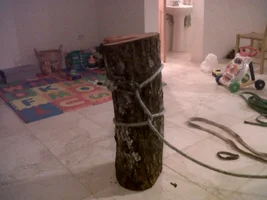
I gotta say, don't really care whose feathers get ruffled but I will reiterate, if you know what you are doing and what equipment you are using i.e rope dia and type, steel locking biner plus some strong purpose built webbing slings ( tubular spectra double thickness and industrially stitched ) and not too much shock loading with a good ropeman you can definitely rig out loads of up to 1000 lbs easily without any problems whatsoever. Going bigger the half hitch running bowline combo, or my preference the marline hitch running bowline combo works like a charm. Down here dudes will laugh when talk about tying knots, they all do what's in this picture and they take large pieces they just don't set the biner in a way that will cross load it, but I am not advocating this so let's not get our panties in a twist shall we. People have choices and let's keep it that way. There are many reasons why steel biners break when negative blocking the chief culprit is the way the biner sits on the piece and if it is not snugged up tight so that when the piece starts to move the biner ends up in a compromised position e.g on its spine. The other is when the ropeman doesn't let the piece run and locks everything up too quick. As I said not my style on heavy pieces as I can tie knots quickly but I ain't knocking it either as I have seen it work sweetly down here for years.
 

Attachments

  • 328117-IMG04045-20120614-1917.webp
    328117-IMG04045-20120614-1917.webp
    246.6 KB · Views: 133
Re: Rigging \"shortcut\"?

As I recall from a Seminar with NATS Ed Carpenter, he said that after researching negative blocking and the stresses on ropes that the first knot above your block, for instance a half hitch, takes nearly all the weight of the drop. He said testing showed the cow hitch was the most forgiving, if I remember correctly.
 
Re: Rigging \"shortcut\"?

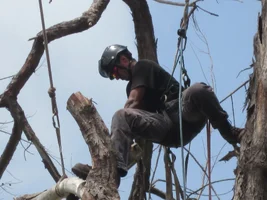
Cretree that puts a whole new perspective as to why on heavy wood these dudes down here have been having success for such a long period. Still not advocating this practice, however I do have a open mind and have watched it work over and over again. The main thing is gear inspection and cycles to failure, so as long as ropes and the steel biners are changed out often I see no reason why this practice is bad. To each their own. Again not telling some greenhorn to go out and do this, practice tying your knots and forget knotless rigging except for light brush situations. I am just trying to say for the experience rigger this method can and does work within reason. Too many variables and I ain't no teacher by any means. This is just a discussion and I am doing my chime. I think discussing is healthy for the brain. This shot shows what I do regularly with branches up to 1000 lbs in circumstances where there is little shock loading involved.
 

Attachments

  • 328121-IMG_1187.webp
    328121-IMG_1187.webp
    168.5 KB · Views: 135
Re: Rigging \"shortcut\"?

thanks for the input swingdude, it seems like there is a split consensus on my initial question of whether or not to knot a steel biner, so i guess the answer is---IT DEPENDS
 
Re: Rigging \"shortcut\"?

[ QUOTE ]
the answer is---IT DEPENDS

[/ QUOTE ]

Of course...but...what does the choice depend on?

Go back to basic rigging fundamentals. Look at the maximum load is going to be, multiply by a safe working load...and choose your tools.

Rigging can be done with shoelaces...if the shoelaces are strong enough or the load is small enough.

Don't blame the tools if the wrong tools are chosen or used improperly.

Biners, snaps, shackles, loops...have all been used successfully for years. There have also been accidents using the same tools. So, what DEPENDS?
 
Re: Rigging \"shortcut\"?

Tom a good word to describe how I have come to know you over the last year is SENSIBLE ( realistic/reasonable ). You are a man of great integrity and thoughtfulness. Some day I hope to meet you in person so I can put a face to a person whom I have come to respect. Not because you are an administrator, I really don't care about positions, I am always evaluating people via their hearts. No shame in posting these for others to see, when you get to know Swing ( Paul ) what you see is what you get I never keep secrets or have things hiding.
 
Re: Rigging \"shortcut\"?

Definitely Tom, the right tool for the job. I do use steel biners and rings sometimes in rigging but I primarily use knots. My major beef with rigging using a biner is that I often find it difficult to keep the biner from being loaded laterally versus longitudinally. Carabiners are designed for dynamic loading (have you ever been rock climbing? Most climbers attach themselves to gear or bolts with these funny little clippy thingys which do seem to be designed to catch a fall) but they are substantially weaker if not loaded properly. That being said, it will always come down to being able to evaluate the situation and make an educated decision.
 
Re: Rigging \"shortcut\"?

I had meant to reply to this but lost sight of which thread it was in.

If carabiners were not meant to be shock loaded they would have SWL measured in pounds, a unit of weight. As it is they have SWL and MBS listed in kilonewtons a measure of force. If one was not calculating shock load than force measurements wouldnt be needed.

Carabiners are designed specifically for shock loading, what you are thinking of is this:

http://www.fordogtrainers.com/images/large/black-l30-snap-hook-round-ear-dog-leash_LRG.jpg

Which has a rating in lbs I am sure and is not meant to be shock loaded.
 
Re: Rigging \"shortcut\"?

I agree 223Tree, I shockload my ISC steel biners from time to time and they are some strong boys. I avoid it as much as possible, which is best. However that being said I don't negative block with my biner setup ( these days but I have done in the past ). Aling the biners correctly and all will be well. There can be no slop in the system. Everything needs to be snugged up tight allowing for the correct line up of the biner, it's a definite skill I do believe.
 
Re: Rigging \"shortcut\"?

A brief survey of any user instructions for any rated carabiner will caution against using as an anchor unless the load is under the anchor point. Some will even give a 4:1 wll recommendation.

DMM even states that if any of their carabiners have arrested a load they should be retired.

Am I to take that with all these warnings in the manufacture's user guides that they are designed to have loads dropped into them repeatedly as in blocking a spar?

Tony
 
Re: Rigging \"shortcut\"?

Tony let me first say that here on the island, the price of tree gear is through the roof, what you guys pay for equipment in the States we pay three times as much ( frieght and duties ) so most dudes here have learned to get by with minimal stuff. One of my good friends and myself are the only one's here that rig using blocks and porty's. He even has a GRCS. That being said, I have seen with my own eyes what steel biners can deal with. I have used them without incident in many applications. Manufacturer's have always been conservative with their warnings ( I have seen it over and over in the diving industy ). They need to be able to have a loop hole in case of misuse injuries and liability. I honestly am not tying to dissuade others in their methods or what they believe is correct. I am only stating from my experience and the experience of my peers here on this island. Knotless rigging using steel biners and spectra ( and not those flimsy slings arborist supplies sell either which are for light duty, these are very specially built slings ) slings is common place. Not advising anyone to take this up, however I know it works and works well. And believe me not just on light stuff.
 
Re: Rigging \"shortcut\"?

Tony I also said that I don't negative block with steel biners in the post before, blocks and knots only. Have done in the past though when I didn't own blocks. Just to clarify. But I do respect your stance and see it's validity.
 

New threads New posts

Kask Stihl NORTHEASTERN Arborists Wesspur TreeStuff.com Teufelberger Westminster X-Rigging Teufelberger
Back
Top Bottom