Rigging at Japanese Shrines

SoftBankHawks

Branched out member
Location
Japan
http://db.tt/wrG5Ybbe
http://db.tt/G8Oh9eGW
http://db.tt/NeBiKW5e

I have recently moved from the UK to Japan.  The arborist industry is very young here.  They have 'to ku shu ba sa i' climbers, most of whom are ex forestry workers who have done extensive crane works....and often with no safety ropes.  The things I have seen already would make your eyes roll back in your head.  Japan has trees like my photo shows, with no crane access. This is what Japanese arborists or tokushibasai or what ever you want to call tree climbers are facing.  Big, dead trees over very old shrines, temples and sacred stones.
May I ask you a question please?
I will draw a plan if my explanation is poor.  The tall cryptomeria japonica stands on the top of a bank on the left hand side of a small temple, the leaning juniper to the right of the same temple. It leans over a second same sized temple. There is a prop on the juniper as you can see. You may not be able to see the sacred stone and various small targets below and around the juniper.  If you look at the bottom right photo you can just make out a live zelkova.  Looking at the top right photo you can barely see a cypress as it is 34 m away. The zelkova is 12 m away. To the right hand side of the temple in the top right photo is another cypress, 17 m away. The tall cryptomeria is 12 m away.
I have to remove the tree and I have several rigging scenarios running through my head (night and day!). As I said I have a question and this is it.

A rope runs perfectly parallel over a pulley and a force is applied to one end while the other is tied off. If the loaded end is lifted away from the parallel toward 45 degrees is the rope weakened and if so is this exponential?  

You will have guessed that one of my scenarios involves four ropes from four trees.  I would very much like to slice a disc and manipulate the ropes in a way to elevate the disc before it moves in either sideways direction.

I can run ropes at shallow angles to compress forces on the support trees.

I envisage two grcs pulling the stretch out of the two other lines to lift each section and then it being a matter of carefully placing in to the drop zone.

The cryptomeria poses less of a problem as we can free fall pieces into a river.

Thank you for your time.
 
I'd take lots of time and slice and dice those trees into itty bitty chuckable pieces so as not to apply any dynamics to them at all.

Like a very patient spider with a laser sharp saw.

Your idea of using other trees is good, as a lifeline TIP for the climber.

Seems the one thing you have an excess of is time.

Zelkovas are not a good choice to tie into in my opinion.

Jomoco
 
The main tie in point will most likely be a highline between the zelkova and the 34m away cypress. If i rig The Juniper I will tie, cut and then bail out while the pieces are being shifted.
Slicing and dicing is an option once we get lower down but I cant see the top being done like this because of the angle of the Juniper and all the objects.
I hope to keep peak forces way way low but am concerned that I may have to cut more than I am comfortable with weight wise to ensure the rope stays on each piece. Notches will be used.
This is a new ball game in term of species, what are your concerns with the Zelkova?
I have put aside 5 days to complete both trees, clean up not included.
Scaffolding was proposed. I am trying to find a working rope solution cheaper than the 5000pounds scaffolding charge. I'm not being hard headed though....just determined
Helicopter....now that's a thought. Not sure how those heritage shingles will deal with the downdraft?
Yes, the rigging/anchor trees are the weakest link. Everything feels tenuous in this regard.
 
[ QUOTE ]
This is a new ball game in term of species, what are your concerns with the Zelkova?

[/ QUOTE ]

American nurseries have done a piss poor job with them until lately, so they tend to have horrible inclusions, that's probably what he's referring to.

-Tom
 
SBH, the lateral forces exerted on your anchor trees will be exponential as the weight goes up.

You can test your own fully equipped weight on the system without getting dangerously high off the ground first.

It will most certainly be rather spongy bungee as a relatively secure TIP.

But you as the climber are most in need of a secure tie in. If you can't get high enough to dice and chuck? Then speedline off the target tree 180 degrees opposite that target tree's lean.

You, the climber are the irreplaceable component of this contract. So work smart, keep the dynamics on everything as low as humanly possible.

Don't commit seppuku simply because you're in Japan on a high profile job my friend.

Keep us posted SBH.

Jomoco
 
I'll keep scratching away at ideas and then try something off site...i.e. practice static lifting from four points in my home woodland and ponder each point of stress.
Backing up anchor points AND running ropes through anchor pulleys to compress rather than pull/tension seems mandatory.
We can only move pieces at 90 degrees to the lean because of the first shrine.
Thanks everyone, I will be back!
 
[ QUOTE ]
but am concerned that I may have to cut more than I am comfortable with weight wise to ensure the rope stays on each piece. Notches will be used.

[/ QUOTE ]

COOL tree pictures. Not getting the full picture of the anchor trees and such though.

But, reading your concerns...

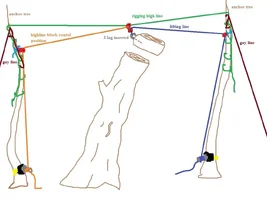
IF you are working with large diameter and don't want a long peice due to the weight; but concerned with rope coming out of groove.... Then you can use a drill, preferably a gas drill if many sections needed. Drill a pilot hole in the side of the cookie you will be cutting. Intall a 5/8" J lag in the hole with lag spinner. Screw the lag in until the air gap is gone and the lag tip starts scraping the bark. Tie your rigging line to the lag eye, or else use a heavy duty steel binner for knotless rigging. J-lags work great. Now it's secure and no need to worry about rope slipping off a short section.

Now on to your anchor support trees. If stability is a concern, then back up the high tie in point several times with half hitches down the tree to a larger diameter. Then, if the whole tree is a concern, install an earth anchor (if no other trees) and a guy line.
 
I might not be getting the full picture.

I will try to re-read tomorrow.

But, if I think I get it, here is how I might approach the task.

I have not done exactly every one of these components ALL together as in this diagram, but each one separately for different scenarios. So, I think this should work just fine.

I drew this up in a hurry, so, I'm sorry if messy and not real clear.

I will try to look at tomorrow again, as I am very tired and may have made a mistake somewhere.

I would LOVE to have a situation like that. Those types of things are the only thing that is fun anymore.

I am very jealous.
 

Attachments

  • 322234-highlinerigging.webp
    322234-highlinerigging.webp
    48.7 KB · Views: 177
Just remember X-Man, 34 meters is 111 feet away from the target in just one direction!

SBH is very wise to test his approach off site first!

I like your diagram and J lag attachment recommendation.

But the support trees' varying distances from the target tree are formidable to overcome without going to wire ropes in my opinion.

Jomoco
 
Thanks for the drawings. Yes, the distance is fairly massive in one direction, the drop zone direction, and not so massive in the direction that crosses both shrines with dead tree anchor and smallest cypress at either side of the shrines.

I decided against picking on to a highline because of both rope and anchor point stress. I simply don't have enough experience of this technique to go ahead with it. Not in such a delicate target scenario.

I will practice pulling pieces in two directions with double braid against two static lines in the opposing directions. I think that this may give me a nice 'lift off'.

I've always wanted to try the lag technique. Where do you buy yours from? Are they strength tested and stamped?
 
I get ours from american arborist, www.arborist.com but the J-lags are likely from China and not stamped or otherwise marked.

although, I do trust them for what we use them for.

Look at our new video in buzz buster video section. titled Arbor-X rope rigging Part II.

at 8:27 minutes, using J-lags there because we could not tie around trunk due to it being on ground.

I wanted control of the root ball going back, due to close proximity of house and windows.

used 3 J-lags to give a wider radius on rope eye and 3 is stronger than one.
 
Do you have a feeling for how much support the props are providing? How long have they been in place? If there is much pressure or they have been there for a long time, the tree may be counting on them to a high degree.

Applying 40:1 tension between 2 trees that far apart adds just tons of variables to the equation. Guying the supporting trees is a no-brainer, but the forces that they may see may exceed their capacity which should be considered very carefully.

I would guy the target tree triangularly with some heavy rope. Standard roping situation until I got to 4-5m then I would turn the log into sawdust by taking pieces that could be handled. It appears there is clearance from the building if you work on the back side of the log with the rigging. When I said scaffolding, I meant the kind that you set up for construction. We happened to have some that was laying around for our job.

I like the rigging scenario proposed, but it is a ton of variables, rope and communication.

The helicopter would be even more fun!!!
 

New threads New posts

Back
Top Bottom