Rigging at Japanese Shrines

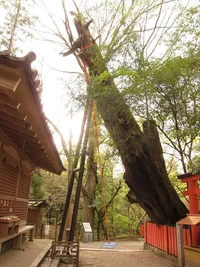
It looks to me like you could have a rigging point in the tree behind the one you are dismantling in picture #2. Just have a tag line going from the piece you are cutting to a portawrap at the base of the tree for extra control.
 
This was the first idea, kind of, running a drift line from the Cryptomeria to the Juniper, the force would pull the Juniper up. I decided that if we could do it with out using the Juniper it would be better.
The prop. That is a whole other bag of worries and troubles. This job will have to be executed in exacting stages.
 
Okay, looked at your great pictures again, love them by the way. Wish i could see in person.

Anyway, be very careful on the dead crypto. those vines look like wisteria and if they are alive, they are like steel cable. Don't underestimate them, not even little ones, be sure all are cut on the peice you expect to be lowered or falling. You may already know this of course.

Now on the the leaning Juniper. (shame they taking that dead tree down, btw. looks awesome). From the two pictures, I'd say definitely use a high line for yourself. It will make cutting on that huge diameter wonderful. you will be able to use the long tension of that high line to get around that diameter to view your cuts so much easily, you don't even have to adjust your friction hitch/device much; just put more weight on lines or less.

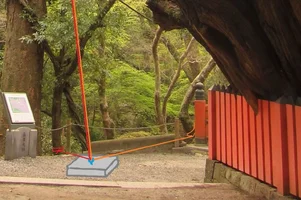
Now, if you are set on using rope and not scaffolding. I think a near vertical speedline with NO control line would work. There is a gravel spot on the level below that seems like a good drop zone from the picture. It would likely be very hard to put in an earth anchor there. So you can do one of two things. You could just do a speedline to the far tree and leave a big belly in the line (lots of slack). But the slight difficulty here is you will be retying your speedline on your removal tree over and over and you might not judge the belly in the line to be enough or not enough (there by missing you target area and or yanking around your unstable tree). So, a better choice would be to be able to pull the near vertical speedline very tight, so you know exactly where the chunk you will be dropping will go. In the gravel area, I would do this by having a loader or fork lift bring in a concrete slab with an eye bolt in the middle. (you could pour one at home with a board frame, insert a big diameter threaded rod with nuts, plates and an amon eye. OR, you might be able to find something at a concrete recycling place. IF it was me, I'd pour one with junk wire and other metal to reinforce it. IF chance falling chunks of tree might bust up concrete, run the ropes through a tire. probably use J-lags on your short chunks of trunk wood again.

I have found that vertical or near vertical speedlines, pull extremely little on the tree you are removing. (Using no control line of course, freely dropping).

will attach pictures to help explain.

 
overall view of near vertical speedline with concrete pad for drop zone positioning.

Oh, i was thinking of using two ropes for the speedline too, just to hold concrete block in it's spot longer.
 

Attachments

  • 322358-leaningjunipervertspeedlineideaJapansmall.webp
    322358-leaningjunipervertspeedlineideaJapansmall.webp
    154.8 KB · Views: 144
close up of concrete block position idea. did i explain, speedline rope runs through the amon eye? It's not tied to the block.
 

Attachments

  • 322359-leaningjunipervertspeedlineideaJapanconcreteblockupclose.webp
    322359-leaningjunipervertspeedlineideaJapanconcreteblockupclose.webp
    173.5 KB · Views: 130
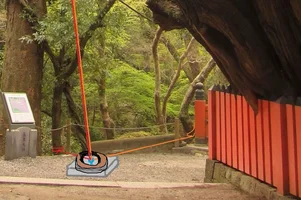
add a tire so block doesn't crack apart before job is over.
 

Attachments

  • 322361-leaningjunipervertspeedlineideaJapanconcreteblockupclosewtire.webp
    322361-leaningjunipervertspeedlineideaJapanconcreteblockupclosewtire.webp
    178.9 KB · Views: 109
I have to agree that the scaffolding idea does sound like the safest. The problem of the prop is what would worry me most. I guess the fear is that once you cut below the prop and the spar isn't resting on it, it may fall? Almost seems like you could remove down to the prop, then remove half of the remaining spar (ripped down the middle) to lessen the weight before cutting below the prop. The scenario is definitely an interesting one. Please let us know what you come up with and keep us posted. Oh yeah, and take lots of pictures.
 
i realize that I'm not likely to get the perfect plan from seeing two photos, but maybe you can scavenge from several plans.

On the scaffolding plan, if you do it and want to speed up the chunk removal. Instead of walking the chunks down scaffold levels until you can throw them off. Buy a beat up big plastic pipe, cut it in half with chainsaw and make a long slide to speed things up.
 
You should be able to get an inflatable air bag like stunt men use SBH.

That combined with you being supported by a high line strung between two or three support trees will ensure no dynamic loading of the dead leaning target tree, provided you slice dice and chuck itty bitty pieces onto the airbag, which can be moved into various catch positions.

That would ensure no dynamics whatsoever will be exerted on the target tree.

You can even get a kevlar cover for the airbag, which is vented and kept rigid by a running portable air compressor.

You need lumber shoring to support that leaner once youRe below the steel brace as well.

That leaner looks like it's been dead for quite some time SBH, so be very careful and methodic in dealing with it.

Keep us posted you lucky climber!

Jomoco
 
I have been trying to locate a series of pictures that I had that showed the use of a product called rescue jacks. I don't think that is going to happen - data loss late last year. We bought them last year to provide support in situations like this or when the tree was against a house or something. They have performed exceedingly well as a means of placing an additional support. They adjust to about 3m and have various configuration possibilities. They act in the same fashion that the prop does.

Additionaly, we usually will set up 2 lines on the trunk that we would move down as we worked down the log. The biggest disaster would be the log falling. Typically we would put a 4:1 X 2:1 in the line for tightening by hand (what we have on the trucks) Using a GCRS may unevenly apply pressure that you may not be able to easily release if something starts teetering (if it is that loose). Guess it really depends on just how much those props are holding up. We have had situations where the base was unstable as well and had to lock that down with rope.

Biggest challenge is finding a bullet-proof anchor and not damaging the cambium with slings under pressure (place some lumber under the sling to distribute the force). Stepping away from the base of an anchor tree starts adding variables and vectors quickly. Definitely can be done, just more to watch.

Good idea for the slide X. We have used oak planks to do that in the past. Has to be the handiest tool ever ;).

Just how unstable is the tree? Move to gentle push?

Like Jomoco's thought of the airbag. The industry needs to make/produce a ballistic gel fall arresting device to catch logs and blocks. My kid came home with this ball that you could get to conform to any shape. You could throw it as hard as you like and there would be NO rebound. Whatever they make that ball out of, we need a bigger version :).
 
TheXMan, thanks for taking the time to draw that out. How about instead of the concrete block run the speedline through a rigging hub that is connected to the two other lines and back along the ground to the base of the 34m away tree, a fiddle block can be easily installed at that point too. Some padding at the drop zone, a dense 2m x 2m pad sounds just the ticket, I wonder how many balls I'd have to stitch together? With the brace the tree doesnt flinch with ground based human touch. I thought to cut the bottom 1.5m off of the brace and re prop it. If only it had been installed 2m lower, seemingly simpler to work around.

Thanks for all the thinking and the cautionary words.
 
[ QUOTE ]
TheXMan, thanks for taking the time to draw that out. How about instead of the concrete block run the speedline through a rigging hub that is connected to the two other lines and back along the ground to the base of the 34m away tree, a fiddle block can be easily installed at that point too.
Thanks for all the thinking and the cautionary words.

[/ QUOTE ]

THAT was my first idea too. then after a drew it up, saw the flaw, the hub would float off of the ground as a chunk was applied to the speedline, therefor putting too much slack in the system allowing chunk to possibly stray from the tight travel path disired.

i still have the picture drawling, i will post it to see if it is what you were thinking.
 
this was my first idea for near vertical speedline, then saw it was flawed and would not truely give a "rigid" line as the hub would lift up off the ground.

dang it! Looks like when i drew it up, i saw the flaw and therefor did not save a copy of it.

if words not describing well, i'll draw sometime, a before load applied and what would happen when load applied if set up a floating anchor point.

gotta rush to work now.
 
That's a pretty cool/crazy job you got there. Is there a reason why pieces can't be lowered straight down? I've been a long time lurker here, I've just started to post here, anyways doesn't matter. I know Reg used lags once in a removal once. You probably can't use the exact set up but it may give you some idea. http://www.youtube.com/watch?v=Cf5ixX-4N...ture=plpp_video

I had this crazy idea and haven't really thought it through at all so you've been warned. Would it be possible to attach a section of steel on the top side of the tree with a block atached to the end. I guess you could attach it with large screws and ratchet straps. Screw in lags to the top of section of wood then tension it to lift it off the cut then lower it down somehow. That's as far as I got.

LOL sorry for wasting your time
 
Can you set up staging on each side of the tree and with workers on each set of staging cut small pieces and actually set up a lowering system between the staging..Just an idea.
 

New threads New posts

Back
Top Bottom