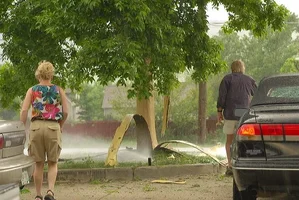
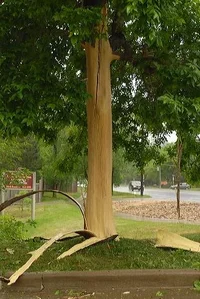
Ride the Lightning!

I am curious.
thinking.gif


This maybe a random topic, but worth talking about. Has anyone ever been struck by lightning while climbing in a tree?

Has anyone ever met someone who has been struck by lightning while climbing in a tree?

Has anyone ever heard of a friend of a cousin of a co-worker who was struck by lighting while climbing in a tree?

Last week a friend and I were in a Locust while a small thunder storm passed by. I didn't feel in danger because the lighting was not within 6 seconds of us .

thinking.gif
I was also thinking: Do our odds of being struck truly increase being in a tree? We would tend to think so, but what if you are out on limbs and not close to the trunk? Would that make a difference?

Any thoughts?
smirk.gif
 
I know a lineman that was lashing a cable with a storm well off in the distance when he took a hit that sent the lasher flying off the strand.
I wouldn't take a chance on it.
 
No way Its safer in the truck with the groundy lissing to his lame azz storys (with over use of an-ums and the F word) then takin the chance of a lightning bult thank you
 
There was an article about lightning a couple of years ago. I think it was in Tree Care Industry that said if you can hear thunder you can be hit bly lightning.
 
[ QUOTE ]
No way Its safer in the truck with the groundy lissing to his lame azz storys (with over use of an-ums and the F word) then takin the chance of a lightning bult thank you

[/ QUOTE ]

Inz..... Now that is funny. (have you been around my groundie or what?)
 
Ride the Lightning, a great Metallica album. As far as i know lightning can travel great distances, so I don't know if 6 seconds is applicable. RemovalWizzard and I have a raging dispute going about lightning. Does lightning have to hit the ground? Is there such a thing as air to air lightning? If lightning has to hit the groud, explain airplanes being struck?
 
June TCI has an article on lightning protection and repair. Feel free to comment, online. I had a call at 6:40 a.m. from some ASCA guy who sought to "educate and inform" me that lightning does not travel down conductors into the ground, but instead ionic charges rose up from the earth through the system.

He knew it for a fact cuz he heard it at an ASCA conference, though he could not find his notes...I told him to write a letter to the editor so he could educate and inform 28,000+ readers. Pancake, the Proceedings of the March lightning conference should be out this summer. There you should see the answer; yes some lightning does not hit the ground.

Wish they were all that easy...
 
That was the precise side of the argument I was making, there is indeed lightning that doesn't hit the ground. I find it facinating that different species of trees emit varying heights of streamers that attract strikes, why did he call you at 6:40 am? Maybe the chagre he was referring to were the streamers which occur constantly, naturally from what I know.
 
I have heard lots of things, on this subject "they" say there are three type of lightning, air to air, air to ground, and ground to air. I on the other hand tend to err on the side of safety when dealing with the power of lightning, go do something else, ah the beauty of working for the self, it allows for putting myself first. I like that. As for the idea that being in a tree increasing your likely chance for a strike, seems if you are covered in metal objects, that in itself might add the "inticement" for a path to ground more than an empty tree. Same idea as the copper wire for lightning protection. Do they really pay enough, for you to want to see if lightning is attracted to climbers?
 
If I was in a tree when a storm came by, I wouldn't want to be in a Locust! Have you noticed how many of them are involved in strikes? Nasty mess they become too. Farmers around here plant them near the house because they say that the higher mg in them attracts the strike and keeps the house safe. Anyone hear of this as well?
 
I can't recall where I read the streamer article, I remember red oaks and locusts being at the top of the list. I will have to search through some files. I never want to be in a locust!
 
From an article in a local NJ paper

All trees are not created equal in their affinity for lightning. Trees high in oils, like beech, birch and horse chestnut, are relatively poor conductors of electricity. Those high in starch are the most vulnerable. They include oak, ash, black locust, maple, tulip poplar and elm. Location counts, too. Lone trees and the tallest in a group are at risk, as are those growing near water or in moist soil.

http://www.nj.com/living/ledger/index.ssf?/base/living-0/1180593403190220.xml&coll=1

another short article

http://extension.missouri.edu/explore/qa/horticulture0011.htm

and here

http://www.mygardenguide.com/care/Lightning%20protection.pdf

and here is one about installing lightning protection in trees and it lists the Black Locust.

http://tinyurl.com/2a9xdx

hope this helps

jz
 
[ QUOTE ]
why did he call you at 6:40 am?

[/ QUOTE ]Felt like jawin', I reckon. I haven't seen his written comments yet, and it's the deadline to get a letter in the July issue, so his confidence level may not be so high.

Sure, streamers go up, but then lightning comes down, as I understand it.

JZgirl, that Bartlett tech paper is pretty dated. Ground rods do NOT have to go to the dripline, etc. I walked the Bartlett Lab grounds with Tom a few months ago. Lots of good research going on there. They have a lot of systems installed there, and are also installing a lot for clients.

I got called for a 2nd opinion behind them on a huge hickory next to a nice house. I heard the price and just thought, o my.
shocked.gif


Even though the species may be high in oil, it needed protection. That whole species list thing I don't find too compelling; mostly it's exposure and target rating that drives the need.
 
I am really wondering what all the discussion is about? The scientific ins and outs are certainly interesting. I know that the question was about the physics of lightning...I am wondering if anyone actually works in thundrstorms. EVERYTHING that I have read and been trained with is straightforward about not climbing, or running a chipper for that matter, in lightning. Am I missing something that, if I had not missed it, would make me feel comfortable working under these conditions? Isn't there enough risk inherent to this profession without adding a huge unknown like lightning? I know that it's not getting the job completed, but I would choose to work another day. I am really sick and tired of good guys dying, or getting hurt, and all their buddies can say is, "if only we knew then what we know now..."!
smilie_barf.gif
 
TCI Lightning!

I'm wondering if anyone who read the June TCI magazine had comments about the lightning article. So far aside from the 6:40 a.m. phone call about ionic charges I heard from just one guy who berated me for calling a Liriodendron a tulip poplar as a common name; he said tuliptree was the correct common name. Ok, and...

I'm currently talking to TCI about future articles so I'm wondering about what readers want or do not want to see.

It's wide open for comment--when something goes out to 28,000 people and all I get is 2 comments (I agreed with both, to a point) I don't have much to go on. So far future topics are Root Pruning for July, already submitted, Restoring Topped Trees for September and Restoring Storm-Damaged Trees IV for October.

Anyone with pics or experience to share on the latter 2 are welcome to send pics or whatever. I may start threads on those soon.

Bring it on!
santa.gif
 

New threads New posts

Back
Top Bottom