Retrievable false crotch for long rappels

[ QUOTE ]
Alternatively, one could tie off the FC with some slipped knot

[/ QUOTE ]

One such method used by canyoneers is the Macrame retrievable anchor (see attached file). This can be tied in the middle of a doubled rope or near the end of a single rope with a retrieval line for release. It requires alteratively pulling on the retrieval and the rappel side in order to release the knot, which makes it somewhat safer than a single-pull release knot.

- Robert
 

Attachments

Yes. Since it requires multiple alternating pulls to release the full knot, it's safer than most slipped knots.

- Robert
 
That's why I included the safety warning on the attachment. Releasable hitches are potentially riskier than systems with some sort of "hard" lock-off (which is why it is recommended that only the last one down the rope release the backup).

Tom's method is certainly safer, but I wonder if the stopper knot would ever get caught in the FC and get the whole rig hung up on retrieval.

Nick's picture shows a retrievable rope/tag line with a non-retrievable sling/link. This is a more reliable retrieval system, but requires leaving some (inexpensive) gear in place.

It is much more common in the rock climbing community to leave rappel anchors in place and to use two ropes tied together with a double-overhand bend (dbl fish) which acts as a one-sided stopper knot. This allows rappelling on a doubled rope for more control and safety (assuming the rappel device will accomodate two ropes), and makes retrieval safe and efficient. But it requires bringing a second rope.

The alternative, if caught with a short rope and a long rappel, is to rappel in stages on a doubled rope.

- Robert
 
Mahk,

I noticed in the picture that you're rappelling on the doubled rope. Do you have a set up that works for a single line (if the doubled rope doesn't reach the ground)? Or would you simply "lanyard in and pull the FC down to repeat"? Sorry if that's obvious.

Also, when you build the setup, how long of piece of rope do you use? And do you use an eye-and-eye split tail? Any chance of getting a clearer photo of your setup?

One more thing: you say to splice the end of the line onto the ring. In rock climbing and caving, no one splices their ropes (at least not to my knowledge); certainly not at home. Is this a common practice in the tree business? I'd be a bit nervous about it.
 
I don't have Word either. :)

Likely a "problem" on the recipient end, but ultimately it should not be assumed anyone will have Word to view your document, or even a version of Word that can/will. And it should never be assumed that any other computer will present your Word document exactly the way it did on yours. PDF is much better that way in that it's designed as a Portable Document Format.

This is the sort of situation the state of Massachusetts is going to get away from by going to the Open Document Format for all their official stuff. Microsoft is livid, but they are the ones who refused to provide support for the free and standard specification in their office suite, and the alternative specification they presented wasn't free enough for consideration. MA doesn't want to leave their information tied up in a proprietary and closed format and I applaud them.
 
[ QUOTE ]
One more thing: you say to splice the end of the line onto the ring. In rock climbing and caving, no one splices their ropes (at least not to my knowledge); certainly not at home. Is this a common practice in the tree business? I'd be a bit nervous about it.

[/ QUOTE ]

I'll take this one! Yes, in tree climbing, many of us are using spliced eyes in our climbing and rigging lines. Many of us do them ourselves. Some of the people around here have others splice for them. A lot of people ship me ropes and I'll splice and ship back, or they just buy stuff I have made specifically for them.

The big difference between us and rock climbers is that our ropes were DESIGNED to be spliced. Rock climbing/caving ropes just weren't designed for it. Though that doesn't mean they CAN'T be spliced. But at this time, there aren't industry standards for it. Basically because the rock community hasn't asked for it. But don't worry, every time I go climbing, people see me spliced lines and they get VERY interested! I'm doing what I can! /forum/images/graemlins/grin.gif

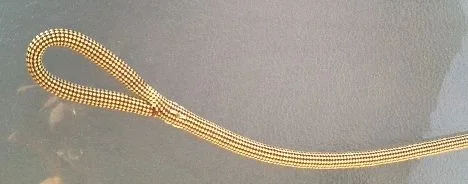
Check out this pic of a 10.2mm Mammut dynamic climbing line I spliced. I've not been able to get an official test on it, but I did do a make-shift break test comparing it to a fig. 8 on a bight and the splice won!

But for now, stick with a knotted line. You're taking quite a risk if you rock climb on a spliced line.

love
nick
 

Attachments

  • 38466-CIMG6440.webp
    38466-CIMG6440.webp
    15.9 KB · Views: 105
[ QUOTE ]
[ QUOTE ]
Alternatively, one could tie off the FC with some slipped knot

[/ QUOTE ]

One such method used by canyoneers is the Macrame retrievable anchor (see attached file). This can be tied in the middle of a doubled rope or near the end of a single rope with a retrieval line for release. It requires alteratively pulling on the retrieval and the rappel side in order to release the knot, which makes it somewhat safer than a single-pull release knot.

[/ QUOTE ]
"Is it safe?" came to mind.
The Macrame' Knot is a slip-free hitch, designed so that rope retrieval won't scar
the environment--there is a complete release from the anchor point, so no draw of
rope around it.
That's not necessary in the present situation, and not essential in a Quick-Release knot.

What I had in mind, e.g., would be a loopknot (of the abseil rope) that could be
spilled by the release line. This would leave the rope still around the anchor, with one
end secured to the long release line (which if adequately strong and secured below,
would ensure that the weighted main rope wouldn't move much were it accidentally
released (which might be quite difficult if weighted, anyway). THAT is much safer.
(Additionally, it's likely in both on-rock and up-tree circumstances that one would
prefer NOT to release a lonnnnng bight [not 'bite', nb :-] to chance snagging something!)

[ QUOTE ]
If the climbing line is tied with a running bowline around the branch there is way too much friction to pull the rope down.

[/ QUOTE ]
Really? I find this surprising, as it should be possible to arrange things such that there
is no more friction than that of the rope merely run over the branch?
On what part of the structure are you pulling to release--maybe that's the issue!?

I'd think that, if the Bwl eye is relatively large, spanning say about 40% of the limb,
and the haul line is attached to the KNOT (i.e., away from reeved SPart), the release
would be pretty smooth--again, the same as hauling any rope over the limb.
--or is THAT hard? (Re above orientation, while loaded/descending, the SPart of
this Running Bwl noose would be near 6 o'clock, Bwl knot at about 10:00; haul line
is attached at knot, and pull should see Bwl eye easily slide down SPart!?

Another plan: have, e.g., tape w/rings on each end in basket arrangement
around the anchor, heavy rope run through that, stopper (w,w/o washer) in end, and
retrieval line tied to it; retrieval line is double-length, and opposite end is tied to
one ring.
Descend; haul climbing line through rings pulling one side of retrieval line;
haul down anchor tape+rings (now free of reeved climbing rope) with other side.

QED?

*knudeNoggin*

 
[ QUOTE ]
I noticed in the picture that you're rappelling on the doubled rope. Do you have a set up that works for a single line (if the doubled rope doesn't reach the ground)? Or would you simply "lanyard in and pull the FC down to repeat"?

[/ QUOTE ]

There are various ways to choke the stem and work SRT. I don't like those setups because you can't adjust your climbing line up and down as easily as you can with this system, and because it can be difficult to get the choked rope back down to you when you reach your next work station on the pole.

Whether working SRT or DdRT, on a spar or in a canopy, I think it is always important to have enough rope to reach the ground.

As I work the spar and cut each log section (whether lowering the logs with a line, or simply letting the logs freefall) I "lanyard in and pull the FC down to repeat".

[ QUOTE ]
Also, when you build the setup, how long of piece of rope do you use? And do you use an eye-and-eye split tail? Any chance of getting a clearer photo of your setup?


[/ QUOTE ]

I have two adjustable friction savers, a shorter one for smaller trees, and a longer one for larger trees.

The small ring is attached to the rope of the AFS with an eye-and-eye split tail. In this attachment the eyes are formed by using a scaffold knot (aka double fisherman's knot) on each end of the split tail.

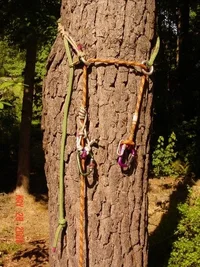
This attachment is another view of the AFS that was in my first attachment. The rope, or actual lanyard part of the AFS, is the green rope. The climbing line is the orange rope. This is the shorter of the two AFS.
 

Attachments

  • 38600-dsc02499_rotated_resized_25%.webp
    38600-dsc02499_rotated_resized_25%.webp
    89.5 KB · Views: 101
[ QUOTE ]
One more thing: you say to splice the end of the line onto the ring. In rock climbing and caving, no one splices their ropes (at least not to my knowledge); certainly not at home. Is this a common practice in the tree business? I'd be a bit nervous about it.

[/ QUOTE ]

Nick answered this already, but I'll just add that many arborists use lots of spiced lines in a wide variety of applications.

In the previous attachment the large ring is attached to the green line with a splice, and the orange climbing line (Blaze) has a large (4 inch) eye splice on the end (the purple carabiner is attached to the line with a girth hitch).

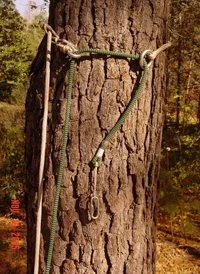
In this attachment the white line is the 'lanyard' or rope of the AFS and the green line (Poison Ivy) is the climbing line. This is the longer of the two AFS. The large ring is attched to the white line with a splice and the green climbing line has a small (approximately 3/8ths inch) eye splice on the end. There is a string through the eye and the string is attched to a screw link.

In the previous attachment the climbing line has both the carabiner and the screw link in the eye. Once the screw link is installed to retrieve the AFS for the first time, the link is left in the eye for the remainder of the tree/spar, and only the 'biner is taken in and out of the eye as the climber alternately climbs on and then retrieves the AFS.

In this attachment, the eye of the climbing line is too small to allow both the 'biner and the link to be in the eye at the same time. If the link were put directly in the eye, the link would then have to be removed from the eye each time the AFS was retrieved so that the 'biner could be put in the eye for the climber to use the climbing line. But, a 'biner and the string will fit in the eye at the same time; thus, attaching the link with the string allows the link to remain in place until the tree/spar is finished.
 

Attachments

  • 38602-dsc03228_resized_25%_rotated.webp
    38602-dsc03228_resized_25%_rotated.webp
    94.5 KB · Views: 100
Mahk,

Thank you. The pictures and descriptions are incredibly helpful!

I do have two more questions, relatively minor:

1. What friction know are you using there to secure the small ring to the lanyard?

2. In the first attachment, it looks as though there is a screw link or a snap connecting the small ring to the standing part of the lanyard. Am I seeing that correctly? Is there a purpose for this?

I like your idea of putting the screw link on the string in the second set up. That makes a lot of sense.

Thanks again. I'm relatively new here and I am most impressed by everyone's willingness to help eachother.
 
[ QUOTE ]
1. What friction know are you using there to secure the small ring to the lanyard?

[/ QUOTE ]

In the first attachment, the split tail is attached to the lanyard with a Knut. In the second attachment, (I think) the split tail is attached to the lanyard with a French Prusik.


[ QUOTE ]
2. In the first attachment, it looks as though there is a screw link or a snap connecting the small ring to the standing part of the lanyard. Am I seeing that correctly? Is there a purpose for this?

[/ QUOTE ]

Good eyes. That is a #2 brass swivel. I put the lanyard through the eye end of the swivel and clipped the snap end of the swivel between the legs of the split tail on the small ring. I was using the swivel as a slack tender for one-handed adjustment of the friction hitch on the lanyard.


[ QUOTE ]
I like your idea of putting the screw link on the string in the second set up. That makes a lot of sense.

[/ QUOTE ]

It's the only way that I know of to use a climbing line with a small eye, leave the screw link on the climbing line and still be able to get the carabiner in the eye.

The string can be shorter than is shown in the attachment. Also, try to set the large ring as it is in the second attachment, so that the ring does not lie flat against the trunk when you descend. If the ring does lie flat against the trunk, then when you try to retrieve the AFS, the rope will slide through the large ring, and then the string will slide through the large ring. But, because the string has a smaller diameter than the screw link, the screw link may jam at the big ring if the ring is flat against the trunk. I've had the link get stuck a couple of times, and, although I've always been able to free the link by shaking the climbing line, it can be frustrating. Work with it a little and you'll figure the best way to set things.
 

New threads New posts

Back
Top Bottom