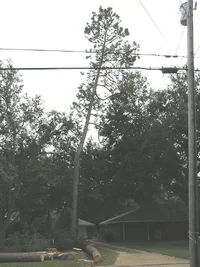
Removing a leaner

I am new to the forum...what a great place to pick up knowledge and share info.

I worked as a tree trimmer while in college and have kept up with it over the years. It is an avocation, I just do personal jobs (family and friends) now. The changes since I started in the early 70's are phenomenal...the split-tail system didn't exist. I knew how to rappel when I went to work for an "official" tree company but they had never seen it!

I recently did a job at my house...thought y'all might like to see the pictures. I have enjoyed many pictures submitted by other forumites.

The pine pictured was directly over a 30 foot poplar. I climbed the pine last Saturday and used it to drop down to the poplar. I then used the pine to belay the poplar as I roped it down. Today my son and I took down the pine.

I have posted some of the pictures at a family web site:

http://layton.smugmug.com/gallery/459228

choose "slideshow" under the heading "style" at the top of the page for an easy way to view.

Gary Layton
near Atlanta
 
I'm with Butch,

The mantra is, "Stubs will always come back to haunt you"

Thanks for posting the pics. It looks like it was a cut/drop setup. Did you have to lower any of the pieces?
 
On vertical trees the stubs have plagued me before...seems like everything would get hung on them. This tree leaned about 25-30 degrees...my belay point was such that NOTHING got hung on a stub...a rare pleasure for me.

I lowered all the limbs...big ones I roped individually...there was a power line to the east (12 feet), a fence to the south (25 feet), new cedar trees to the west (5 feet) and me to the north...I had a triangular target zone to drop chunks in after I lowered the top.

Smaller limbs I "daisy chained" together...is that a real term? I chose a main limb and tied my lowering rope to it. I would then use 10 -15 foot ropes and tie smaller limbs to the main limb, cut the smaller limbs and eventually lower a "bouquet" of limbs down. It helped speed up the process.

It has been a lot of years since I worked with a professional company so I am learning new terms and concepts from your forum. Between Jeff Jepson's "The Tree Climber's Companion" and the many posts here I have picked up a lot of great info.

Any comments from the pros are welcome...sharing knowledge can help recognize mistakes are being made..awareness of potential problems is invaluable. I just added some pictures to the web site that show "daisy-chaining" (what do you guys call it?) and some of the lowering.

I am looking forward to working my way through the “Articles” section of this site.
 
[ QUOTE ]
Smaller limbs I "daisy chained" together...is that a real term? I chose a main limb and tied my lowering rope to it. I would then use 10 -15 foot ropes and tie smaller limbs to the main limb, cut the smaller limbs and eventually lower a "bouquet" of limbs down. It helped speed up the process.


[/ QUOTE ]

The term Ive heard for this technique in the past was "chandeleir"(sp?), ive never heard "Bouqeut" used before.

I like bouquet better, seems like a more fitting name.
 
A stub bit me in the arse today.I popped the top out of a mullbery w/ a pull line.
Imade the cut right above a stub about 8" long and 4"in diameter. As the top came over I knew I was going for a ride so I grabbed the stub and got my hand smashed between the butt and the stub. OUCH!! After wiping away the blood and trying to wiggle my fingers and wrist I realized nothing was broken. I did however get a 1" sucker stub pushed through the palm of my hand. OUCH!!!
 
[ QUOTE ]
This had a bit 'o lean to it!

[/ QUOTE ]

The lean was the first concern...I wondered at what point a tree decides to just fall over...the earth was humped up some...but some vertical trees had humps, too.

Since I used the big pine to lower pieces of the small poplar under it, I had tested it that way..this time.

I wanted to safety to other trees but none were close enough or high enough...this pine ruled the roost. Any more lean and I would have had big problems balancing.

Any pointers on deciding if a tree is near toppling? Any way to test one? Anybody ever have to ride own down?
If you are roped to it and it decides to start falling, all I could imagine is, maybe unhhook as it started its descent and bail out as you approach the ground...hopefully, into soft dirt. But unhooking prematurely might cause you to lose balance and drop under the trunk...catch-22?

I have never seen a tree topple roots and all...I assume the root ball makes the descent rather slow? Maybe slow enough to stay hooked in until ten feet above ground and then unhook?
 
A guy I sub to rode a 35' peg/spar down that failed at 8'. Crushed left and right tibia and fibia, shattered his pelvis and broke his ribs. Doctors wanted to amputate below the knees. He hobbles about on reconstructed legs but they're smaller legs now, and often in pain.
 
Get a throwline into the crown and pull a lowering line into the tree. Get back out from under the tree and set up an anchor. Put tension on the tree. Then you can bounce on the guy-out line. If the root plate starts to lift, scratch your chin and decide if you're going to walk into fire. With the same throwline you can setup other guy lines in the tree to give the roots some extra support.

You can always cut smaller pieces too but that's a Venus and Mars conversation :)
 
[ QUOTE ]
Get a throwline into the crown and pull a lowering line into the tree. Get back out from under the tree and set up an anchor. Put tension on the tree. Then you can bounce on the guy-out line. If the root plate starts to lift, scratch your chin and decide if you're going to walk into fire. With the same throwline you can setup other guy lines in the tree to give the roots some extra support.

You can always cut smaller pieces too but that's a Venus and Mars conversation :)

[/ QUOTE ]

You have an excellent way with words..."scratch your chin and decide..."

Very appropriate. Excellent suggestion about the throwline and anchor test. And setting up guy lines IS something I could have done to help support the tree. That will happen on the next one that has me scratching my chin and wondering just how danged hot it might get. Thanks.
 
Look around the area for other trees that might have been tipped. Stomp around the root plate and listen for the hollow melon sound. Do your feet punch through the turf? If so, the tree is really unstable.

I used to have a good link to the Army Rigging Manual 5-125 but the link is dead now. This is an excellent manual to have. I downloaded it so if you want a copy, let me know. First, check Spidey's page, I'll bet that he has it posted. ]

If trees aren't where you need them you can build a picket anchor system pretty easy.

Riding a tree down sounds exciting but I want to be able to jump off at the last second. Maybe we could get the riggers from Fear Factor to work out the details. Use a retractor maybe...
 
[ QUOTE ]
I used to have a good link to the Army Rigging Manual 5-125 but the link is dead now. This is an excellent manual to have.

[/ QUOTE ]
It wasn't where I've recorded having downloaded it from either, but a little sleuthing has uncovered FM 5-125!

I hate it when I have to enable javascript when I visit a site... But that was just to locate it; you won't need it for that page, which contains links to the PDF documents.

Glen
 
[/ QUOTE ]
a little sleuthing has uncovered FM 5-125!


[/ QUOTE ]

Wonderful...I have a hard copy of a mid 70's version of this...found it for $8 in a Chattanooga Army-Navy a few years ago. This updated version is very welcome.

Thanks. And thanks, Tom, for your stomping and picketing tips...but I really like the Fear Factor-tree ride-retractor image best. :)
 
Sometimes i lower bundled bouquets part way down as curtain to protect stuff from falling and bouncing wood. Sometimes lower the tips to pressurize and bend and line to still have tension to get kinda arched cather's mitt then drop stuff and protect house and ground somewhat.
 

New threads New posts

Back
Top Bottom