Removal Recommendation = Stick to your words?

Guy,

Let me see if I understand your position by setting a scenario for you to respond to...

A phone call comes in...'I have a tree that needs to be looked at, it looks funny' You go out to the property and see a tree that should be removed, there is no other option. But, before you can tell the person the 'bad' news they tell you that they want to keep the tree 'no matter what'. So...you change your tack and sell a 'hazard mitigation prune' of some sort since you don't 'tell people what to do with their tree'

How is this going to stand up in court? From personal experience I can tell you that you're going to get hammered. MANY, MANY years ago, during my 'Evil Tom' era I was called to take the top third out of a couple of large cottonwoods. I told the client that it wasn't a good idea but he wanted it done...no discussion so I gave him the bid and got the job. The next year the trees didn't sprout...they were dead...fast forward six years and 363 days later, two shy of the statute of limitation...I got summoned to concilation/small claims court for killing the trees. I lost and appealed to District Court where I met a real Judage and had an attorney. In the judge's ruling he said that topping was not an accepted practice and that I, as a professional, was required to follow standards not do substandard work...it cost me my deductible and my insurance a sum of money. It seems that your approach is likely to find you in the same situation except the cottonwoods were still sturdy and were never considered for removal.

I'm askihg for a clarification of you stance not a defense of you approach to tree care. For the most part you and I agree on the same model for tree care.
 
[ QUOTE ]
I think this tree might b a good example to what you are talking about.

[/ QUOTE ]

Gettin' close !!

The one in attachment is just about right.

Just a teensy bit more.
 

Attachments

  • 94792-wooddeca.webp
    94792-wooddeca.webp
    643 KB · Views: 45
Mario those are pretty shrooms but it also has good woundwood (on one side only which is a concern). A full assessment would excavate the rot to measure its depth, and look at the whole tree from top to roots, before opining.

Frog, nice pics and interesting case. I'm not clear on the location of the crack vis a vis the cavity, but when a second defect forms from the first that is a red flag for me. It looks like when you see through the tree you are looking through an old branch hole--is that true? If so, that is a minor defect compared to a crack in the xylem on opposite sides.

Reminds me of a red oak at the corner of a house in Richmond with cracks across from each other, but sealing well. I reduced it and ten years later it is still sealing and stable for the long term (knock on xylem). If Hurricane Hortense blew it over tomorrow I would be ready to meet McCoy's hawklike gaze.

Tom I would not hesitate to tell a client their tree was an urgent hazard and needed removal if it was indeed so; I do it all the time (it seems). But if there is any doubt, that doubt has to be resolved by investigating before opining. I think if ten of us looked at an iffy tree, the less experienced and more cautious might condemn it a whole lot sooner than others.
 
[ QUOTE ]
Mario it is clear that not only are you not clear on the difference between "diagnose" and "assess", you are stuck on "hazard = removal" like a broken record (or a skipping cd). Plus, being so judgmental makes reasoning difficult.

Have you read Arborist News at all this year?

[/ QUOTE ]


Guy,


If you take the time to read this, doesn't it seem like the kettle calling the pot black?

We all know that you are an expert in diagnosing hazards and keeping trees alive. His first post dealt with a situation that you never touched on. When an Arborist decides to recommend removal of a tree because it HAS to come down or somebody/something will get hurt, he/she has to stick to their guns and either see the removal through, or walk away.

Either way, when and if the tree falls and someone gets hurt, the lawyers are coming for you, and no amount of articles in the Arborist News will change that.


No offense meant.


SZ
 
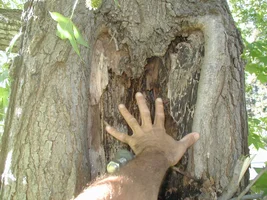
Good eye Guymayor, the light is from a branch hole on the other side. The crack extend all the way through with about an inch or so of sound wood on the other side. Some decay as started in the area. I mis-type on the diameter of the area, it is approx 25 inches. The defect itself is 15 feet from the ground just above the first branch attachments and the wound is facing the house. The knot hole is facing the street.

The major risk in this tree is that the defect is so low compared to canopy height. The sheer crack that has developed will extend with the ocilations of the canopy during wind events. Lastly, this tree on a school route.

If this tree would have been away from so many targets a crown reduction an possibly some bolts to hold the crack together would do. But the target area is very high and this falls into the unacceptable risk for the customer. Oh and they planted it on the gas line.
 

Attachments

  • 94837-P8020031.webp
    94837-P8020031.webp
    299.8 KB · Views: 24
[ QUOTE ]
[ QUOTE ]
I think this tree might b a good example to what you are talking about.

[/ QUOTE ]

Gettin' close !!

The one in attachment is just about right.

Just a teensy bit more.

[/ QUOTE ]

Good Pic
 
[ QUOTE ]
His first post dealt with a situation that you never touched on. When an Arborist decides to recommend removal of a tree because it HAS to come down or somebody/something will get hurt, he/she has to stick to their guns and either see the removal through, or walk away.

[/ QUOTE ]

EasyPhloem...

I'm glad I quit trying to re-explain it. It's so much easier to see someone like you, who knew what I meant, post.

[ QUOTE ]
Mario those are pretty shrooms but it also has good woundwood (on one side only which is a concern). A full assessment would excavate the rot to measure its depth, and look at the whole tree from top to roots, before opining.

[/ QUOTE ]

Guy...

What if I told you that tree was dead?

Even live, its close to a candidate for removal. I can't say for sure, because its in an Oregon coast forest, and I didn't spend much time on it. It just was a very good image to match this thread and something "Frog" mentioned.

But if I recall, it's dead. In which case it would probably be a "perfect" candidate for removal, if such an example were in a residential area.

 

New threads New posts

Back
Top Bottom