Reliable DIY power ascender

What throwline were you using?
Some very heavy fishing line. I get more height with it, with the Big Shot, then pull up a bigger line like paracord to actually set my climbing line. The propane cannon was just too loud to be practical, even if I got the propane charge nailed down.
 
Hi Bart,
I hear that! Do you make it indestructible or make it light and easy to use, and needing a rebuild every year? My unit is about 7 lbs but I see it gaining another pound with new gearing. After looking at gear prices I've been tempted to try a Chinese speed reducer already made and for a fraction of the cost. I suspect there's a 1 in 10 chance it will be durable. Should I buy one just for grins? Who knows.

It sounds like you already have all this figured out, and yet you only made one for yourself?

Thanks!
Jim
Jim, there is certainly a market and you will sell some of these if it’s made well. Insurance will be a hurtle driving up the cost. I’d guess that you’d sell a handful in the first years, picking up sales as time went on. Motorized ascent isn’t a new concept to many Arborist anymore so some of the foundation has been laid.
I’d expect that you’d have a few made up as loaners to get the word out, a little R&D and hype building. For its faults and long wait time this is exactly what made the Akimbo fly off the shelf with months long wait times once released. (And the fact the manufacturing moved at the time of release).
So yes there is a demand, and arboriculture has grown rapidly. As we age and get dinged up the idea of a free ride become more appealing. If it’s good, and durable I’d imagine it would be a huge cost initially, and only get more profitable in time. We are not the only work at height rope access, just the coolest
 
. . . We are not the only work at height rope access, just the coolest
Very true, there is a huge market in industry for such a device, aside from arborists. Tall building construction, drilling rigs, crane boom assembly and maintenance, mountain rescue, etc. All my own climbing when younger was industrial, shipyard, drill rigs, etc. before I re-discovered my boyhood love of being in trees. A power ascender allows one to save all energy for the job in hand once at height, instead of expending it just getting up there. And as we get older and creakier (sigh), this is more and more important.
 
A power ascender allows one to save all energy for the job in hand once at height, instead of expending it just getting up there. And as we get older and creakier (sigh), this is more and more important.


This is one of the most important reasons for using tools. Footlocking into a tree is such a good way to grind down a climber on each climb. Years of doing that will show up in creaks too.
 
Some very heavy fishing line. I get more height with it, with the Big Shot, then pull up a bigger line like paracord to actually set my climbing line. The propane cannon was just too loud to be practical, even if I got the propane charge nailed down.
You should've used dynaglide or a similar superlight dyneema line.
 
This is one of the most important reasons for using tools. Footlocking into a tree is such a good way to grind down a climber on each climb. Years of doing that will show up in creaks too.

40 years of standing/working on concrete slabs has pretty much shot my knees. I can footlock 4 or 5 times and that's it. Even frog walking makes me sore after 30'. It's why I like my ZigZag and MRS. Although it takes twice as long, I can pull myself upward using only my upper body if I can get my feet on the trunk and the rope to self tend. The orthopedist gives me steroid shots to push back the inevitable knee replacements, but I would've made this anyway. I'm an addicted tinkerer.
 
40 years of standing/working on concrete slabs has pretty much shot my knees. I can footlock 4 or 5 times and that's it. Even frog walking makes me sore after 30'. It's why I like my ZigZag and MRS. Although it takes twice as long, I can pull myself upward using only my upper body if I can get my feet on the trunk and the rope to self tend. The orthopedist gives me steroid shots to push back the inevitable knee replacements, but I would've made this anyway. I'm an addicted tinkerer.

FWIW,
Super easy to use 3:1 on SRS/ SRT, and still be able to use 1:1, easily.

If your ReDirect point is at 60', attach a pulley at 70' from the end with the 3:1 using the climbing line tail. When you pull it in, you can pull the pulley up to just short of the ReDi point, and base-choke or attach another rescue rope through basal lowering point, and connect ends.
Hope that makes sense.


I have a Wrist Rocket hand ascender for back-up, like if I have a finger injury. Doing lots of pulling, the Wrist Rocket might give you some more longevity.
 
FWIW,
Super easy to use 3:1 on SRS/ SRT, and still be able to use 1:1, easily.

If your ReDirect point is at 60', attach a pulley at 70' from the end with the 3:1 using the climbing line tail. When you pull it in, you can pull the pulley up to just short of the ReDi point, and base-choke or attach another rescue rope through basal lowering point, and connect ends.
Hope that makes sense.

I have a Wrist Rocket hand ascender for back-up, like if I have a finger injury. Doing lots of pulling, the Wrist Rocket might give you some more longevity.

I've been exploring the idea of using a static line, basal-tied, with a primary SRS/MRS Tie In Point being a pulley prusik'd or butterfly'd to the static line just below the redirect to base. My thought that sparked this was, using my non-midline attachable, stock rollgliss for access to that TIP, and switchout to my MRS to move about. Another great reason that I thought of this was that then I can use the rollgliss as a powered work-positioning device to get out on those long 40ft limbs while still being attached to my primary TIP with my MRS system!

And, it allows me to move my MRS system & rope around in one piece on a biner! instead of de- and re-attaching my unicender whenever I want to move TIPs.
Downfall: requires a static rope, an MRS rope, and then the 3/8" rope with the rollgliss. So, three ropes and more gear vs a single rope + ascenders that most SRS climbers use.
 
Last edited:
Just curious as to what kind of success you've had with the milwaukee drills for your rollgliss?
Been on vacation, I'm receiving some more 3/8" line this week and will play with the Milwaukee drill on some longer real-world ascents soon. I'm suspecting I will buy the DeFault today at Home Cheapo, test it out, and return it if it behaves sub-par to the Milwaukee.
 
The deFault performs the best, not based on shear power but because the motor/clutch will not reverse when the trigger is released.
I have some crude video, trying various drills. I'll find some time to edit something together.
 
Hi Jim,
Been off buzz a while. Gear trains are daisy chained devices with the final shaft and gear combo taking the direct brunt ( look at the wraptor gears) and each previous stage taking less hit e.g. the gears inside the tanaka. So with the Dewalt drives the rollgliss takes the brunt and drops the punishment for the Dewalt. There was no comprehensive engineering info on the gears I used. I think they just put the onus on you to balance the size and lifespan. You just hope their quality is on the good or better side; how can an ordinary guy tell? I don't have any metallurgy tools. Gear design and production is a bit of an art. When they claim a max working torque you don't really know where along the lifespan chart they chose that number. So they're going to wear out gradually and experience/testing is the final arbiter. I haven't used mine much as I concluded that if I couldn't move around a tree without it I should question being in the tree. It's definitely neat to use though.

I had a vision impaired customer ask me post climb how I went up the rope and I did a big explanation about a Pantin etc to hide the ascender. But what she saw was the ascender on my SRT line and my DRT long lanyard out a big stem hanging the spiderman in between. To get back to the main stem was squeeze the trigger and manage the DRT release. The downside was having the unit transition from sitting loose on my lap/thighs to pushing the hitch/wrench to back on the thighs slack. Never hit me you know where but it was somewhat in the way.

The mech eng is one issue but I did a post about the elec eng somewhere relatively recently. Think about tanaka getting all their gasoline management ignition hot muffler reliable throttle kill switch etc ducks in a row and the counterpart is getting speed/load control circuit heat circuit reliability battery heat battery reliability lifespan don't do a lithium burn wires reliability don't fry the motor etc ducks in a row. And charging. A drill is elegant because someone else did all that and just says all bets are off because you're not using it as intended, a liability conundrum.

I don't have it all figured out I'm at about 85% with some refinements needed and of course testing refinement cycles always tell additional story. An eye to commercial manufacturability tends to throw a wrench into the works. Time has healed my memory of how much tedious machining was involved but like going on a bender you eventually forget about how bad the hangover was and do it again. A lack of time and feeling pretty good about where it got to has prevented pushing it further.

Did you do your own electrical/drive/control/charge?
 
A lack of time and feeling pretty good about where it got to has prevented pushing it further.

Perfectly understandable. I've sorta given up on the idea of offering a complete solution from scratch. Too much work, too much hassle, too many years to break even. If I were a younger man...

That said, I just completed the second prototype and got to test it in a red oak today. To overcome the gearbox heating issue I broke down and bought a prefabbed gear reducer and adapted it to the original rope handling mechanism. It uses an oil bath to maintain lubrication and distribute heat. It was also the only reducer I could afford ($140) that came with good documentation written in English.

The re-design gained almost a pound, from 6.6 to 7.55, but the tradeoff is bigger shafts, bigger bearings and cooler running. Since there aren't any redwoods in my backyard, I went up and down the same section of rope multiple times without stopping. According to my thermometer, the temp didn't get any closer to the manufacturer's limit than about 60F degrees. Using Makita's largest cordless drill (XPH07), the ascender lifted my 200+ lbs. at 44.3' per minute, or .74' per second. I got about 200' of continuous ascending and descending on one 5.0Ah battery charge.

The Makita might not be the best drill for this application. It has what appears to be some kind of centrifugal brake which makes a rattling sound while descending. According to the manual this is normal. I only got it because it uses the same batteries as my electric chainsaw and several other tools.

Did you do your own electrical/drive/control/charge?

Nothing like that. I'm not an engineer or a machinist. Out of high school I got a job doing carpentry at a local candle factory. When the woodwork was over, they offered me a job on their maintenance crew and pretty soon I was building one-of-a-kind machines for a new production line. Since then I've had several jobs as a millwright in furniture factories and semi-production shops.

Back in 1990 I bought a Dutton Lainson hand winch for loading heavy machinery into the back of my truck. I'd buy old woodworking machines, fix them up and then resell them, or add them to my shop. The winch came with a bale (loop) for attaching a hook in a carpentry brace for speed winching. It was just another step to swap out the brace for an electric drill, but back then all the powerful drills were corded and didn't spin at 2000 rpm. Times change.
 
Jim,
If I might ask, was your first gearbox greased or oiled and just spur gear stages or planetary? I have a hedge trimmer head that gets surprisingly hot squishing the grease around inside it. The dealer warned me not over grease it due to overheating. I'd be curious if you took the Makita and drilled a 1/2" max? capacity hole in hardwood or al or steel, somehow monitor if the gear head is heating or the stator/armature. You might estimate if the load is the same as ascending by sound and rpm since I think even with brushless drive you get IR winding loss and would have the same drive and battery droop. 40 deg is hot to touch so 60 is holy cow. 220 lbs is 100 kg x 9.8 m/sec sq = 980 N, 44.3 fpm is .225 m/sec so power = 980 N x .225 m/s = 220 watts just under 1/3 hp at the rope. 220 watts sounds right. So throw in some efficiencies and maybe the motor is doing 250 watts and the battery maybe 260 watts. Those numbers are probably higher because of grinding and bending/binding the rope in the sheaves. Maybe do a calc (watts) of 1 lb of steel (gearbox estimated weight) getting heated from 20 deg to 60 deg in whatever your runtime was and see if something is rotten in the state of denmark (blame my old physics prof for that phrase). I never got serious heat that I recall. How about you, Burrapeg?

steel is 500 J/(kg K) so getting 1/2 kg up 40 K or C would take 1/2 as much times 40 times as much or 20 x 500 = 10,000 joules. if it took an hour is 3600 sec to heat its 10000 J/3600 sec = 2.77 watts. You can scale the calc with the correct numbers easily. 2.8 W is about 1% of 250 W is a relatively sane number. engineering math, gotta love it. just don't use it a tax time
 
Hi Bart,
Believe it or not there was a time I could've followed your numbers but my mind just won't go there anymore. Atrophy and old age have taken their toll.

It's not the drill. After a good workout it gets a little warm. Battery output drops about 2% per 25' of rope ascended. The original gearbox was greased and would get so hot it boiled the lube, but then again I was exceeding the manufacturer's recommended input by 1400rpm. The new box made by the Chinese is actually holding up really well. After more than 2000' of rope climbed the temperature is dropping while it gets broken in. The max temperature after a 270' workout yesterday was 155F right above the input shaft (huge thrust load there). The rest of the box averaged around 120F. Ambient was 73F.

I haven't seen a RollGliss or a Wraptor or a Ronin. Just from the outside appearance I suspect the RollGliss is a 2-stage helical gearbox. Both my gearboxes are worm drive, mostly for lower cost, improved ergonomics and self-locking. At least that was the intention. Unlike the first gearbox which angled the worm to be flat against the wheel, the imported gearbox is showing the capacity to un-lock and reverse (like the Rollgliss) if the drill is removed. This will only get worse once it's fully broken in. I don't think it will get bad enough to need anchoring the drill but time will tell. Here's a pic of the first two ascenders, the original on the lower left.
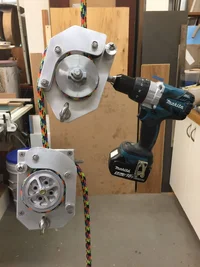
OneandTwo.webp

As you might have noticed, the Maasdam rope pulley is missing on the second version. I "texturized" the inside of a zinc die cast A-belt pulley using a Dremel and it worked really well for the larger ropes, but any ropes under 11.7mm started slipping with a 200lb load. I have a couple ideas for that, just need the time.

Even though the anchor ring has a purported working load of 1300lbs, and I tested it to over 1000lbs, it just didn't feel right, resulting in a third version of the ascender that incorporates a stainless U-bolt as seen below.
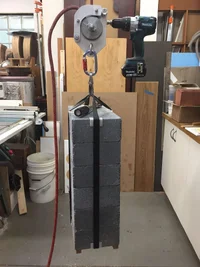
Three.webp

Although this cinderblock stack is a little scarier than me hanging from the ascender in my saddle, it's a lot faster to hook up and put a quick couple hundred feet on the ascender. I measure the input starting torque before and after each time, and so far it's dropped more than 20%. Once it levels off the gearbox will be fully broken in. If it drops far enough it might be time to look at a lower gear ratio (faster ascending). Battery life is also improving.

HTP.webp

Here's a pic of the short piece of 1/2" HTP Static that's been used for most of the in-shop testing. The piece on the left is the part tied to the ceiling anchor. The right is what it looks like after going through the ascenders 1000+ times. The discoloring is from aluminum and zinc oxides (I think). This rope is tough!

Once the gearbox is fully broken in, and if I can work out the problem with the thinner ropes, does anyone want to give it a try? You would have to be a well-known member, have your own 1/2" cordless drill, keep a log of how much rope you climb, and promise to mail it back to me after a week or two. Bart? Burrapeg? Send me a private message if you're interested.

Thanks,
Jim

 
Once the gearbox is fully broken in, and if I can work out the problem with the thinner ropes, does anyone want to give it a try? You would have to be a well-known member, have your own 1/2" cordless drill, keep a log of how much rope you climb, and promise to mail it back to me after a week or two. Bart? Burrapeg? Send me a private message if you're interested.

Thanks,
Jim

Jim, how much does the unit weigh, sans rope & drill?
 
. . . I never got serious heat that I recall. How about you, Burrapeg?. . .
I haven't noticed any excessive heat at all. The drill's own gearbox will get slightly warm on a long climb and the batteries are warm when they start getting low. The internals of the RollGliss are a 10 to 1 ratio simple spur gear train with hardened steel gears and I replaced the original grease with new grease mixed 50/50 with Moly-D. The one weakness of the design that I would change, if I could, is that the bearings are a solid bush of some sort of high-tech stuff like teflon and I would have used roller or ball bearings. I pour aluminium in my foundry as well as gray iron and several of the bronzes, and I have given some serious thought to getting up a foundry pattern for a new housing for the Rollgliss that had enough metal in the right places for ball bearings to be pressed in. The special sheaves could also be a casting. It would require a core to cast the shape we need with the groove and its internal ribs that grip the rope, but this is not a very difficult job.
 
. . . Once the gearbox is fully broken in, and if I can work out the problem with the thinner ropes, does anyone want to give it a try? You would have to be a well-known member, have your own 1/2" cordless drill, keep a log of how much rope you climb, and promise to mail it back to me after a week or two. Bart? Burrapeg? Send me a private message if you're interested.
Nice job! And very thorough testing you are doing. I would be happy to put one of your ascenders through some trials, although the immediate future doesn't leave me a lot of free time. I am building a new studio building for my girlfriend over on Orcas Island and we are really pushing to get the windows in before the Fall weather changes and the wind and rains begin.
 
Also from me, nice work! Making me feel guilty about being net pics shy with my gizmo. I think the temperature rise is from the inherent nature of worm gears, mystery solved. Maybe scoop some MolyD and try its magic. Maybe mix it with #1 or 0 grease depending if mfr restricts lube options. Remember grease just holds oil. It appears to have no midline attach ability. Have you considered clearance to pass the rope bight out around the sheaves? Looks like an easy mod. (?) Mid line feature was a major pita in my design due to major emphasis on compactness. The u bolt nut looks a bit unfriendly to the carabiner, perhaps a conical nut cover if you have a lathe. Failing a lathe, make a split expanding shaft you can chuck (make a partially threaded hole in the end, putting a screw in expands shaft dia), drill the "cone" and hold it from the inside then "lathe" form the outside. I've made plenty of things this way. Made a 1/2 treepeedo like that, just for pulling rope through the crotch.

I appreciate the test invite, but I think you've got it in hand quite well. Glad to bounce tech talk your way though. BTW go upsize, way oversize on the u bolt, strength is not failure, later fatigue cracking is the gotcha so give it lots of beef. You're shear loading it not tensile and the threads are stress risers. All the best.
 
Hi Bart,
oops, my bad. It is mid-line attachable which was my number one complaint about the Ronin. After the rope is unloaded, the fairlead (that little hocky stick looking thingy) swings outward on that bottom pivot for looping or unlooping a bight around the pulley. It takes about 10 seconds to install and 5 seconds to uninstall.

Sorry for leaving out the instructions...

About the u-bolt, it's 3/8" thick with 1" ID. Going up to 1/2" in thickness will more than triple the size. I could just drill a hole through the 1/4" aluminum (6061-T651) backing plate, and you just clip into that, but the aluminum would wear faster than the steel u-bolt, and throw off the load alignment causing the rope to rub on the outside cheeks of the fairlead.

Maybe skip the u-bolt altogether for a through hole, and bend a zig-zag in the 1/4" backing plate to keep everything aligned? Whadya think?
 

New threads New posts

Kask Stihl NORTHEASTERN Arborists Wesspur TreeStuff.com Teufelberger Westminster X-Rigging Teufelberger
Back
Top Bottom




















