
Reduction pruned red oak

Excellent documentation, and a fine job imo compromising between your view and the client's.

That's a lot of old pruning wounds above that decay column. Is it your opinion that this sudden loss of large limbs started or at least accelerated the decay? That is my suspicion; the lack of callus growth indicates that scenario.

I've shown similar trees on risk mgt ppts but this one is very clear and compelling. How old are the cuts pictured? Did the branch that hit the house have a simiar unclosed pruning wound?

the open wound at the base is not that wide--how is the callusing/woundwood around it? Any fruiting bodies? Did you probe for decay in the adjacent roots? From the lake picture--which was neat to see; I used to live across from there, in Racine, a long time ago--it seems that the decay streak faces south--does it?

Sorry to bug you with ?'s but this is a fascinating case of a borderline tree.

>>>>>>>>>>>>>
{Nitwise I read this: "reduction pruning removes the larger branch to a lateral at least 1/3 dia of the parent limb." and think, well, that's a good guideline (or 'rule of thumb', as stated in the BMP's), especially in a declining tree like this one seems to be. But is it really a definition, not in ANSI or BMP's.}
 
Guy
I am not sure which limb fell previously because it had been pruned off and the last limb that fell was in the summer of 05
I am not sure how long ago the tree was pruned from the callus growth and some of the dead branches I would guess 4-7 years. Also there were some old spike marks on some of the branches.
The branch that fell last year did have an old pruning wound that had not closed
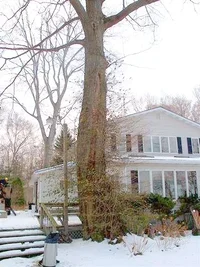
The woundwood around the wound at the base seemed good and overall the tree seemed vigorous for its age.
There was no fruiting bodies and I did not investigate the soundness of the roots.
This property is on the Southern tip of Lake Michigan so the wound actually faces Northwest
I don't understand what you are saying at the bottom of your post
 
mann, you said "reduction pruning removes the larger branch to a lateral at least 1/3 dia of the parent limb."

That's a good guideline (or 'rule of thumb', as stated in the BMP's), especially in a declining tree like this one seems to be. But is it really a definition? Not in ANSI or BMP's.

Too-close adherence to the 1/3 rule, and overavoidance of "tipping" can lead to bad decisions and hazardous trees, that's all I'm saying.

Is it your opinion that the sudden loss of large limbs 4-7 years ago started or at least accelerated the decay? My point is, the tree might likely be safer today if it hadn't been overpruned in the past.
I call it Raising Cain.
 
I see what you are saying guy I have broken that rule in the past on obviously hazordous trees in the past but since this one is borderline and the homeowners did not want the tree to lose its aesthetic integrity I thought that I would start with this amount of pruning and adjust accordingly with subsequent inspections.

With the pruning cuts in the past there is only one that is dedinitely not removal of a dead branch. The rest of the cuts are on the interior of the crown and could have been live or dead branches.
 
Hi all again.

That's the problem when you're offline for a few days, that "Active" button drops off threads like this so I'm happy to find it again.

I've attached a lighter pic of the tree. The opening is only 13" for 55" DBH.

So the calculation for the % opening goes like this.

55" x 3.1416 to get circumference = 173"

13"/173"= 7.5% opening ; a 40% opening would be 69" but now you have to be smart how you measure this as you have to measure radially <font color="brown">not the tangient </font> . For such a small opening I just bend the steel tape measure to suit the tree. Anway it's well under the 40%.

The DBH for wall thickness is in range too.

Also woundwood is stronger than conventional wood so those rolls around the opening are strong. I think it's 40% stronger but may vary and you could have to do some research. I wonder what caused that big wound, lightening?

The previous pruning cuts looked a little flush but the tree may have grown or something. The big tear out you showed looked like a co-dominant tear out but the pic missed the top part of the tear.

Good case this one. Also, to get those wall thickness measurements did you drill it or something?

Often here, when you have an exposed heartwood like that which turns the traditional grey colour it doesn't necessarily mean decay. It turns grey from the sun, UV.

Many times it's still hard as a rock. I've cut old stumps that have been in the field for 10 years plus (just grey posts sticking up) and they are still hard as a rock and no decay. so one cant assume that because the altered colour heartwood is exposed it's also decayed.

Sometimes large mature trees drop branches anyway, poor unions, over extended, heavy foliage, strong wind, SLD etc ... and some of those failures probably had nothing at all to do with the condition of the tree's trunk.

Be interesting to see the what happens in the years to come. I personally dont know the species but it was a good one for the exercise. Personally I think it will be around a lot longer than us. /forum/images/graemlins/grinyes.gif

A bit of PHC for the root zone this year and it will do fine.
 

Attachments

  • 48547-treeman.webp
    48547-treeman.webp
    51.4 KB · Views: 76
The large branch that failed was not a codom. It had decay internally that looked like it began from old pruning wounds. Since those were my thoughts when I inspected the tree some of my drill points were directly into some of the old pruning wounds and they were soft until a certain depth then the drill encountered more solid wood.
 
Just want to thank you guys for the great discussion of this tree. I dealt with many red oaks here in Toronto. Always difficult to see a big beauty taken down when it could be managed to extend its life.
 

New threads New posts

Back
Top Bottom