Redirect at base of tree- easier pull?

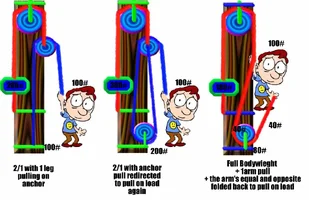
Ummmmmmmm so in your "Mayhem Alert" drawing; if in #3 his 2 hands were 50" apart; and he drew them to touching (moving each 25"), that would be the equivalent of just moving 1 hand 25"(other locked in position pulling on anchor)? The total distance moved, would not have an effect on the outcome?

So, you are saying that a Zrig doesn't take us from a 2/1 to a 3/1 by redirecting a pull on an anchor to take another turn (of pull) on target load; such as illustrated in #3?
 

Attachments

  • 34855-zrig.webp
    34855-zrig.webp
    86.8 KB · Views: 75
In a Z-rig, one of the redirect points in fact moves (nears the other) as a result of the action, does it not? (see your new part 2!) In your picture part 3, which of the two redirects moves? If neither moves, you've gained no advantage against the load have you? Aren't both your points affixed to the same member?

Looking at it this way, if it takes 40 pounds of pull to move the rope 'round the stationary lower redirect, won't each arm be doing 20 pounds of work? If one arm is doing 40 pounds of work, how much is the other doing? Or, what would be the difference between each arm pulling 20 pounds in the direction of rope travel in part three, and the lower arm releasing the rope and the hand being placed near the upper, with each arm then pulling 20 pounds? I believe there would be no difference there, Ken. Apart from balancing the load, allowing you to effectively lift more than your weight, that is (i.e. instead of losing 40 pounds of your weight as far as your feet see, you'd still press the ground with them at full force). In that sense there's an advantage to be had, but it's not a mechanical one which causes more rope to move relative to the distance the object moves.

Maybe I'm wrong; it was rather late/early...

Glen
 
i think in the #3's; the option of the lower hand pulling an imoveable is foregone. So lower and upper moves. So if each moves 25" @ 20# ; then that is 2 x 25" x 20#; the distance traveled of the 2nd hand must be recognized. In pairallell, if the force is redirected to pull again on the load instead of terminating at the anchor, it must be recognized.

In the 2nd picture i maid for you... The differance between the 2/1 and the 3/1 i submit, is in fact, the same pulley on the lower anchor; that simply takes the anchored line from the 2/1; and lets it pull on the target load once more.

This is one of the arguements i tried to show before. Usually we think of more power by pulley position as pulley must be on the load(2/1). But we can get more power from a redirect off of anchor(1/1) too, iff it is redirected to pull on target load again.

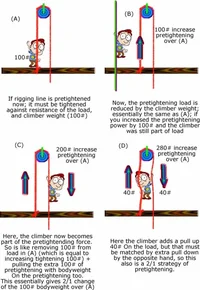
Attatchmeant is application of this, by strategizing on the climber's unique position, for 2 2/1 functions in pretightening.
 

Attachments

  • 34866-climberrigforces.webp
    34866-climberrigforces.webp
    63.7 KB · Views: 56
[ QUOTE ]
i think in the #3's; the option of the lower hand pulling an imoveable is foregone. So lower and upper moves. So if each moves 25" @ 20# ; then that is 2 x 25" x 20#; the distance traveled of the 2nd hand must be recognized. In pairallell, if the force is redirected to pull again on the load instead of terminating at the anchor, it must be recognized.

[/ QUOTE ]
I think we're on the same page here. Each arm pulling 20# 25" = 25" of pull at 40#. Like I said this morning, the only difference between that and pulling with both hands downward for the same total of 25" of pull at 40# is that when pulling both hands downward, your feet will be pressing 40# less on the ground and with each pulling on a side of the lower redirect your feet press on the ground with your full weight. There's no mechanical advantage in the system, however.

[ QUOTE ]
In the 2nd picture i maid for you... The differance between the 2/1 and the 3/1 i submit, is in fact, the same pulley on the lower anchor; that simply takes the anchored line from the 2/1; and lets it pull on the target load once more.

[/ QUOTE ]
The way I see the third part of your second (and first) pic is that the 100# weight of the groundie hanging by his right hand has 40# added by him pulling up with his left, for a total of 140# each side of the upper pulley. The fact that the lower pulley might see 80# total upward force on its anchor point (if it does) is totally inconsequential.

In a sense, the lower redirect does add some advantage to the total system (potentially an additional 40# of pull), but it's a totally separate system from the upper redirect. The lower doesn't work in direct conjunction with the upper in this case. Not the same or even remotely equivalent of the situation in possibility #2 in your second drawing, where both redirects work together to create one closed system.

In a (single) compound system, you're making the load seem lighter to yourself. With your system #3, all you're doing is making yourself seem heavier to the load -- by 40# only, for a total, as the load sees it, of 140# (if that much in practice; I firmly believe it will be somewhat less unless you can ensure the rope maintains a straight shot from the top redirect to the bottom one).

[ QUOTE ]
This is one of the arguements i tried to show before. Usually we think of more power by pulley position as pulley must be on the load(2/1). But we can get more power from a redirect off of anchor(1/1) too, iff it is redirected to pull on target load again.

Attatchmeant is application of this, by strategizing on the climber's unique position, for 2 2/1 functions in pretightening.

[/ QUOTE ]
I pretty much agree with what I perceive you're saying in the first three parts of your latest attachment, Ken, but in the fourth part, you're only adding 40# (best possible case) to your body weight of 100#. But that would really only be if the lower arm was pulling upward with 40# of force from an immovable object!

This is not the same thing as your previous item 3's! Think of it like this, Ken. Say you've got a rope affixed to the bottom of a pole, with a redirect affixed to the top. You hang with both hands on the "far" side of the upper redirect, and you'll subject the upper attachment point to double your body weight. Now, let loose one hand and instead grab onto the affixed side of the redirect with it. Your body weight is now equally supported by both hands, and the upper attachment point only sees your body weight. Now, reach down with the hand on the fixed side and pull up. However much you pull up will be countered by your hand on the "far" side, adding it to your apparent weight there. Pull up with 40# and you'll have 140" each side of the redirect.

But that's because you're pulling against an immovable point, and it represents the most gain you could hope to achieve with such a configuration. If you were hanging by one hand against a load equal to your body weight, it would not move. If you reached down across the redirect and pulled up with a force of 40# it would be all the same as though for the duration of the pull, you weighed 40# more on "your" side of the redirect than you really do. As soon as you quit pulling up on the load side, you'll stop, being balanced again.

I think you're thinking in terms of, say, a four-leg lug wrench, where if you put 100# of force against the end of one of the 1' legs, using the other hand to hold the perpendicular leg upon which it's pivoting, you'll be applying 100 ft-lbs of torque. But if you simultaneously push down at 100# on one leg and pull up with 100# against the opposite one you'll be producing 200 ft-lbs of torque. While it's true that's essentially what you'd be applying across the redirect by both pulling and pushing opposite ropes, torque about the redirect is not what's doing the work (and how can you push a rope?).

This hurts my head...

 
Nick,

You are funny!

The way I see it, one is easier for two quick reasons. 1) The extra friction in each pulley (since none are 100% efficient). And 2) There will be a loss of efficiency in the extra rope in the system.
 
Loss of efficiency by length assumes facts not in evidence i think- elasticity.

[ QUOTE ]
There's no mechanical advantage in the system, however.

[/ QUOTE ]
Then no added MA going from 2:1 to 3:1 by adding same pulley to base anchor; as i do to hand pull. Force is force, doesn't realize if pull is coming into pulley by hand or or 2/1.

[ QUOTE ]
The fact that the lower pulley might see 80# total upward force on its anchor point (if it does) is totally inconsequential.

[/ QUOTE ]
Impossible. If the bottom pulley recieves 80# of upward pull, then equally and oppositely it must give 80# of downward pull; else give up the differance in movement. If it has a Zer0 degree bent line; it must have 2x multiplier.

[ QUOTE ]
, Ken, but in the fourth part, you're only adding 40# (best possible case) to your body weight of 100#. But that would really only be if the lower arm was pulling upward with 40# of force from an immovable object!

[/ QUOTE ] The upper arm pulls on moving object and creates pull on it. When the lower arm pulls on anchor you are write; force flow terminates there, but when it too pulls on load, it must matter, force is force. The way of the bent line is jujst hard to see. Like the hanging mayhem puzzle i devised to show it, and like the 2/1 in DdRT etc. same pattern of force.


i've all ways been the lil'guy; maid this stuff up when a teenager working on farms, trying to keep up. i've pulled many a grain and red meat fed farmboy over (Stopped their laughin'quick!) with this pull of other hand redirected to target/ not ending at anchor. But, bringing it's force around for another shot at the load. i've proven it with scales and now dynamometer; like i did with the hanging mayhem puzzle. i had 3 10 yr. old mens out'ere with dynamometer; showing them these things; each could pull 1400# on it with 1 hand easily by following this pattern; 1 alteration to pull on anchor rather than redirect onto load; couldn't grunt 900# with both hands. This helpful pattern of force maximizing is often right there; if you can call it up.

Exerting force on something can move it, but also creates an equal and opposite effect somewhere in the effort. The most frugal and powerful efficiencies of Nature, use the force, and it's promised equal and opposite force together to target i think.
 
In post #34855, the person on the rope in #3 would be holding 180#. The rope is just redirected with a fixed block. There is no MA or load mass loss if the ropes at the fixed block are parallel. The force on the lower block would be 180 X 2 = 360#.
 
There's another way to look at this scenario.

Keeping your arms lower, as in #2, keeps your shoulders in a more natural position. This saves wear and tear on that complex joint. If for no other reason than body mechanics that's the reason that I like to rig with a redirect. YOu can only bend the paper clip so many times before it breaks.

I read once that the most pull that a person can apply to a line is about 80% of body weight. Something to consider when calculating the setup.
 
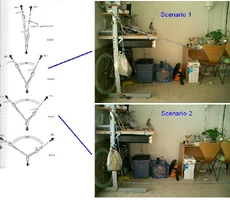
Ok guys. I've been thinking a lot about this, and am really suprised at all the responses! I'm baffled about this. First, let me say that when I originally posed the question, I truly believed that Scenario 1 was a lot easier than Scenario 2. But after playing around a bit, I'm no longer so sure. First I'll comment on some of the posts so far.

Tom- I looked at your original attachment, then thought about a diagram I've seen a lot in many rock climbing books. I wonder if what I'm experiencing is more along the lines of what happens when using large angles when building top-rope anchors. See my attachment

John Meiszner- No, it not like 2 many wraps were taken. The added friction from the other pulley really is negligible. As a matter of fact, for our learning purposes, we can really ignore that as a factor.

John and RemovalWizard- The angle DOES change the loads at the ENDS of the rope. See my attachment.

TreeSpyder- Good point about Scenario 1 lifting the tires of the truck off the ground. If you were using a truck, I think you'd ALWAYS want the redirect to bring things down to the trucks level.

Mark- There is no loss of efficiency in the second scenario. In either one, a movement of 4' on either side of either scenario results in a 4' movement on the other end. In order for there to be a loss (or gain) of efficiency, doesn't there have to be a discrepency in the amount the rope is moved, ie- if pulling 4' of rope only moves the weight 1', then you had a 4:1. In both Scenario 1 & 2, we have a 1:1

And this leads me to my current conclusion. I think these 2 are equal. I set it up in my aparment using a 12 pound bag of pennies /forum/images/graemlins/grin.gif and could not notice a difference in what it took to move the bag in either scenario.

I got work to do, but later I can share what brought this all up.

love
nick
 

Attachments

  • 34968-anchors.webp
    34968-anchors.webp
    79.5 KB · Views: 58
I forgot to mention...

When playing around, I THOUGHT I noticed a little difference. I'm not sure if I was just seeing what I wanted or if it was real. Unfortunately I don't have a way to measure it other than me pulling on each end and telling what I think.

If there IS a difference, and it is Scenario 2 (with the redirect) that is the one that is harder to pull, could it be that the angle of the rope is pulling harder on the anchors. In this case, one of the anchors is ME. I KNOW how this rule applies when setting up climbing anchors, and similar rules apply when setting up speedlines and things of the sort.

Does the same thing happen when the rope is moving over a pulley?

love
nick

ps- Seriously, I'm not trying to mess with anyone's head. I can and often do set up pulleys to make my work easier, but it's hard for me to grasp WHY it works. That's all I'm going for here.
 
Now Nick,

You have me all really confused... /forum/images/graemlins/confused.gif /forum/images/graemlins/crazy.gif /forum/images/graemlins/icon310.gif

Is your question which is easier or which requires less force?
 
Nick,

My loss of efficiency is due to elastisticity. The extra friction is present in all blocks. The more blocks the more friction. You won't feel it much in one or two, but add four or five and you'd be surprised.

The difference in your two scenarios would be minimal. I'm not even talking about body positioning or such. Just forces. And, as far as I am aware, the block loading angle only effects the anchor of the block. The force should remain consistent from one end of the rope to the other.
 
Some possibly by ergonomics. (B)could be harder, but could throw and trap force with heavier upper body as lever, wedging feet into ground as catch if done right. Wimmens have better balance with wider/lower CG, so are not afforded this ability to pivot at hips and throw/lunge weight forward like a man pulling a locomotive example etc. But, least taxing would be bodyweight hang.

Truck pull has more horsepower, than weight to use; but still needs traction to operate that horsepower, so is different scenario.
 
Nick (and to a certain extent Ken),

You've got two things conflated here.

The force it takes to do the work and the loadings seen at the redirect points.

I'm ignoring the friction of the redirects because it surely must be inconsequential unless you're dealing with merely grams or ounces of force, and you're certainly using ropes and pulleys matched in size and in good operational condition. I'm also ignoring redirects outside the range 0 to 180 degrees inclusive.

If you must exert 20# of pull on the rope to do what you want, it matters nothing what the angle of redirect is between 0 and 180 degrees. However, the loading on the redirect point itself will vary from 0 to 40# at those two extremes.

The included angle Tom brought up only pertains to the loadings at all the endpoints in a system where the load is shared between interconnected legs. It has absolutely nothing to do with the amount or ease of your effort in using a rope redirection.

Between your two original scenarios, Nick, the only functional difference will revolve around the conditions which make one or the other system more favorable at the time. Neither one has inherent advantage over the other.

Ken, I don't know what to tell you. The lower redirect attachment point in #3 sees 80# but the 100# pull with 40# pull from the tail added to it only comes to 140#. Sorry about that...

Glen
 
Well, i guess the dynamometer is broke then....

i've measured this up, down, sideways... force is force it says; all must have E&O; all must be accounted for. Just as distance. For, force is the only thing than can overcome distance; so, any change in distance, msut show a change in force.

The way of the bent line can be tricky, especially whenst folded back upon itself as in mayhem, DdRT etc. They are actually all the same pattern if ya can squint to see them; all exactly the same, but different!

Also shown by the dynamo scale; is that by similarily "2 handing" a 3/1 z rig, ya can get 4x 1 hand's pull. Similarily, the "2 handing" of a 5/1 pretightening device, you can get 8x a single hand pull.

The secret is jsut that you don't throw away the E&O force, or let it jsut be your own bodyweight (or pull on anchor with other hand); but rather you employ the E&O to join with the 'normal' exerted force, to take focus on the target. So, you are just not discarding the promised E&O, by letting it pull on a non-target event; you are recycling and folding it into your efforts.

This is why the Ship's Tackle used both ends of the inset zrig to pull on the outer/main rig. Force, is force; whatever 1 end could pull on an outside anchor, it could also be employed to pull on target. The dynamo scale proved this one too.
 
I figured you must have been talking about something other than what we were talking about and other than what you drew. What you're now clearly introducing is neither of the two situations Nick was asking about.

Glen
 
Though this has wandered sum from Nick's scenario choices, the 2 handing while hanging at base of tree is kidna a merging of the choices. For it is using the available pulley at base of tree in his choice #2, with the hanging on line of choice #1; to give bodyweight + 2 handing of a kinda #3 choice if he will allow....

The 2/1 of a climber's position in air for pretighteneing, a usable tangent i think; but, all the same. As i shift to the ship scenario; i plead that pulling on target from both ends of a 3/1, and not just 1 end; is the same notion as pulling in opposite directions with both hands. Each folding both ends of effort to target, not just 1. For, each doesn't waste the E&O pull on termintating at anchor, but at the target load. Focussing both ends of the force created on the target, not just 1 end, captures and uses the E&O instead of 'wasting' this quanity of force.

Because the E&O by definition will be traveling the opposite direction of focussed effort on target, it must be arched around to bear on target, to be used. But, the pattern prevails; and becomes more distinct as the pattern repeats itself constantly in these different forms.

Holidaze are coming up, and Doc is gonna knock me down again tomorrow. i will try to find the time to dust off the Dynamo; bring it out, just cuz i likes ya so much!

/forum/images/graemlins/propeller.gif
 

New threads New posts

Back
Top Bottom