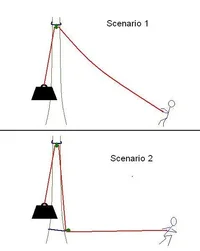
Redirect at base of tree- easier pull?

How much do you weigh and how much does the load weigh?

I think you already know the answer to your question; why are you asking it?
 
Glen- I don't think the weight of me or the weight changes if one scenario is easie or not.

Truth is, I know which is easier. But Tom has posed the question the answers why I posed the question. (yes, I just wrote that)

I don't understand why one is easier. That's what I'm hoping to figure out.

love
nick
 
There is more friction with more blocks, but the factor that effects this problem the most are the changes in the rope angles.... although if it were me, i would have a truck or a winch on the line of #2 and it would not be very hard to pull at all. /forum/images/graemlins/grin.gif
 
[ QUOTE ]
Think of the setup as an inverted sling.

What happens to the load on the sling eyes as they go from parallel or zero degrees up to opposed or 180 degrees?


[/ QUOTE ]


I don't think this situation is the same as an inverted sling.

Discounting the friction in the blocks, changing the sling angle only affects the force on the block and the sling that are in the tree. It doesn't change how much the worker has to pull to keep the weight off of the ground.

If the weight is 100 pounds, the ground worker has to exert 100 pounds of force whether s/he is directly under the block or standing in the tree above the block. The difference is that adding the block in the second drawing makes it much more ergonomically comfortable for the worker to pull the rope.
 
Removalwizard, Yeah like Mahk said, the rope angle factor effects how much force on the block & sling in the tree. The greater the angle, the less the weight put on the block & sling in the tree...if I understood Norm & Tod correctly at IL. convention.
But "the problem", or what Nick asked is which is harder to pull. I don't know. But Mahk says No.2 is more comfortable, someone else already said No.1 is easier.
 
[ QUOTE ]
...which is harder to pull. I don't know. But Mahk says No.2 is more comfortable, someone else already said No.1 is easier.

[/ QUOTE ]


I was thinking about it the way that the worker is positioned in each of the drawings. In the first drawing s/he would be fighting the rope angle, so I think that adding the block would make it easier.

But, the easiest way would probably be for the worker to stand directly under the load without adding the redirect. This would allow him/her to use all of their body weight and not have to use as much muscle to hold the load.

In either case, in order to hold the load off of the ground, the worker would have to generate a force equal to the weight of the load that they are holding.
 
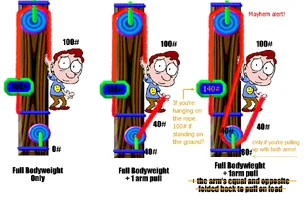
Especially on truck pulls, i go with lower redirect if possible, so that the truck doesn't lose traction from the upward angle of the pull. But, on hand pull go with the bodyweight as force + any extra pull ya can muster from pulling on farther out anchor with other hand.

On hand pulls, i think a pulling with L behind you as you pull on target with R can be better. Especially if you concioulsy schedule your force to be body wieght, then add hand pull to increase beyond that. Even better if a pulley redirects the L pull to add to the R; to place your pull + it's equal and opposite to target! More Power to Ya!
 
[ QUOTE ]
Glen- I don't think the weight of me or the weight changes if one scenario is easie or not.

Truth is, I know which is easier. But Tom has posed the question the answers why I posed the question. (yes, I just wrote that)

I don't understand why one is easier. That's what I'm hoping to figure out.

love
nick

[/ QUOTE ]
"Easier" is quite relative in this case; dependent upon the weight of the load in comparison to the worker (you). I'd think it would be relatively safe to say that in the long run, the second scenario will prove to be the "easiest" overall.

If the load weight is much less than your own weight, then the first would undoubtedly be comfortable as you could merely grasp the rope and lean back on it. Much the way that Mahk alluded to when he spoke of position, you'd be able to use your own weight to good advantage without having to use much beyond your upper-body muscle groups. In the second configuration, however, you could get by quite easily effectively locking the rope to your waist and leaning into it and/or walking, thus really only using your legs.

As the weight approaches (and especially as it exceeds) your own it's a no-brainer. You'd not be able to get any meaningful thing accomplished in the first configuration. In the second, traction is probably the largest factor as the load increases, but you'll be applying loads in various ways throughout your personal structure in doing the work. It would be beneficial to have the angle of the rope from you to the first block be on a slightly downward angle as it would then assist you in purchasing traction.

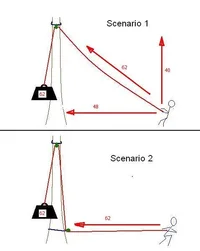
Attached is the image with some plausible forces shown in the direction they would "appear".

So, were you talking about this at work or something?
 

Attachments

  • 34842-lifting.webp
    34842-lifting.webp
    15.8 KB · Views: 80
I think there are several vector forces to consider here. In set up one the vector force following the line to the puller is somehow associated with two different combined vector forces one vertical and one horizontal. I don't remember my physics that well but it seems that pulling a load vertically by combining a vertical and horizontal vector (as in figure one) requires more effort and less efficiency.

Tree spyder alluded to it when suggestion the front of the truck may lift. even tho there is 100 pounds on the line at that angle there is an upward and horizontal force to contend with.

I agree with one of the previous posts that the "best" position would be with an equal and "opposite" pull directly underneath. Best because you are concentrating your force vectors in only one direcion.

So, that would/should be easiest.

Second easiest should be example "B" as you are again concentrating your vector force in only one direction...horizontal. Ignoring friction in the redirects would probably make this even more so'

The "A" example should be the most difficult since you have to direct a portion of your pull down towards the ground and away in the horizontal. You are doing two things at once to accomplish the one task....much more difficult from an effort point of view.

Now with all that said, I belive in practice "A" is easier because 1)my body weight can act as a counter balance to the load and 2) it is easier to move my body, even with the extra load, horizontally than it is to lift it vertically.

Keep in mind tho, that the closer to horizontal your end of the line becomes, the easier it is to move the load.

I know all that was as clear as the Mississippi this time of year, but chew on it a while and see if it doesn't make a bit of sense.

If someone can offer the math to explain my gut-thots here please do.

ThanX!
 
I believe this sort of stuff has been (relatively speaking, of course) well understood for thousands of years.

If you reduce the problem to a right-triangle and have access to a calculator with trig functions (or at least some trig tables for pencil-and-paper work) you can determine the simple load vectors.

Assign the known force value to the applicable leg of the triangle. Knowing either non-right angle and any one side you can determine all the other values. Side opposite the angle divided by the hypotenuse equals the sine of the angle. Side adjacent to the angle divided by the hypotenuse equals the cosine of the angle. Side opposite the angle divided by the side adjacent to the angle equals the tangent of the angle.

In my first attachment above using Nick's diagram, I figured 40 degrees for the angle at the worker.

X / 62 = sin(40) is sin(40) * 62 is 40 for X
Y / 62 = cos(40) is cos(40) * 62 is 48 for Y

Pythagoras said that in a right-triangle, the sum of the squares of the sides equals the square of the hypotenuse, so ( 40 * 40 ) + ( 48 * 48 ) = ( 62 * 62 ), which is pretty much true.

So holding 62 units of weight at 40 degrees upward angle means it takes 40 units of downward pull and 48 units of horizontal pull. Needless to say, if you only weighed 40 units yourself, most times you'd have no weight on the ground with which to anchor yourself for the 48 units of horizontal pull...
 

New threads New posts

Back
Top Bottom