Reaction Wood

....
Yet one would think if this softwood/hardwood theory is accurate, that softwoods would have more wood on the topside. I HAVE seen this, but it’s not the norm. I do think this is over simplified and lacks into an area that there needs to be more study. OR perhaps it simply needs more explanation.
I might be stepping beyond where I have strong enough knowledge to address this, but I'll try with my simple understanding:

It's not a theory. There are observable chemical and physical differences. Those are consistent. I don't know of instances where a conifer is documented to have developed tension wood or a hardwood has developed compression wood....but maybe? My understanding is they are no more capable of that than they are of switching leaf type.

So, we've all seen plenty of branches. Either hardwood or softwood will have off center pith/rings with wider rings at the bottom, right? That seems to imply they are both creating compression wood. The difference is that chemically, in hardwoods, that wood on the underside is the same as regular wood. It is not true reaction wood.
 
Last edited:
I might be stepping beyond where I have strong enough knowledge to address this, but I'll try with my simple understanding:

It's not a theory. There are observable chemical and physical differences. Those are consistent. I don't know of instances where a conifer is documented to have developed tension wood or a hardwood has developed compression wood....but maybe? My understanding is they are no more capable of that they they are of switching leaf type.

So, we've all seen plenty of branches. Either hardwood or softwood will have off center pith/rings with wider rings at the bottom, right? That seems to imply they are both creating compression wood. The difference is that chemically, in hardwoods, that wood on the underside is the same as regular wood. It is not true reaction wood.
I don’t doubt there is science backing this up. The science and my experience don’t overlap well enough for me to fully understand this. Some species of soft woods are very dependent on tension wood.
Redwood for example: if one’s spurs are sharp enough, you can stab the top side of the limb time or three and the limb will pop right off.
So speaking thoughts out loud, either the tension wood in this case is doing the bulk of the work OR the compression wood is grossly inadequate.

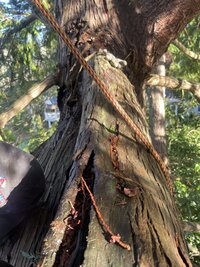
Western red cedar can be much the same. IMG_2229.jpeg
 
Does any of the chemical vs. structural differences described above blur the line of what is considered a hard wood or soft wood?

Feeing bad because I started this thread but haven’t made enough time to dive into any of the links or do any field recon myself.

I’m sort of thinking about concepts I held as a kid that were smashed when I began to really learn about trees…such as; there are deciduous conifers (Tamarack /Larch) that I would have called evergreen without knowing any better. We also have broad leaf conifer(s?), like Ginkgo.

So, would something like Tillia be considered a soft wood? I’ve seen a lot of Linden examples that more resemble Steve’s Loblolly example than any hard wood.
 
Last edited:
Does any of the chemical vs. structural differences described above blur the line of what is considered a hard wood or soft wood?

Feeing bad because I started this thread but haven’t made enough time to dive into any of the links or do any field recon myself.

I’m sort of thinking about concepts I held as a kid that were smashed when I began to really learn about trees…such as; there are deciduous conifers (Tamarack /Larch) that I would have called evergreen without knowing any better. We also have broad leaf conifer(s?), like Ginkgo.
While ginkgo isn't a conifer, there are loads of broad leaf evergreens, as well as deciduous conifers. Gingko actually does drop it's leaves, but I know our live oaks around here that don't lose all their leaves dry out to be muuuuch lighter than black, blue, or white oaks around here
 
While ginkgo isn't a conifer, there are loads of broad leaf evergreens, as well as deciduous conifers. Gingko actually does drop it's leaves, but I know our live oaks around here that don't lose all their leaves dry out to be muuuuch lighter than black, blue, or white oaks around here
Here’s a bit of reference that dispels my comment. Maybe still up for some debate?
 
Right...Ginkgo is a gymnosperm ("naked seed"), but doesn't bear cones.

Is Tilia a softwood? So "softwood" and "hardwood" are more trade names and less scientific. It would be considered a hardwood...often called a soft hardwood. There is never an "always" (or "never" for that matter!), but speaking of the temperate forest trees: the angiosperms - broadleaf trees (aside from Ginkgo which is very unique) are hardwoods and the conifers are softwood. My guess, without looking, is that Ginkgo would move in hardwood markets if it were ever sold as lumber. Most of the time bald cypress lumber moves in hardwood markets as well...
 
Bald cypress is some badass wood
I’ve never seen it milled. How does it fare With such deep sinuses around the base? Around here, Eastern Red Cedar is about the most beautiful wood you could ever cut, but it’s really hard to find anything very large and clear of trunk defects that complicate milling.
 
I’ve never seen it milled. How does it fare With such deep sinuses around the base? Around here, Eastern Red Cedar is about the most beautiful wood you could ever cut, but it’s really hard to find anything very large and clear of trunk defects that complicate milling.
Never seen it getting milled, but I have seen some big chunks cut. It was way back when I was a boy scout in Florida, but I remember it feeling so hard and heavy, like teak. There was a guy who'd had one fall in his yard, and he had a big party where all the small wood was burned away and I got to experience a single embered piece of wood the size of a small van.
 
Old growth bald cypress and "regular" bald cypress" are often classified differently. Old growth is about as rot resistant as you can get.

Both are beautiful and wear well. I've seen some flooring done with it.

I never saw it, but worked with a client who told me about his floor.... There was an old pickle factory in town. Their old vats were made of bald cypress. He got a hold of those, planed them down, added T&G and installed them in his house. Apparently, it was stunning...old growth, unique staining/coloring. However, the smell never went away (after a few years, IIRC) so he had to replace it.
 
Old growth bald cypress and "regular" bald cypress" are often classified differently. Old growth is about as rot resistant as you can get.

Both are beautiful and wear well. I've seen some flooring done with it.

I never saw it, but worked with a client who told me about his floor.... There was an old pickle factory in town. Their old vats were made of bald cypress. He got a hold of those, planed them down, added T&G and installed them in his house. Apparently, it was stunning...old growth, unique staining/coloring. However, the smell never went away (after a few years, IIRC) so he had to replace it.
Sounds like a reaction TO wood, not reaction wood.
 
  • Haha
Reactions: ATH
Reaction TO wood… reaction wood…. going to leave that one alone for a minute
Here we go. Yes, we can just leave that alone entirely. I do aim to make time for reading some of the links posted here, but unfortunately, as @Tom Dunlap says, “reading isn’t research.”

I just want to know much more on the subject and how it can relate to end weight reduction efforts, etc. An over tensioned cable system can flip reaction wood over night. End weight reduction could potentially do the same. I have been accused by peers in the past for not taking enough material off, but I never wanted to surpass the point where the branch felt too little force and failed to build up proper cell strength. Such a balancing act.
 
I have a worked with cypress but not in a milling situation. To me its very similar to Cedar. I gave some to my wood turner who made some fantastic stuff. I have a River Birch vessel thats amazing but this is way different than in the milling situation.

I have an off question. If reading isn't research, how do you understand the research as its all in written form? Can you not research through reading of studies, history, ect? Is a Meta Analysis research? It uses all other written studies to come to a conclusion in a given subject matter. Is this semantics? What does read the research actually mean?
 
....
I just want to know much more on the subject and how it can relate to end weight reduction efforts, etc. ... I have been accused by peers in the past for not taking enough material off, but I never wanted to surpass the point where the branch felt too little force and failed to build up proper cell strength. Such a balancing act.
My thoughts on end weight reduction:

I start with an assumption that we overuse the idea of an over extended limb. The tree has been growing like that for decades in many cases. It has engineered itself with reaction wood branch taper, load damping branch along the limb, other branches around to protect it, etc. The tree isn't too terribly concerned about that over extension - in fact it quite likes the extra sunlight.

Now, there certainly are circumstances where they are more concerning. Perhaps the environment was changing when other trees or branches were removed. There are times when the risk of failure - even if not high isn't tolerable to us.

When we do end weight reduction on an "over extended" limb, any reduction at the end is a massive reduction in force applied to that branch - especially when the load is increased by the wind. To that end, I don't think we need to be drastic. I generally am looking for the first suitable pruning location working back from the end into the tree.

Can't say I've seen one of those fail yet....but all of those were also there for decades without failing before I showed up.
 
I have an off question. If reading isn't research, how do you understand the research as its all in written form? Can you not research through reading of studies, history, ect? Is a Meta Analysis research? It uses all other written studies to come to a conclusion in a given subject matter. Is this semantics? What does read the research actually mean?
Well, of course contemporary usage of a word may drift away from its origin or etymology. As far as roots are concerned, research simply means to search intensively or to search again.
I've been paid to be a researcher for 45 years or so. Nobody has yet told me directly what that means. My experience (and bias) is as an experimentalist. So reading does not assure comprehension, even a little bit. I'll go so far as to say that even if I read everything relevant to a subject with 100% comprehension and total recall (which definitely is not me), that is not yet research. To me, research is to connect observations, measurements, responses, implications, pathways etc. in a new and critical way, taking into account the work of others. As an experimentalist, I manipulate conditions and observe responses using the scientific method. The latter involves specifying falsifiable hypotheses. That means more than just observation but analysis that may or may not be statistical. As far as meta-analyses are concerned, the authors usually have some axe to grind so the slant or spin or prioritization can certainly be research. Meta-analyses are...analyses and not just compendia or compilations of other people's stuff. Now, there is good reason for compendia and compilations of research, but that is different from providing a new slant. Sorry to be schoolmarmish here but you guys sometimes push me over the edge.
 
Last edited:
My thoughts on end weight reduction:

I start with an assumption that we overuse the idea of an over extended limb. The tree has been growing like that for decades in many cases. It has engineered itself with reaction wood branch taper, load damping branch along the limb, other branches around to protect it, etc. The tree isn't too terribly concerned about that over extension - in fact it quite likes the extra sunlight.

Now, there certainly are circumstances where they are more concerning. Perhaps the environment was changing when other trees or branches were removed. There are times when the risk of failure - even if not high isn't tolerable to us.

When we do end weight reduction on an "over extended" limb, any reduction at the end is a massive reduction in force applied to that branch - especially when the load is increased by the wind. To that end, I don't think we need to be drastic. I generally am looking for the first suitable pruning location working back from the end into the tree.

Can't say I've seen one of those fail yet....but all of those were also there for decades without failing before I showed up.
Sounds like I’m in the same boat as you. The cases in which I’m most concerned with adequate reduction are when I see:
- Significant wounding from old injuries or poor pruning practices.
- Significant change in direction of the lead’s original path leaving it prone to torsional stresses.
Both instances leave the lead susceptible to breakage and I want my intentional wounding to prevent something far worse.
 

New threads New posts

Back
Top Bottom