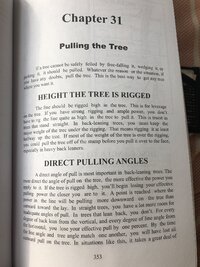
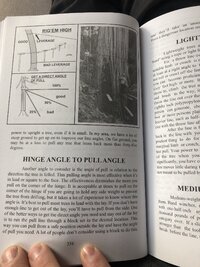
Pull Rope Height - what is optimal?

With faith in the hinge I guess you could pull substantially off axis to clear the two trees from each other's canopies. Agreed with said caveat. Or two pulls from equally out to the side trees could also work.

Or are you referring to a 90 degree control rope plus off axis pull? practical insurance style.
 
I have placed two lines in one or two trees to get the best of both worlds - a high one and a above-gravity-center one.
two lines, anchor points and machines used here


this one needed a 2:1 MA natural crotch with compensation pull.. 4WD 2500 pickup, moving downhill on grass. Notice the driver hesitates so as not to break the pull line... He knows what he's doing.. he was giving the tree and hinge fibers time to move/stretch/rupture before adding more load.

 
For those using a redirect to solve the swat zone of the top, e.g. a pulley anchored to a tree trunk in the direction of fall, wouldn't the top hit the trunk? Unless it was already far enough away that a redirect wasn't so needed?

Tree's gotta fit between self and pull point always, no?

Dan, you got the same numbers as me (same formula, well of course!) minus rounding error. Wanna try fixed L (attachment height in tree) and vary the base (distance from tree to winch) which causes theta (rope angle from horizontal) to also vary?

edit - is it as simple as L constant, find theta atan(L/base), then cos(theta) does all the torque reduction
It’s pretty easy to avoid slapping the block. Obviously pulling in the direction of the lay is ideal, this includes anything within 10 degrees to the lay.
Frequently one can get 45 degrees on some trees with a good sawyer.
Rarely are leaning trees like limp asparagus, they mostly might have a back lean with some crown weight or sweep to one side or the other. Many times this can be accounted for at the stump with the saw.
We are pretty lucky here and frequently have the option of pulling things over
 
I try to avoid:

1.) Putting the rope below the center of gravity, to avoid yanking the bottom out if the hinge has to be thin or otherwise weak.

2.) Putting the rope so high that the top breaks.

3.) Putting the rope so high that I loose a bit of directional control that I get from the longer sustained pull associated with putting the rope lower when the hinge is less likely to independently control the directional path of the fall.

4.) Putting the rope too low and thus missing out on the tipping force from having it higher.

Each tree has a sweet spot for the goals you want to prioritize.

I have placed two lines in one or two trees to get the best of both worlds - a high one and a above-gravity-center one.

One was a big dead oak of uncertain seasoning and a hollow stump with slight back lean towards a house. I had wedges and a jack on that as well. Imagine if I had jacked the tree off the hinge and had only a single rope placed below the center of gravity to maximize control of the direction... I ended up using a bit of each of my four force appliers to delicately get the tree vertical, then had the ropes pulled hard, simultaneously, while chasing them with the wedges and jack in case the ropes were not enough or the top shattered, leading to some form of sitback. The drop went very well and I felt overly cautious in retrospect. The top rope was 9/16ths on a grcs. The lower rope was 3/4" redirected to a 4wd forward hook, pulling in reverse.
I’ve rarely used two pull lines, but that is the beauty of that yarder when I worked with it. One person can work both drums, pulling or giving slack or allowing free spool.
You nailed describing the sweet spot. Knowing your species and reading the tree. Doug firs are very forgiving and I’ve seen back leaners with high pulling points bend like a fishing pole, and once over center start straightening out, then when gravity starts winning bend the other direction on its ‘whoosh’ to the ground.
Big leaf maple and alder are entirely different animals, where power and speed are more important due to much more brittle wood. Just have to take the weight and cut them up before a non jerking fast hard pull. These will break hinge well before over center if pulling slow, and if left too thick will barber chair.

You brought up a very important point of the step cut, often it’s a good idea to step more than head leaners. Blocking out the apex of the face can give a little more holding too.
 
For those using a redirect to solve the swat zone of the top, e.g. a pulley anchored to a tree trunk in the direction of fall, wouldn't the top hit the trunk? Unless it was already far enough away that a redirect wasn't so needed?

Tree's gotta fit between self and pull point always, no?

Dan, you got the same numbers as me (same formula, well of course!) minus rounding error. Wanna try fixed L (attachment height in tree) and vary the base (distance from tree to winch) which causes theta (rope angle from horizontal) to also vary?

edit - is it as simple as L constant, find theta atan(L/base), then cos(theta) does all the torque reduction
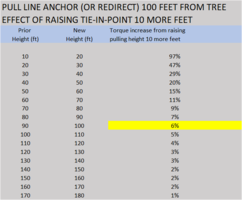
How much benefit will I get if I climb up an extra 10 feet to set the pull line?
Or,
If I can install the pull line with my pole saw at 20', how much benefit do I get by climbing or using throw ball instead?

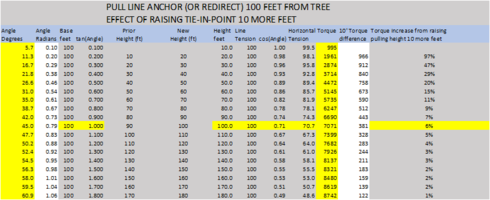
The attached spreadsheet answers the question: how much more torque will I get if I raise ten more feet the tie-in-point for the pull line?
Since I've assumed a 100' distance from tree to anchor, this can be read as percentages.
- If anchor is 60' from tree then how much extra torque is achieved for every 6' increase in height of tie-in-point?
- If anchor is 150' from tree then how much extra torque is achieved for every 15' increase in height of TIP?

One picture shows the practical chart.
The more detailed picture shows details so someone can verify my calculations.
 

Attachments

  • Pull line 10-foot rises.png
    Pull line 10-foot rises.png
    8.4 KB · Views: 11
  • Pull line 10-foot rises - data check.png
    Pull line 10-foot rises - data check.png
    12.9 KB · Views: 10
Last edited:
For those using a redirect to solve the swat zone of the top, e.g. a pulley anchored to a tree trunk in the direction of fall, wouldn't the top hit the trunk? Unless it was already far enough away that a redirect wasn't so needed?

Tree's gotta fit between self and pull point always, no?

Dan, you got the same numbers as me (same formula, well of course!) minus rounding error. Wanna try fixed L (attachment height in tree) and vary the base (distance from tree to winch) which causes theta (rope angle from horizontal) to also vary?

edit - is it as simple as L constant, find theta atan(L/base), then cos(theta) does all the torque reduction
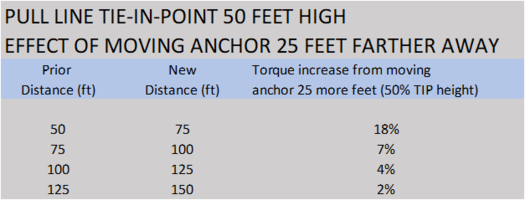
Bart's specific suggestion was eye-opening.
How much does anchor distance from the tree matter?
Not much!!

If tree is 100' tall -- with TIP at 50' -- and anchor a minimum safe distance away of 100' -- moving the anchor back another 50' only increases the pulling torque 6%.

In other works, get your anchor a SAFE DISTANCE away, and it's not worth the effort to find a more distant anchor.

On the other hand, with anchor (or redirect) closer than TIP height, torque is greatly decreased.
 

Attachments

  • Pull line anchor distance increase.png
    Pull line anchor distance increase.png
    6.3 KB · Views: 4
  • Pull line anchor distance increase - data check.png
    Pull line anchor distance increase - data check.png
    8.1 KB · Views: 6
Last edited:
I figured as much but thought the masses would appreciate it being laid out in a table. Bit of myth busting one might say. You caught the trick with theta where because the trunk is 90 degrees the rope angle above ground is the same as the rope angle off perpendicular at the pull point? Bit of serendipity there.

I got the impression that going higher on the trunk had a more rapid onset of less usefulness than trying to decrease theta by using a longer "base". Maybe because advancing the vertical point is way more PITA than walking further away.
 
Ok who wants to try the ugly math of best angle theta for a fixed length rope? My bet's on 45 degrees (base = L) and other angles being worse. I say this because you don't have the extra rope to increase L up the tree to get that gain like in the OP question case and in the less than 45 degree cases you're directly losing L below original 45 degree L even though base and cos are making contributions. twist - but there will be limited L gain above 45 with the limit Lnew = rope length but 90 degree theta makes a zero torque!

pythagorus or trig functions? need at least one trig cos theta for torque vector effect
 
Ok who wants to try the ugly math of best angle theta for a fixed length rope? My bet's on 45 degrees (base = L) and other angles being worse. I say this because you don't have the extra rope to increase L up the tree to get that gain like in the OP question case and in the less than 45 degree cases you're directly losing L below original 45 degree L even though base and cos are making contributions. twist - but there will be limited L gain above 45 with the limit Lnew = rope length but 90 degree theta makes a zero torque!

pythagorus or trig functions? need at least one trig cos theta for torque vector effect
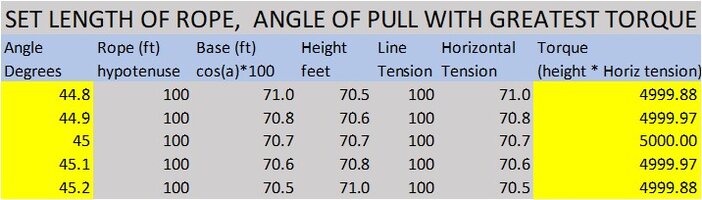
Your intuition is again correct.
If rope length is limiting factor, then 45 degrees produces the greatest torque.

Over the last two days, during my vacation, I put down six trees for a retired missionary friend. Four were pulled against the lean with a rope and Maasdam rope puller. This discussion was very helpful in theory.

Most important decision, however, was how high I could attach rope to tree and still have tie-in-point strong enough to pull and not break.
 

Attachments

  • Optimim torque with set rope length.jpg
    Optimim torque with set rope length.jpg
    35 KB · Views: 9
Last edited:
2/3rd the height of the tree has been the rule of thumb based on the books I’ve read: the exercises I’ve seen here seem to support this, with the new understanding that there are Diminishing returns past 45 degrees.

In my experience, providing the stem will support the tie-in point forces, this 2/3rds rule has been sufficient.


I buy 200’ & 250’ pull lines for this reason as trees around here are basically never more than 120’ tall & that allows adequate distance away from the tree. With the 200’ section, mechanical advantage is aided with hydraulic or truck adder.

The 250’ gives enough extra length for redirects & manual 5:1 M/A if there isn’t enough room in the work zone for a truck or tractor.


My experience, 5/8” Stable Braid does wonders with 100’ tall ~30” DBH Pine, Oak, & Gum trees.

Poplars on the other hand must be trusted almost never due to their typical bottom rot. 1 insurance claim in 7 years taught me this hard & expensive lesson. Remove all side loading on a poplar: do not risk the side-loading of a big poplar near any structures.


This math is amazing however there are no hard fast rules, & each tree must be assessed & the methods adjusted per the as-found conditions.


Sent from my iPhone using Tapatalk Pro
 
Safe height depends partially on the lean to overcome, hinge suppleness/ brittleness, hinge thickness, and hinge width (gutting the hinge means less force to bend the hinge.
 
  • Like
Reactions: evo
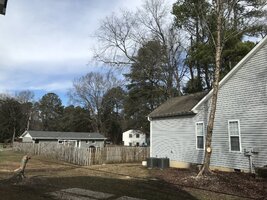
Been following along, snapped this photo just because this was an annoying scenario. Ground was absolutely saturated. River birch with lean towards front house corner. Not huge, but if the hinge failed it would certainly hit the neighbors house. Too much lean to comfortably hand pull and did not trust the machine to keep traction (also ground damage).I’m worthless with a wedge so I wasn’t going to try that here. Only place to redirect was this stump. Angle was not well enough against the lean. Vetoed the fell and just climbed the thing after entirely too much deliberation . Height of pull line was about 2/3. Base anchored. This view is during a pretensioning test pull6F505EF9-1601-4386-A1A8-2D57CB3F2AEE.jpeg
 
It's been a snowy day, so I thought I would write this problem up. WARNING!! There's lots of math.

The result surprised me a little. You can get 80% of the torque possible by pulling at 27 degrees. For a 100 ft rope, this translates to a height of 45 ft. Go figure...

 

Attachments

Last edited:
Been following along, snapped this photo just because this was an annoying scenario. Ground was absolutely saturated. River birch with lean towards front house corner. Not huge, but if the hinge failed it would certainly hit the neighbors house. Too much lean to comfortably hand pull and did not trust the machine to keep traction (also ground damage).I’m worthless with a wedge so I wasn’t going to try that here. Only place to redirect was this stump. Angle was not well enough against the lean. Vetoed the fell and just climbed the thing after entirely too much deliberation . Height of pull line was about 2/3. Base anchored. This view is during a pretensioning test pullView attachment 91887
You easily had that.... even with hand pull, as long as you put 3:1 MA system
 
It's been a snowy day, so I thought I would write this problem up. WARNING!! There's lots of math.

The result surprised me a little. You can get 80% of the torque possible by pulling at 27 degrees. For a 100 ft rope, this translates to a height of 45 ft. Go figure...

That is more in line with my original thought process. Thanks Keeth, really appreciate the math!
- Patrick
 
Keeth, I want to buy and drink whatever brand of coffee you drink that let's you produce such excellent writing and publishing quality!

Dan, on further pondering it dawned on me that for the ugly third case, constant rope length, Pythagoras is trig - cos sq + sin sq = 1!! What got me was losing the convenient inter-case reference of either fixed base or fixed height (L) because they both change. But then I said to myself just inter-reference at 45 deg for all three case graphs. Rope (hypotenuse) just becomes base / cos45 or 1.414 x base. First time rope length was actually cared about.

I got torque arm is (constant 1.414 x base) x sin(theta) or call it Lnew
and perpendicularity for torque is again cos(theta)

so it differs from the OP fixed base case by being sin(theta) x cos(theta) rather than tan(theta) x cos(theta) IIRC
and sinxcos ought to have a bump at 45 degrees

I call it rock n roll math.
 

New threads New posts

Kask Stihl NORTHEASTERN Arborists Wesspur TreeStuff.com Teufelberger Westminster X-Rigging Teufelberger
Back
Top Bottom