Muggs
Been here much more than a while
- Location
- Canuckistan
No, not if you are using a sideways deflection. Would feel dangerous to stay that close yourself, but a redirect would be fine...Tree's gotta fit between self and pull point always, no?
Follow along with the video below to see how to install our site as a web app on your home screen.
Note: This feature may not be available in some browsers.
No, not if you are using a sideways deflection. Would feel dangerous to stay that close yourself, but a redirect would be fine...Tree's gotta fit between self and pull point always, no?

two lines, anchor points and machines used hereI have placed two lines in one or two trees to get the best of both worlds - a high one and a above-gravity-center one.


It’s pretty easy to avoid slapping the block. Obviously pulling in the direction of the lay is ideal, this includes anything within 10 degrees to the lay.For those using a redirect to solve the swat zone of the top, e.g. a pulley anchored to a tree trunk in the direction of fall, wouldn't the top hit the trunk? Unless it was already far enough away that a redirect wasn't so needed?
Tree's gotta fit between self and pull point always, no?
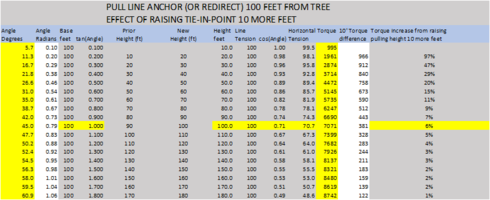
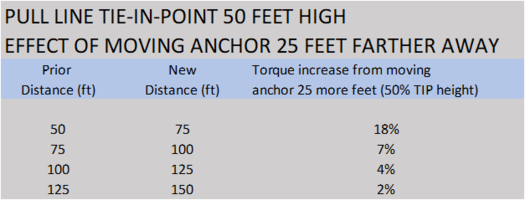
Dan, you got the same numbers as me (same formula, well of course!) minus rounding error. Wanna try fixed L (attachment height in tree) and vary the base (distance from tree to winch) which causes theta (rope angle from horizontal) to also vary?
edit - is it as simple as L constant, find theta atan(L/base), then cos(theta) does all the torque reduction
I’ve rarely used two pull lines, but that is the beauty of that yarder when I worked with it. One person can work both drums, pulling or giving slack or allowing free spool.I try to avoid:
1.) Putting the rope below the center of gravity, to avoid yanking the bottom out if the hinge has to be thin or otherwise weak.
2.) Putting the rope so high that the top breaks.
3.) Putting the rope so high that I loose a bit of directional control that I get from the longer sustained pull associated with putting the rope lower when the hinge is less likely to independently control the directional path of the fall.
4.) Putting the rope too low and thus missing out on the tipping force from having it higher.
Each tree has a sweet spot for the goals you want to prioritize.
I have placed two lines in one or two trees to get the best of both worlds - a high one and a above-gravity-center one.
One was a big dead oak of uncertain seasoning and a hollow stump with slight back lean towards a house. I had wedges and a jack on that as well. Imagine if I had jacked the tree off the hinge and had only a single rope placed below the center of gravity to maximize control of the direction... I ended up using a bit of each of my four force appliers to delicately get the tree vertical, then had the ropes pulled hard, simultaneously, while chasing them with the wedges and jack in case the ropes were not enough or the top shattered, leading to some form of sitback. The drop went very well and I felt overly cautious in retrospect. The top rope was 9/16ths on a grcs. The lower rope was 3/4" redirected to a 4wd forward hook, pulling in reverse.

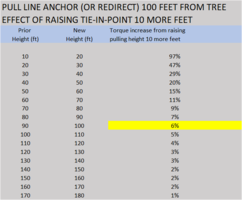
How much benefit will I get if I climb up an extra 10 feet to set the pull line?For those using a redirect to solve the swat zone of the top, e.g. a pulley anchored to a tree trunk in the direction of fall, wouldn't the top hit the trunk? Unless it was already far enough away that a redirect wasn't so needed?
Tree's gotta fit between self and pull point always, no?
Dan, you got the same numbers as me (same formula, well of course!) minus rounding error. Wanna try fixed L (attachment height in tree) and vary the base (distance from tree to winch) which causes theta (rope angle from horizontal) to also vary?
edit - is it as simple as L constant, find theta atan(L/base), then cos(theta) does all the torque reduction
Bart's specific suggestion was eye-opening.For those using a redirect to solve the swat zone of the top, e.g. a pulley anchored to a tree trunk in the direction of fall, wouldn't the top hit the trunk? Unless it was already far enough away that a redirect wasn't so needed?
Tree's gotta fit between self and pull point always, no?
Dan, you got the same numbers as me (same formula, well of course!) minus rounding error. Wanna try fixed L (attachment height in tree) and vary the base (distance from tree to winch) which causes theta (rope angle from horizontal) to also vary?
edit - is it as simple as L constant, find theta atan(L/base), then cos(theta) does all the torque reduction
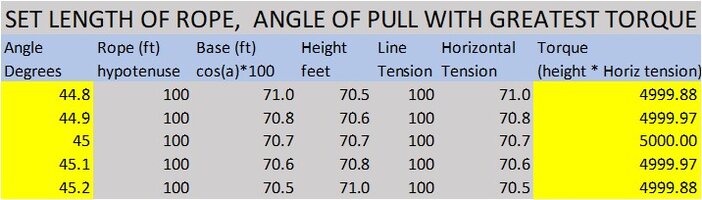
Your intuition is again correct.Ok who wants to try the ugly math of best angle theta for a fixed length rope? My bet's on 45 degrees (base = L) and other angles being worse. I say this because you don't have the extra rope to increase L up the tree to get that gain like in the OP question case and in the less than 45 degree cases you're directly losing L below original 45 degree L even though base and cos are making contributions. twist - but there will be limited L gain above 45 with the limit Lnew = rope length but 90 degree theta makes a zero torque!
pythagorus or trig functions? need at least one trig cos theta for torque vector effect

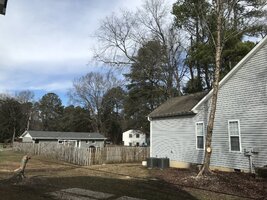
You easily had that.... even with hand pull, as long as you put 3:1 MA systemBeen following along, snapped this photo just because this was an annoying scenario. Ground was absolutely saturated. River birch with lean towards front house corner. Not huge, but if the hinge failed it would certainly hit the neighbors house. Too much lean to comfortably hand pull and did not trust the machine to keep traction (also ground damage).I’m worthless with a wedge so I wasn’t going to try that here. Only place to redirect was this stump. Angle was not well enough against the lean. Vetoed the fell and just climbed the thing after entirely too much deliberation . Height of pull line was about 2/3. Base anchored. This view is during a pretensioning test pullView attachment 91887
That is more in line with my original thought process. Thanks Keeth, really appreciate the math!It's been a snowy day, so I thought I would write this problem up. WARNING!! There's lots of math.
The result surprised me a little. You can get 80% of the torque possible by pulling at 27 degrees. For a 100 ft rope, this translates to a height of 45 ft. Go figure...