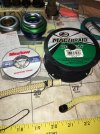
Prusik cord by the foot question..

I prefer HMS biners on my lanyards (personal preference, no actual reason) but on my hitch climber system I just like to use ovals.
Having said that, I really love the DMM Phantom HMS as a compact HMS biner, the thing is freaking tiny. It fits the holes of the HC no problem but I'm not sure it's large enough for a full on rope wrench setup, it's PerfectO size.
 
I prefer HMS biners on my lanyards (personal preference, no actual reason) but on my hitch climber system I just like to use ovals.
Having said that, I really love the DMM Phantom HMS as a compact HMS biner, the thing is freaking tiny. It fits the holes of the HC no problem but I'm not sure it's large enough for a full on rope wrench setup, it's PerfectO size.
Oh alright thanks..just wondering for the hc and prusik cord with double fisherman's knots. I guess they pretty much fit on the ovals. Little tight. And i dont have my wrench anymore sold it to a buddy. So i dont really need a hms. But wanted to check em out. Ill check out that biner tho. Thanks
 
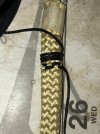
Start by leaving the tape on to hold the cover together. Go down the length you want and pick a strand and go under or through every other one around the cord at the same level, and sew around once more to cover the gaps, this keeps it from being pulled off. One end of twine is used to sew core to cover, needed if the cover has been relaxed for a stiff cord. Relaxing is removing a small length of core and milking extra cover to the middle. The other end wraps around up to the tape and is sewn again just one time around, usually. Cut the end off and you can stop here and melt together, or continue to cap the end also, this helps with tying when the ends are passed through itself.
Usually use poly whipping twine, but nylon works, but melts at slightly lower temp. For melting, use lowest heat possible, or twine will sepatate. Cosmetic corrections can be made by melting small pieces of twine were needed. If not melted together enough can separate in use, but easily repaired.
08C6564F-3978-4DF4-B4D4-BF0D3C44362D.jpeg
D18A0B44-6D99-4C25-9855-F407FBBD7231.jpeg
 
Hey brocky..can you give me the run down on what a beginner splicer would need to get into splicing. I dont know where to start. I wanted to try to make my own eyes on hitch cord. And if successful be able to make my tight eyes or swen for climbing lines

And while on that thought ive been curious if i could sew my eyes for my hitch cord? Idk
Start by leaving the tape on to hold the cover together. Go down the length you want and pick a strand and go under or through every other one around the cord at the same level, and sew around once more to cover the gaps, this keeps it from being pulled off. One end of twine is used to sew core to cover, needed if the cover has been relaxed for a stiff cord. Relaxing is removing a small length of core and milking extra cover to the middle. The other end wraps around up to the tape and is sewn again just one time around, usually. Cut the end off and you can stop here and melt together, or continue to cap the end also, this helps with tying when the ends are passed through itself.
Usually use poly whipping twine, but nylon works, but melts at slightly lower temp. For melting, use lowest heat possible, or twine will sepatate. Cosmetic corrections can be made by melting small pieces of twine were needed. If not melted together enough can separate in use, but easily repaired.
View attachment 72256
View attachment 72257
 
Wire fids can be used for a lot of splices, tubular fids make passing the core through itself easy, but many less expensive substitutes can be used. Ceramic knife works best for hi tech cords and ropes. For hand sewing, look up the thread Moss started in the Splicing Forum, he has nice instructions and what materials to use.
 
Thanks @Brocky very helpful. I will have to try that sewn whipping sometime.

What is the method you use for capping the end?
The twine is wrapped circularly from the outside to the middle, a little at a time, fusing as you go. A soldering gun, or similar is definitely needed.
 
Wire fids can be used for a lot of splices, tubular fids make passing the core through itself easy, but many less expensive substitutes can be used. Ceramic knife works best for hi tech cords and ropes. For hand sewing, look up the thread Moss started in the Splicing Forum, he has nice instructions and what materials to use.
Ok thanks
 

New threads New posts

Kask Stihl NORTHEASTERN Arborists Wesspur TreeStuff.com Teufelberger Westminster X-Rigging Teufelberger
Back
Top Bottom