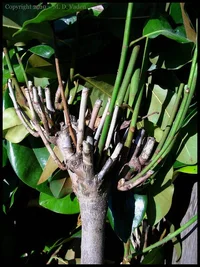
Pruning Magnolia grandiflora

guymayor

Branched out member
Location
East US, Earth
This spins off from the epicormic thread:

RH A bit of dogma that's been floating around in my head for a couple years: "M. grandiflora compartmentalizes wounds and closes wounds poorly." Your posts on the species are making me wonder otherwise.

I have a dozen or so young M. grandiflora planted on our campus, and understanding how to do structural pruning on them is kind of baffling, and Gilman's textbook doesn't touch on the species much. Add the above dogma, and I'm almost afraid to look at them...

Any links or books with relevant info on the topic?

gpm Cass Turnbull's Guide to Pruning despite her unfortunate bias against them has very good info p 253-5. She reports the opposite, with which I agree--these codit very well. Buy this book--she is gifted in this area for sure Downplay those tolerance lists--so few arborists contribute to those
mad.gif
that they are not too accurate.

George Brown's book has precious little on them. A word on training a single leader which is obviously preferred. He and Bird and Tanner all talk about training these up walls; must be a british thing.

Post some pics and we'll take a virtual whack at them. The species is highly trainable when necessary, but like many trees it's best to avoid big cuts. Less is more, as they say. Retaining lower branches is key with these, for beauty and stability and...otherwise they will be considered a litter nuisance, as they drop leaves 365 days a year.
 
For some reason, I find those particularly fun to prune. They are a big brittle, so occasional snow or ice does a bit extra damage now and then.

It seems that extra stem growth I see in these here more often than not, could be described as reiterated stems or sprouts, and not so much what I'd describe ad "epicormic".

If the leaves were not so big and leathery laying on the ground, I'd probably have one. They grow very well here.
 
I'll get some pics post holidays - I'm taking vacation for a couple weeks.

Good to know about Cass Turnbull - I'll check her out. I agree that Brown has little helpful info on them. When I checked in with his book, I walked away even more confused since most of the trees I've got, which are relatively new nursery stock (planted within the last 4 years) seem to be covered with multiple leaders. I understand subordination, but the crowns of these trees seem to follow some different "rules", if you will.

Add to the mix a mighty specimen on the Agnes Scott campus in Atlanta/Decatur, GA with one of those lateral turned leader growing 6' up off the main trunk with the girth of a Subaru that seemed to defy every law of physics...and...it seems like I need to throw everything I know about structural pruning out the window before I start cutting.

The glass just keeps getting darker.

Pics later on. Thanks!
 
Usually, the evergreen magnolia that I encounter are either neglected, which I much prefer, or, topped.

The one below is one of a dozen extra stems thinned this year. Its going to take 3 or 4 years to improve that mess.

Every stem top was like this.

258839-Magnolia_Topped_600.jpg
 

Attachments

  • 258839-Magnolia_Topped_600.webp
    258839-Magnolia_Topped_600.webp
    91.6 KB · Views: 55
Guy,
In my experience and observations with a very common landscape tree here in the south:

M. grandiflora NEEDS to be left "full to base". The self muching, shading and elimination of competition in their dripline is critical to their success. Turf competition is guaranteed trouble.

A good compartmentalization and callus/woundwood response to reasonable pruning doses and cut sizes. I have, however, seen large cuts still open with strong decay decades after they are inflicted, e.g. "limb-up" operations.

Fairly strong tendency to epicormic sprouting after pruning of vigorous stems, dieback easy to cause in suppressed/less vigorous parts.

The more decurrent cultivars such as 'Claudia Wannamaker' and 'Little Gem' respond poorly to attempts to narrow shape once established, yet as your reading indicated, can be trained as handsome espaliers.

In my opinion, "less is more", for sure.
 
Robert, some of those "wolf" limbs, imo ya just gotta let em go; too strong a nature to fight.
Actually Cass' magnolia piece was an article in TCI back in 2001. O and if most of your trees have been in 4 years, that sounds like a boring job for a climber!

Mario, the guy who did that should have his shears tossed in a lake. Makes me think there should be a shatreea law system where the perp topper gets his arm cut off; or his head, just like he did to the tree. On your pic maybe the target is one node below that mess, and start over.

atlas, agree on all. They are so ugleee when suddenly raised and hollow out like that.
 
[ QUOTE ]


Mario, the guy who did that should have his shears tossed in a lake. Makes me think there should be a shatreea law system where the perp topper gets his arm cut off; or his head, just like he did to the tree. On your pic maybe the target is one node below that mess, and start over.

[/ QUOTE ]

Great suggestion Guy.

Because the back yard of that home slopes right down into the lake behind it.
 
[ QUOTE ]
O and if most of your trees have been in 4 years, that sounds like a boring job for a climber!


[/ QUOTE ]

Indeed! I meant that our M. grandiflora specifically have only been in for 4 years...No mature specimens, but I've got several 80+ year old Tsuga canadensis and Picea Abies and an assortment of mature oaks and A. rubrum to keep me off the ground...
applaudit.gif


If you're curious, the campus where I work was originally a hotel built in 1929: http://www.hctgs.org/Photos/lookout_hotel.jpg
We don't have a lot of the original landscape trees, but the ones that have held up over the years are magnificent.

Man, I'm kind of bad about the derails...sorry...
 

New threads New posts

Back
Top Bottom