Promoting Crossing & Rubbing Branches

mdvaden

Participating member
This is a duplicate topic of one I posted on the UK forum.

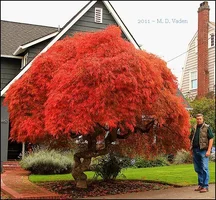
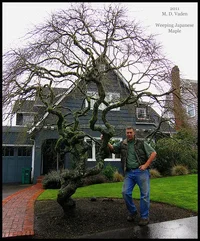
Last week, I pruned a very old weeping Japanese maple again: first time was about one year ago. One thing that makes it so attractive are the twisting and crossing branches.

I found that for the first time ever, I started to purposely leave twigs that I normally would have removed. The difference being, these were saved because they are headed back towards the interior, or other branches that they will touch and rub against in a few years.

It seemed like the best way for the next 40 years worth of growth, to match the past 80 or so years worth of growth.

This would be completely opposite how most pruning books teach to do pruning.

In the past, I have retained crossing and rubbing branches. The difference in this case, was recognizing where twigs are pointed with the intent of causing a lot more rubbing and crossing.

From here on out, I plan to do this more often with smaller trees too, depending on what the trunk and branch structure looks like when I start working on it.

310132-270990-oregon_maple_pruning_600.jpg
 

Attachments

  • 310132-270990-oregon_maple_pruning_600.webp
    310132-270990-oregon_maple_pruning_600.webp
    174.7 KB · Views: 40
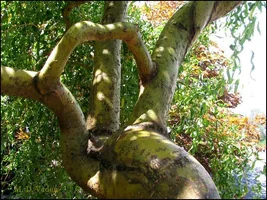
This below, is from a different tree. A willow.

Although this kind of fusing (inosculation) is contrary to what most pruning books teach and promote, I think the crossing and self-fused limbs are far more interesting to look at.

310134-graft_inosculation_600.jpg
 

Attachments

  • 310134-graft_inosculation_600.webp
    310134-graft_inosculation_600.webp
    91.4 KB · Views: 26
Wow!

My thinking on cutting out rubbing branches changed after an ice storm a number of years ago. There were some rubbing limbs with cracks in them that had to be removed. I had the groundies cut off the rubbed spots and save them. That night I used my bandsaw to dissect them along the pith, radially and in disks. By doing this I could see how the CODIT patterns formed. In almost EVERY case there was very little decay. On some of the rubbing areas about 30% of the circumference of the limb was rubbed bare...with almost no discolored wood.

I thought about this and talked with other arbos. We all concluded that cutting away rubbing branches, just 'cuz they're rubbing and no other reason, needs to be questioned.

Now, if there is a rub I need a few more reasons to even consider removal. It is not a death cut to the rubbing limb.

Good plan, look to the future needs of the tree. Keep more growth low and inside.
 
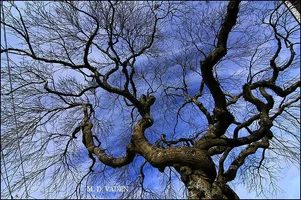
Looking straight up with a wide angle lens.

Lots of progress to make yet, regarding getting those twigs to come back through the midst.


cool.gif
310144-Jap_Maple_Sky_800.jpg
 

Attachments

  • 310144-Jap_Maple_Sky_800.webp
    310144-Jap_Maple_Sky_800.webp
    225.7 KB · Views: 20
I like this.

On ornamental pruning I admit that I have often removed inwardly crossing small stuff just because I thought it was not aesthetic. I may re-visit that notion.

We rarely remove large branches that are crossing and rubbing at our company because we believe the new wound would be worse than what the tree is already dealing with (if it is indeed a 'bad' thing at all). Especially if both limbs are healthy and filling in different parts of the canopy.
 
Sun exposure and sun requirements come into play. If it'll get shaded out then why leave it. Inosculation can be forced by scraping bark and bracing.

Even if codit is working now on those rubbed branches, when the tree loses its juice those walls can come tumbling down. Better to graft/inosculate?
 
[ QUOTE ]
Sun exposure and sun requirements come into play. If it'll get shaded out then why leave it. Inosculation can be forced by scraping bark and bracing.

[/ QUOTE ]

Yes ... that's why yearly pruning can come into play.

Why leave it, would be so the upper canopy gnarl and twisted branch appearance more closely resembles that of the lower canopy where it is that way already.

cool.gif
 
[ QUOTE ]
Last week, I pruned a very old weeping Japanese maple again: first time was about one year ago. One thing that makes it so attractive are the twisting and crossing branches.

I found that for the first time ever, I started to purposely leave twigs that I normally would have removed. The difference being, these were saved because they are headed back towards the interior, or other branches that they will touch and rub against in a few years.

It seemed like the best way for the next 40 years worth of growth, to match the past 80 or so years worth of growth.

This would be completely opposite how most pruning books teach to do pruning. (Bob W's emphasis.)

In the past, I have retained crossing and rubbing branches. The difference in this case, was recognizing where twigs are pointed with the intent of causing a lot more rubbing and crossing.

From here on out, I plan to do this more often with smaller trees too, depending on what the trunk and branch structure looks like when I start working on it.
[/ QUOTE ]

Mario,

Thank you for following your instincts and publicly explaining your own sense of stewardship with encouraging some natural progressions of grafting.

I am also pleased to find you an ally in implying that dogma (removing rubbing and crossing branches) is not as sure-footed as some insist.


Bob Wulkowicz
 

New threads New posts

Back
Top Bottom