Professional reference resources

Print off the test outline for that exam and focus on areas mentioned that you're weaker at first before jumping into all the stuff in this thread.

Boddy and Raynor are great, (and if mrtree ever comes back he'll first call me an ignorant hack and then suggest some even better reading) but they won't help much with that exam. I think there are a few "studying for bcma exam" threads on here already or you can always pm me sometime for suggested reading. ISA website has many for sale but the old Google Machine works well too
 
Last edited:
Oldies but goodies! From the 2006 piece: "Hardware installation The installation of hardware to support weak branch crotches and to reinforce cracked branches and stems has long been practiced. Individual trees that are in good condition and are of species that are naturally strong compartmentalizers effectively resist the loss of normal wood functioning and the spread of decay following the insertion of ‘dead-end’ screws and ‘through bolts’. However, hardware installation can breach compartmentalization boundaries and release previously compartmentalized infections, resulting in the spread of decay (kane and ryan 2002). Consequently, the whole tree needs to be considered prior to the decision to install supporting hardware."

Screws and bolts are often 1/2" or 1" wide, but through-cabling with end fasteners involves much smaller holes. Ergo, modern supporting hardware entails less wounding and decay. Just an update. :)
 
Gilman's Illustrated Guide to pruning has probably been mentioned in this thread already. It's pretty expensive, even Member pricing from ISA.

However, look on Amazon first!!!

Going for around $90 right now.
 
  • Like
Reactions: ATH
I paid $97 on Amazon last fall. I've since learned about camelcamelcamel which is a site where you can see pricing history and set alerts when something you can wait for drops to a certain price. Looks like it has bounced around quite a bit... $90 is a "good" price for the book.
 
God forbid we kill a few Honey bees or Earthworms introduced from Europe, while patriotically protecting a critically endangered American Hardwood from its species functional extinction event. Caused by mans untimely introduction of Asian Jewel "Phloem borer" beetle. Fatally killing off one of his best Urban surviving Parkway species. Killing Bee's just because a professional Arborist fails to take State pesticide application test, and continues to improperly apply General use Imidacloprid. Instead of safely trunk injecting Tree-age, well proven not to affect non target Bug species. One must remove flowering plants at base of drenched tree, that's only way Bee's targeted. India's Neem tree produced Azadirachtin, a natural Larvaside available as Tree-azin & Aza-sol which lasts one year.

Imidacloprid, even if trunk injected...must be applied by end of April, since only kills Adult leaf feeders and borers first two smaller instar stages. Already EAB damaged trees over age 35 require trunk injection of 99%, god-sent Tree-age. Undamaged trunk tissue for drilling found under soil line. Damaged trees produce thinner growth rings, and target depth is last three years of xylem. Drill slow as to not heat up bit, which will cauterize tissue and block uptake. Dose rates rise with trees size. Open hand width or less measured between each hole. Watch Ash trees from August to just before true fall in your area, as any branches or limbs loosing leaves early will not come back next spring. Sides of tree loosing leaves earlier and earlier each year, reveal direction borers flying in from. So properly treated trees should have whole crown turn color and drop leaves within same two weeks.

Full dose of Tree-age only works 3 years during very early stage of local event, before borer populations exponentially build to iconic "4 year curve of death" stage. Chicago proved 3 year applications work within city treatment zones, where all public trees trunk injected for average $30 cost are turned into "Big EAB bug Zappers" that lower borer populations so much...private untreated trees survive 3-6 years longer.

Related to super long lived Olive trees, alive 2000 years after planted. Green Ash matures from 180-220, and can stand for 300 years. White Ash matures between age 350 and 450, and documented living 600 years. Remember, only unprotected trees die from EAB! Danger from damaging Borer "Infestation" populations inevitably passes locally within 12-15 years, after that full dose applications no longer required. Borers do not "Infect" or disease Ash, like Dutch Elm does. Learn from a huge towering forest of facts in order to become your communities most knowledgeable Ash tree/EAB expert, by checking out my Scottie Ash Seed blog_ https://scottieashseed.wordpress.com/
 
Last edited:
Forgot this thread existed. Will add resources as I find them. Just bought:
Macrofungi Associated with Oaks of Eastern North America by Denise Binion

Another good fungi one (though, not focused on tree care/tree decay - but still a good reference):
Mushrooms of West Virginia and the Central Appalachians by: William C. Roody.

surprised nobody has listed (that I have seen) Chris Luley's Wood Decay Fungi (looks like he has a list of publications available in pdf

What do ya'll think of Pirone? I have found Diseases & Pests of Ornamental Plants to be helpful. I haven't read Pirone's Tree Maintenance. Is it worth the read?

Also on my list, but don't own:
Caterpillars of Eastern North America: A Guide to Identification and Natural History (Princeton Field Guides) by David Wagner.
 
Yeah it's a beast but not organized well for sure.

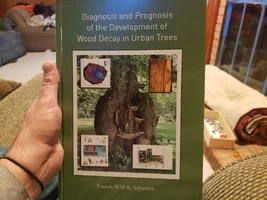
Luley's book is OK asna quick reference but Schwarze is way better, though a MUCH more difficult read.

Haven't read Pirone.

There is a good link or pdf on here for fungi of the eastern US I believe. I need to check out that oak fungi reference
 
Forgot this thread existed. Will add resources as I find them. Just bought:
Macrofungi Associated with Oaks of Eastern North America by Denise Binion

Another good fungi one (though, not focused on tree care/tree decay - but still a good reference):
Mushrooms of West Virginia and the Central Appalachians by: William C. Roody.

surprised nobody has listed (that I have seen) Chris Luley's Wood Decay Fungi (looks like he has a list of publications available in pdf
I read Pirone. It's ok but Harris, Clark, and Matheny is significantly better

What do ya'll think of Pirone? I have found Diseases & Pests of Ornamental Plants to be helpful. I haven't read Pirone's Tree Maintenance. Is it worth the read?

Also on my list, but don't own:
Caterpillars of Eastern North America: A Guide to Identification and Natural History (Princeton Field Guides) by David Wagner.

I read Pirone. Probably not worth paying retail
 
Last edited:

New threads New posts

Back
Top Bottom