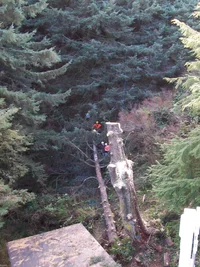
Procedure for trunk splitting?

another shot.

despite the cavity in the trunk, the tops were sound, and I didn't feel the bottom would collapse. Plus, obviously, I was using a bucket truck, so it's hardly even applicable to this thread, just thought i'd throw up a pic.
 

Attachments

  • 29328-bevbch3.webp
    29328-bevbch3.webp
    305.2 KB · Views: 158
Speelyei,
First let me say that if I offended you, I am sorry, that was not my intention.
I was trying to highlight the fact that you may have mis-intrepreted the scenario and that you seemed to imply that the well proven standardized techniques for rigging and work positioning for top removal as taught by many experts would not effectively work.
Here was the scenario by the original poster:
"One person had offered some ideas on topping and commented about the spar possibly splitting when topping a tree.
I have often wondered about this happening but never heard of it...anybody here have experience with a trunk splitting like that while lanyarded/roped into it? Or having a big limb tear down into/through a lanyard/climbing rope?"
And he asked if there were some standarized procedures to help prevent this.
He wasn't talking about the tree collapsing beneath him as you mentioned, but was talking about the trunk splitting into the lanyard.
So also, my purpose was to say that, Yes, there is some proven and standardized techniques, many of which were proven at a very high cost by the actual terrible peril of men's health or lives, so that we can learn from them and avoid their tragedy and deploy these techniques to minimize this occurring.--This is why the tragedies are not an everyday event, but the possibility of trunk splitting can occur easily without the use of the these good techniques and some knowledge of the rigging science.
So to say that these proven techniques are simply "some lanyard tie-in scheme" or just "psychological protection" and were of "dubious reliance" implied that they are ineffective in your opinion, which you are entitled to of course, but, these safety techniques are based on good science and well proven experiences which contradict your opinion and give honor to the men who paid dearly for their discovery.
 
Well, i think it's interesting that no one posted to say "Yeah, I had a tree split lengthwise vertically, good thing I wrapped my lanyard twice.." I think any body who has spent very much time dumping the tops out of trees, or taking large sections of trunk in one cut, has thought "what if" to themselves. You can't spend very much time doing that and not ask yourself, "what would I do?"

I guess my point was that the best method is to avoid such a dangerous situation. And that if it can't be avoided, maybe the job is unsafe under any circumstance.

While clearing ROW's in the coast range, we worked with a lot of Alnus Rubra, oregon alder. They're pretty brittle, alittle unpredictable, and have a predilection for growing at scary angles. I was working with several ex-loggers, and we were talking about barber-chair trees, exactly the kind of scenario you are talking about. One of the wilder guys grabbed the 066, sharpened it, and said he would demonstrate what happens so I would know what to do. He walked over to a 70' tree, about 28" DBH, growing at about a 60 deg angle. "Ya'll might wanna step back a little.." he said, and wound the saw up, and started cutting through
from the top/back, with no face. He cut in about a third of the way, and then there was a crack like a rifle shot. The tree split up about 30', with a jagged, lightning bolt crack, the top swayed sickeningly, and the guy jumped back and yelled, "Look first, then run!!" The tree kind of half peeled/rolled off the jagged splinter of what was left of the trunk, and as the top rolled and fell through the adjacent trees, it went an entirely different direction than what I expected. After the tree was down, I had ample time to look at the cut and the stump, and I'm telling you, that wrapping your lanyard or a false crotch is a darn shady way to protect yourself against that kind of thing. The tie in outlined by arbormaster et al is a pretty good idea, but I think they would say that it is a desperation move, and that you should minimizes the forces involved as much as possible before relying on it. I am pretty sure that even if the rigging techniques employed did save your life, the whole event would be so terrifying as to end your career.
Here's an idea though. You seem to have a lot of faith in this scientific rigging. Why not find a heavy head leaner, tie yourself in as you see fit, and dump that bad boy so he splits down beneath your feet? My guess is that you, like me, would do almost anything to AVOID this situation, even if it meant declining the job. Maybe not, though...I'll wait for the pics...
 
You guys have made some good arguments here. I like what I have read. Yes it is true that these types of conditions exist and they can be very hazardous. Some great men have unfortunately fallen to such conditions in order for us to better realize their potential. I would agree that they aren't a daily occurence, but if you don't consider the concept that it "may" occur you may be in serious trouble.

I am a firm believer that the proper cutting procedure can elimainate most of these situations- but there will be some that will still be present even so.

A good friend of mine was working in the woods doing line clearance on old growth (for us) where the setbacks were up'ed from 15' to 25' feet on transmission lines. This meant more removals and large limb cutting. Well we went day in and day out felling and "hacking" with no problems. One day in an old red oak he tried to jump a lead (14") off and was lanyarded to it when it split. I was in the tree next to him and another climber in the tree past him. We were both in horror when we saw the splitting. It was near -15*F with the wind everyday and that made it more brittle than usual. But, the point is that this was a "close-call" that happened to someone that I would call a sawman. He has learned cutting while logging with some pros and then worked with me in the tree care end. Very good with a saw. Even still, a close call.

Not sure if this helps the discussion, but it was a real experience that I wanted to share.

I would say that many of these trees that could split can be dealt with, but keep preparing for the one that may catch you by surprise and you will be much more successful at avoiding a real problem.
 
Well said Mark.
And thanks Speelyei, really, because we can all learn a great deal from you guys.
We all would avoid a dangerous situation by any means definitely like you said, but my question is (Speelyei), what do you do to protect yourself when lanyarded in at the top during a normal tree top removal so as not to get caught by surprise by the one that Mark talked about? --Not a heavy leaner, just a normal, healthy trunk.
P.S. The pics. were awesome.
P.P.S. Don't hold your breath for my pics. lanyarded to a splitter!-haha.
 
Let me preface by saying that I am not some hotshot or some guru. I'm not the boldest guy on the crew or anything like that. On a "normal" top removal, I just tie in with my lanyard and climbline and make the cut. I eye everything up carefully, first, and I almost always get a little adrenaline going, unless its pretty small. As far as the heavy leaners so far, I've avoided 'em. I've always been able to tie in to another tree, or shinny up with the pole pruner...knock on wood.
When it gets wierd, I try to make it as routine as possible. Sometimes I ve climbed 'em and whittled em down to where I could throw the top cut off by hand. Its laborious, but predictable. I think thats the thing that line clearance teaches you, is to mitigate circumstances, and make things as predictable as possible. You have to know where your cut is going, and that you can do it succesfully. If the top is too big, make it smaller, if it leans too much, tension off to another tree to make it more vertical. If I seriously thought the tree would barberchair, I would think maybe I wasn't the right guy for the job, because I was out of options. If you drop a limb on the greenhouse, you might get fired. If you drop a limb on the three-phase, you might get killed. I think the bore cut back-cut is a good technique, if the trunk is thick enough. I think a powerful, fast cutting saw is a must in that kind of situation too. The splitting is caused by the piece falling faster than the backcut can follow, so do it fast..

Here's a question for some of you guys though..
When removing a top, I size up which way it's going, make my cut, and once that piece is past about 45 deg, sometimes i'll cut almost all the way through the holding wood. To me, it seems that (barring interference from other trees, wedges, etc)once that piece is past 45, it's committed, there's not much more steering or benefit to keeping that strip of holding wood thick. By cutting the back cut almost all the way through, I avoid the catapulting action, and minimize tearing and splitting. I usually make my face cut a humboldt style, to help it slip off the top and minimize any chance of it trying to slide off the spar and sit in my lap. How thick do you leave the hinge in top removal, once the piece is committed to the direction you want it go?
 
Just from my two cents, that I use, which comes from the Arbormaster Art & Science of Practical Rigging, is to allow a hinge thickness of 5 to 10 percent of the tree's diameter.
They suggest to be flexible here, so for example if you're cutting short sections and thus the climber has limited leverage then 10% may be too much for the climber to handle. So a hinge of 5% would be in order.
So with this rule of thumb, I usually do about a one inch hinge thickness on a diameter of up to about 18", then go to about 1 1/2" over that up to about 30".
This is only on a small section of no lean type trunk.
Maybe someone else with more experience could chime in here.
 
[ QUOTE ]
How thick do you leave the hinge in top removal, once the piece is committed to the direction you want it go?

[/ QUOTE ]

As long as the piece is committed I'll stop cutting and take advantage of the time to put my saw back on the clip.
I was taught by one guy to leave the bottom cut in the face flat in a lot of situations, in other words the face is less than 90*. To make it pop off early.
Another foreman used to harp on me for making an undercut. He's said "No undercuts. When you want the peice to go, you just cut through fast, and finish it." I don't know if my saw was never sharp, or if I just didn't get the guy, but I never could find control that way. The piece would always hang on. I'll put a notch in almost everything.
 
Wait a sec I think I can pee the farthest. Prepairong for the worst. Is never a bad thought. Its better than just hopeing for the best.
 

New threads New posts

Back
Top Bottom