Practical planting tips for Landscapers

I've been working with a large and very well known locally, landscape design/install and garden center. They do the best work in the area that I have seen and we have a great relationship. Recently, I met with a client of theirs. All his trees that he had installed by this place, still had the wire baskets on. Not even the top loops cut off.
I had a long discussion with the owner today and his argument for leaving the baskets on was because as soon as you remove the basket some of the balls fall apart and they are difficult to keep upright or survive. He also argued that it just wasn't practical with the large amounts of large trees that they plant to take the chance on having the balls fall apart. Plus, he wanted to know how many trees actually develop root system problems from leaving the baskets on.
So my questions: To what extent does leaving the basket on impede with the trees root system and tree transplant success? What is practical to suggest to them on better planting techniques? I suggested at least removing the top foot.
 
Our local tree nursery has Sandy soil, which I prefer. The ball falls right apart. It is perfect. We pretty much plant b&b bare root. Even in the middle of the summer. Only lost one tree, I believe the homeowner drowned it.

Planting it with the ball "intact" is a terrible idea. IMO

Although our girdling root program finds pretty much every basket still intact. Unless it is planted 4' too deep. Then the tree is toast.
 
I dig a big enough hole so that once you get the tree in there using the wire basket as hoisting point, you can sneak your arms in there to cut the wire. Always get that wire off. Always.
 
... he wanted to know how many trees actually develop root system problems from leaving the baskets on.
So my questions: To what extent does leaving the basket on impede with the trees root system and tree transplant success? What is practical to suggest to them on better planting techniques? I suggested at least removing the top foot.

Sam, as you suggest, the top 1/3 off is a 'should' in the A300. But who has seen damage from the wire? I've seen roots grow around it, and a few inosculate (swallow) it, but not enough to damage the tree. I showed a C kousa with a wire swallowed to Bonnie Appleton, but the effect on overall condition was negligible. She spent the last part of her career looking for real damage, as Ed Gilman is now, but zero, zip, nada reported.
Some of the A300 Standard is just tradition, not science-based. Like not digging the hole deeper than the rootball, or the big to-do about 'heading cuts', for instance...there is a lot of crap in there, if you look. Buyer beware!

If this crew is getting flares visible and above grade, and everything else done right, I'd still give them a passing grade. The worst problem I've seen from packaging is wadded-up burlap creating large air pockets just outside the rootball.
 
... The worst problem I've seen from packaging is wadded-up burlap creating large air pockets just outside the rootball.

Also, if the burlap is left on and not pulled back and is not visible, the new tree will have been planted to deep. We have ground out a lot of stumps that had the burlap and wire cage still on. Most had roots out beyond with the wire well absorbed into the root ball. We have also talked to contractors that have been cutting roots for sidewalks for years without having any trees die.
A best practice should be just that, not something that the tree will survive in spite of it. There has been a lot of questionable things done to trees that the justification given is dollars and cents. Very few landscapers seem to care about the long term survival of the trees that they planted beyond the warranty period.
 
Last edited:
Thanks Guy! Good points.
I do like to see the burlap and wire removed, but that is personal preference and anecdotal. But then again, I prefer bare-root and gravel beds over any other method too.
 
I have the same preferences but woul dnot impose those on contractors unless necessary. IME the wire's no issue if the rest is right.

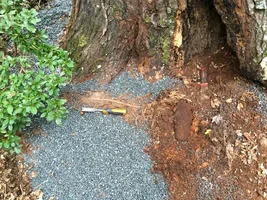
Gravel's got a lot of uses...expanded aggregate gets specced for tough planting sites, and also therapy for old hollow trees.
 

Attachments

  • gravel maple.webp
    gravel maple.webp
    232.2 KB · Views: 31
I have seen the most damage from having twine left on the rootball. It's so easy to take off the packaging of the rootball that why would you ever leave it on?
 
I've generally removed at a minimum, the burlap, bindings (twine, wire or straps) and cut away the top foot of the wire basket. Without establishing a minimum standard that is consistently performed it leaves room for justification to do the least or nothing due to time constraints. While it may allow you to get away with it for the duration of the warranty you're going to be left with a very frustrated client. Educate the client on BP and why it will be better to pay the extra to get it done right. Maybe the way to advertise it is "WE REPAIR $100 PLANTING JOBS".
 
But who has seen damage from the wire?

I have seen good sized urban trees toppled over, with the failure point being right where the roots were girdled by the basket, more than once. It definitely looked to me like the weakness was created by the root being girdled by the wire. There were other factors involved, with these being sidewalk plantings, but I'm just pointing out that yes, it can play a part in tree failure.

-Tom
 
I have seen good sized urban trees toppled over, with the failure point being right where the roots were girdled by the basket, more than once. It definitely looked to me like the weakness was created by the root being girdled by the wire. There were other factors involved, with these being sidewalk plantings, but I'm just pointing out that yes, it can play a part in tree failure.

-Tom

That's amazing; I went to a planters' workshop at mike marshall's nursery last year and gilman was sayin the same as bonnie--no evidence of that happening; bring it on! Those nursery guys can whine as loud as developers, but sometimes they have a point. But many factors yes; if rootball fails then #1 Cause is lack of staking/stapling..:p

And the ? is; does it play a big enough part to require all that clipclipclip cutting? Then again if it's not cut isn't is a tripping hazard?
 
Last edited:
I think I've come to the conclusion (agreeing with Guys 1st post) that if they are doing everything else right, then not cutting the basket is a minor point. However, I still feel (anecdotally) that leaving the basket is a poor planting practice and I would rather see at least the top foot or so removed. So I guess what I'm going to suggest is that they keep doing what they're doing and if they have the opportunity to at least remove the top little bit of the basket, then great.
 
I will pose this one question: Other than creating short term stability, and to prevent the risks involved with root exposure during transplant, can the wire basket be a GOOD thing? I would say unequivocally no. Does it create an unacceptable risk level for tree failure down the line? Maybe not, but I'd prefer to have my plantings go commando if possible. I have bent many baskets down in my day, but never left one whole and in place.

-Tom
 
We've all seen trees growing and engulfing wire fences. Does it kill the tree? Almost never. Does it cause structural weakness/stress riser/entryway for pest and disease? Seems like sometimes it might, and sometimes not at all. I would think that the same (or similar) is true of wire baskets where roots are growing. If nothing else, I believe it can be a future unseen hazard for stump grinder operators.

I worked in landscape construction for several years before becoming an arborist. I've ignorantly planted a LOT of trees incorrectly. I've done just about everything wrong that there is to do wrong. Countless trees I used to stuff all the excess burlap, twine, and wire (folded down) from the top of the root ball down into the hole beside the root ball. A hole that was often only a couple inches larger in diameter than the ball. Using a spade to stuff all that garbage down beside the root ball is just as much work as simply removing all of it and hauling it off. Seriously, it's very easy to remove ALL the wire basket, ALL the burlap, ALL the twine, ALL the nursery staking, ALL the strapping, ALL the tags. I've done it thousands of times both ways. Trust me, get a system down to do it right and you will never go back. And, there's no good reason to not do it that way. What's the reason for leaving any of that stuff on? It's not quicker or easier.
 
And the time saved at planting is spent unwinding it from the grinder's shaft. But that's just a perpetuation of the mindset of nurseries. While what they do saves them time and money, they're just passing a cost along to someone else.
 
The way I've always looked at is this. When you plant a tree you're trying to make it as easy of a situation for that tree to get established and healthy. They're already under a lot stress once they've been placed in a basket and burlap. Why make it more difficult for them to get established? I remember in school seeing pictures of roots trying to grow through burlap and their diameter on the other side is significantly smaller than normal. Also that wire is going to take an incredibly long time to break down (if it all) thus increasing the risk chance of girdling. I worked in landscaping for almost ten years before going to school and I can tell you the number one reason baskets and burlap are left on is time. Much like in tree work unfortunately, people will sometimes take the short cut in order to get the job done quicker.
 

New threads New posts

Back
Top Bottom