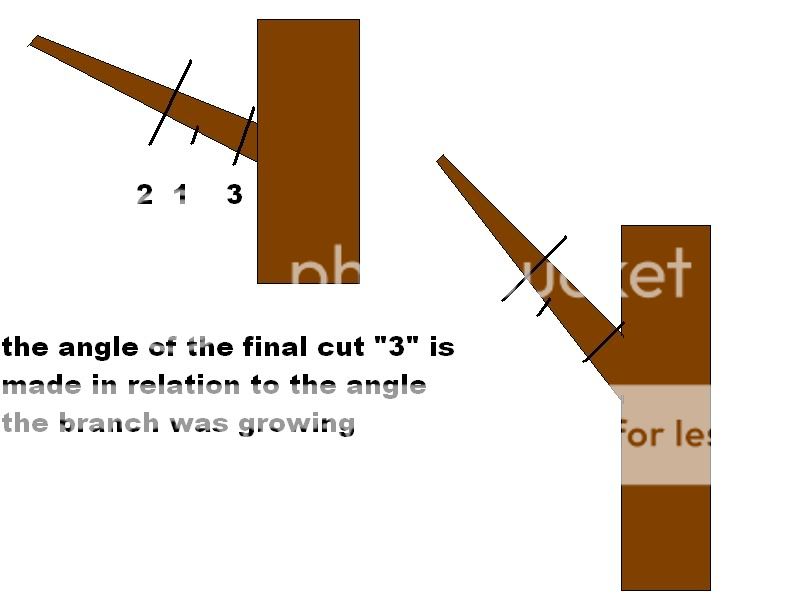
Branch collars come in all different orientations.
I suggest looking at some firewood of various species. If you pull the bark off, you can get a better view of the trunk and branch fibers.
A few species have some somewhat sunken branch collars due to the undulations of the trunk. Sometimes redwoods will have bulging trunk wood around some branches. You will be flush to the trunk when you remove the branch, without "flush cutting" it (in the bad sense). You might even use the tip of the bar to remove more of the branch tissue, leaving a smoother, though "indented" branch pruning cut/ wound.
Pacific bigleaf maple, Pacific Madrone/
Madrona and Sitka Spruce are some species in my neighborhood that have somewhat-to-vary extended branch collars. I just went past some spruces on a golf course nearby, and without knowing how spruces can look in their larger branches, it would look like stub city.
I suggest that you do some debarking and dissection, as well as looking at where you see dead branches getting grown upon by live trunk tissues. The more the dead branch is intact, all else being equal, the less years since the branch tissues died, and the trunk tissues started to grow over them. The converse, where there is a little stub of a dead branch left, all else being equal, makes one think that it has been many more years that the trunk has been growning out/ over the stub. Looking at the way different pruning wounds callus over on different species also gives some indications of the quality of the final branch collar pruning cut/ wound.
You might be branch collar cutting properly. It might just be internet/ written communication. Without pictures, it is hard to know. If you use Google Images for "branch collar" and/ or "3 point cut", you will see many good photos and diagrams that give a bit more detail than your Paint picture above. Good work on putting the time into the picture to be able to get a more accurate message out to the TBers, and to be able to pick up whatever you can from the TBers.
Note that your picture (not knocking it) doesn't show a bulge beneath your 3rd cut. That is the key on the bottom of the branch collar cut, with the top typically being just outside of the branch bark ridge (BBR). Each branch is unique, some more than others. Each proper branch collar cut is based on the anatomy of that particular branch in relation to the trunk tissues.