
Navigation
Install the app
How to install the app on iOS
Follow along with the video below to see how to install our site as a web app on your home screen.
Note: This feature may not be available in some browsers.
More options
You are using an out of date browser. It may not display this or other websites correctly.
You should upgrade or use an alternative browser.
You should upgrade or use an alternative browser.
Peavey used as a Lever
- Thread starter chris_girard
- Start date


- Location
- usa
Right on ill google n see what I find but are they designed for different applications or is it just a matter of preference to have a spear tip or the flat tip sorry for the greenhorn questions lol
I once knew a guy who knew a guy
I once knew a guy who knew a guy

allmark
Participating member
Of course at the point he's at another person might stick another peavey under
Here's a good example of an old time logger using a Peavey as a Class 2 Lever.
No worries...Alex taught us to clean up our language. Still a place for lingo and local usage too.
I never thought of the issue in this detail before
I found this a while ago:
"If you wish to converse with me, define your terms"
Voltaire? Is the "terms" here conditions for conversing, or definitions of words that were be used in the conversation? Thanks! 74.67.42.162 15:30, 1 February 2007 (UTC)
This is why taking quotes out of context Is often a bad idea. I can't find this exact quote but this comes from the section on miricles in the wictionnaire philosophique "Define your terms, you will permit me again to say, or we shall never understand one another.…Miracle, something admirable; prodigy, implying something astonishing; portentous, bearing with it novelty; monster, something to show (à montrer) on account of its variety." So it seems he means the definition of words not conditions. BTW he elsewhere says the advice is from John Locke. MeltBanana 15:55, 2 February 2007 (UTC)
Thanks, I wonder if the quote I knew of is just a loose paraphrase from the one you identified. It would be nice to source it to Locke too, in whatever form it may take. You are a fine upstanding banana, melting or not! 74.67.42.162 02:21, 3 February 2007 (UTC)
A paraphrase it may be, but I doubt whether there is any source for this supposed Voltaire quotation other than the one MeltBanana has given. I'll take a stab at locating the Locke original:
The names of simple ideas are not capable of any definition; the names of all complex ideas are. It has not, that I know, been yet observed by anybody what words are, and what are not, capable of being defined; the want whereof is (as I am apt to think) not seldom the occasion of great wrangling and obscurity in men's discourses, whilst some demand definitions of terms that cannot be defined; and others think they ought not to rest satisfied in an explication made by a more general word, and its restriction, (or to speak in terms of art, by a genus and difference), when, even after such definition, made according to rule, those who hear it have often no more a clear conception of the meaning of the word than they had before.
w:An Essay Concerning Human Understanding (1689) Book III, chapter 4. Antiquary 11:04, 3 February 2007 (UTC)
I studied both Locke and Voltaire, but many years ago. I remembered the quote as "If you would converse with me, you must first define your terms." I remember it as being Voltaire's. I liked it precisely for the lawyerly pedantry and double meaning... but then, I've always been a "wordgeek" - Rowena Cherry
I thought it was Socrates' statement in one of Plato's works. 108.94.8.229 19:00, 26 April 2012 (UTC)[/QUOTe
Mine would be
" if you want to talk let's make it quick"


Evan Sussman
Participating member
- Location
- Stanwood, WA
I think a cant hook is made for handling "cants" or milled lumber. The first time I heard the word cant applied was after I helped a mentor mill a beam, and he described the beam as a can't.Right on ill google n see what I find but are they designed for different applications or is it just a matter of preference to have a spear tip or the flat tip sorry for the greenhorn questions lol
I once knew a guy who knew a guy
Maybe the bent hook allows turning of the beam without a dent that the point might make?

SRTsteve860
New member
- Location
- North West Connecticut
I'm civil engineering with a focus in geotechnical and transportation.
The unique thing about the use of a peavey is it uses the lever effect to impart torque on the object as opposed to linear displacement. With a traditional use of a lever (as shown in the initial pictures) it is moving the load, "doing work," in a line, like lifting a rock out of a hole. with the peavey, there is no real movement of the object centroid, rather the rotation created by the lever arm rolls the centroid in the intended direction. and torque as we all know, if force x distance. so hanging your 200 lbs of ass off the end of your 4 ft peavey would create ~800 ft-lbs of torque on that log (varying with log diameter slightly)
-Steven
The unique thing about the use of a peavey is it uses the lever effect to impart torque on the object as opposed to linear displacement. With a traditional use of a lever (as shown in the initial pictures) it is moving the load, "doing work," in a line, like lifting a rock out of a hole. with the peavey, there is no real movement of the object centroid, rather the rotation created by the lever arm rolls the centroid in the intended direction. and torque as we all know, if force x distance. so hanging your 200 lbs of ass off the end of your 4 ft peavey would create ~800 ft-lbs of torque on that log (varying with log diameter slightly)
-Steven

- Location
- Retired in Minneapolis
A cant is a milled piece of wood...generally large.

okay so I have a question. Can you measure the force that is applied at the end of your peavy? Meaning, if you apply 150 pounds of force to the effort end, is there anyway to know who much force was applied to the resistance end? I would image the longer the peavy the more force would be applied. Is there a way to calculate this?
SRTsteve860
New member
- Location
- North West Connecticut
okay so I have a question. Can you measure the force that is applied at the end of your peavy? Meaning, if you apply 150 pounds of force to the effort end, is there anyway to know who much force was applied to the resistance end? I would image the longer the peavy the more force would be applied. Is there a way to calculate this?
you certainly can, with just some simple force-equilibrium equations such as torque and moment, you can find the leverage effect. think of a peavy as a wrench and the log is a bolt/nut. the longer the handle the less force you need to impart to get it to rotate.
like i said a few posts ago, a peavy imparts torque on the log, so with the 150 lbs of force you mention, using a 4' peavy (the Stihl one i have is this long i think) its simply force (F) times distance (d) equals torque (T)... F x d = T
these numbers will vary though depending how big around the log is, as the distance (d) value would in reality also involve the trees diameter (I was just talking about a simplification of the forces)
so a 4' peavey, with 150 lbs pushing/pulling perpendicular to the handle (most effecient use of force) you get 150 x 4 = 600 ft lbs of torque. so you can compare that to perhaps the little husqvarna felling bar with the peavy hook on it, lets for arguments sake say its 2' long, working the same equation backwards, you would need 300 lbs of force to get the same rolling movement out of the same log.
-Steven

Jeff
Branched out member
- Location
- Marlborough, MA
As somewhat mentioned above, once a sawmill cuts the 4 curved sides off a log and makes it into a large square (or rectangular) timber, it is known as a cant. (No apostrophe - it is a Cant, not a can't). After sawing several slabs off one side, a cant hook was used to turn the cant so another face could be sawn. (Today it's all mechanized. Go on YouTube and search "The HELLE Log Turner and Cant Kickers" for a good visualization)Is there a difference between a peavy and a can't hook
A good explanation with pictures is available on the LogRite website, maker of the BEST tools, IMHO, from which I copied this below:
Traditionally cant hooks were used around sawmills for turning cants. While peaveys were designed for and used for river drives.
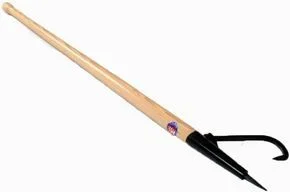
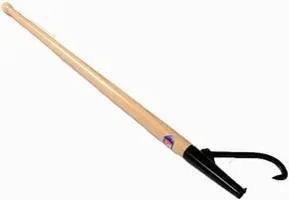
Both tools consist of a handle with a swing hook. The difference between the two is what is on the end of the handle and the way the tools grip a log. A cant hook has a small toe hook on the end which provides a second biting edge. A peavey has a point on the end which is used to separate logs.
Today these tools are used interchangeably and are capable of doing the same jobs. So it comes down to personal preference when choosing between the two tools. We have noticed regional preferences.
Cant Hook

Benefits:
Two biting edges.
Gets a better grip on the log.
Peavey

Benefits:
Can be stuck between logs to free them.
Point can be stuck in ground to stand the tool up making it easy to find.
Cant Hook

Peavey

Here is southern New England, everyone seems to prefer the peavey, at least until they try my cant hook and realize how much better it bites into the log with that second little hook on the tip.
Jeff

JeffGu
Been here much more than a while
- Location
- Osceola, Nebraska
Very nice... and informative!
- Location
- usa
Good info and we have a can't hook at the shop I've used but never even heard of a peavy that's why I asked but thanks every one for the infoAs somewhat mentioned above, once a sawmill cuts the 4 curved sides off a log and makes it into a large square (or rectangular) timber, it is known as a cant. (No apostrophe - it is a Cant, not a can't). After sawing several slabs off one side, a cant hook was used to turn the cant so another face could be sawn. (Today it's all mechanized. Go on YouTube and search "The HELLE Log Turner and Cant Kickers" for a good visualization)
A good explanation with pictures is available on the LogRite website, maker of the BEST tools, IMHO, from which I copied this below:
Traditionally cant hooks were used around sawmills for turning cants. While peaveys were designed for and used for river drives.
Both tools consist of a handle with a swing hook. The difference between the two is what is on the end of the handle and the way the tools grip a log. A cant hook has a small toe hook on the end which provides a second biting edge. A peavey has a point on the end which is used to separate logs.
Today these tools are used interchangeably and are capable of doing the same jobs. So it comes down to personal preference when choosing between the two tools. We have noticed regional preferences.
Cant Hook
Benefits:
Two biting edges.
Gets a better grip on the log.
Peavey
Benefits:
Can be stuck between logs to free them.
Point can be stuck in ground to stand the tool up making it easy to find.
Cant Hook
Peavey
Here is southern New England, everyone seems to prefer the peavey, at least until they try my cant hook and realize how much better it bites into the log with that second little hook on the tip.
Jeff
I once knew a guy who knew a guy
New threads New posts
-
test
-
 Alternatives to standard asphalt around roots
- Started by southsoundtree
- Replies: 2
-
-

-

-
 For Sale: 2018 Vermeer BC1000XL Chipper | 918 Run Hours | Deutz Diesel
- Started by Blue Ribbon Tree
- Replies: 2
-


