
OSHA bans body belts & lanyards in buckets

I've read quite a few "catapult" scenarios in regards to the bucket. My only guess is that a high dorsal attachment with shoulder restraints vs a ventrical (bridge) with no shoulders helps keep the worker in their fall restraint device vs being launched out of it when everything comes tight. I think up and out is more of the concern than falling over the side. Either way, I think the nature of the fall is a lot different than climbing a tree and falling off a branch.

I've never slipped and went head first while in the tree. I've went deer first and ass first countless times, to which the nature that a rope comes tight on a saddle would up right you or at least prevent you from coming out of the saddle. In a bucket, you pretty much have to come out head/shoulders first so such a restraint would make sense.


And yes, I like most of you, have played around and hung upside down in my saddle. I also realize how astronomically low the chances would have to be for you to be launched out of your saddle should the bucket bounce hard.

We do have a guy that wears his saddle loose. The Velcro lumbar support strap seems to be all that holds it up when he doesn't have tension on it, and I could see it potentially happening when all the stars line up if he wore it in the bucket.
 
I just saw another post on FB regarding a fatality. Guy launched out of the bucket. Like so many regs there's plenty of deaths that precede them. No pencil pushers dreaming up ways to make our lives difficult, just trying to figure out ways to keep us from killing ourselves. We use a full body harness when running the bucket, I do the saddle and strap when I'm using the bucket as an elevator into the tree. It's been bugging me. So, now we have the motivation to come up with a solution.

And this is in response to all aerial lift fatalities not just those in our industry.
 
It's interesting that nobody on this thread has highlighted the difference between a work positioning harness and a fall arrest harness, specifically regarding their difference in purpose and design. Perhaps someone with a calculator and engineering mindset would do a calculation of the potential force exerted on a bridge or D-ring when a 200-lb operator wearing a traditional saddle and 4ft lanyard is catapulted upward out of a bucket and then thrown downward onto an essentially static connecting system attached at his waist. (My guess is that impact force is around 1,800 lb-ft exerted on the lumbar spine...ouch). With that situation in mind, perhaps, the importance and advantages of fall arrest system would be more obvious.
 
I am glad somebody has finally clued into the different belts for different purposes.

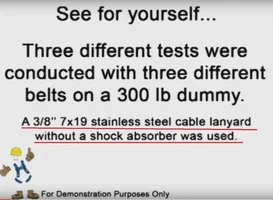
See why work positioning / body belts are not for fall arrest:

That looks like almost a six foot fall. I didn't see where it said, even in the graphs presented. Of course a fall arrest harness and lanyard would be best in that scenario. Seems biased to say the least.


I keep my climbing line snug so the fall would be only a few inches, at most a foot. Treat the bucket tie in like a tree climbing tie in and there is no problem. If six foot of slack in allowed of course there is going to be problems in the bucket truck or tree climbing.
 
Since tree co's represent a small portion of the aerial lift market most of the stuff you're seeing is geared toward the others where using the lift as an elevator isn't even considered. The lanyard is such that it still provides mobility in the bucket.
 
What about wearing your climbing saddle and then throwing on fall arrest harness over top? Then once you hook in you take the top harness off. That a no go?


Sent from my iPhone using Tapatalk
 
And if you're at John Ball's presentation, you'll also know the importance of proper fit and adjustment…:eek:
Ohhh that picture is rough! I wish I had it to show people :rayos:

What about wearing your climbing saddle and then throwing on fall arrest harness over top? Then once you hook in you take the top harness off. That a no go?


Sent from my iPhone using Tapatalk
Technically you would be compliant to the bucket regulations of needing a full body harness and energy ab lanyard. However, you wouldn't be wearing the harness properly because it wouldn't be snug on you.

The best bet would be a full body harness (not to be confused with suspenders!) that can be used for both work positioning (climbing) and fall arrest (bucket).
 
Since tree co's represent a small portion of the aerial lift market most of the stuff you're seeing is geared toward the others where using the lift as an elevator isn't even considered. The lanyard is such that it still provides mobility in the bucket.
Things go wrong and cause you to fall out of the bucket regardless of the type of work you do. I've found that tree companies are rougher on the bucket than other industries, most other industries tend to use them more for elevating platforms than we do.
 
Right, I was responding to Treeco.

I've tried to find the stats on all aerial device accidents but it's fragmented.

If tree climbers left that much slack in their system it would create the same results is the point I'm trying to make. Also rope climbers should be able to use their climbing saddles in the bucket if they promise to keep slack out of their system.....you know, like they do in trees.

I do think the fall arrest harnesses are a good thing but I'm against it being mandated to ALL persons all of the time. The discussion of wearing one harness over another is more than a little absurd especially when applied to trained rope climbers. It is zero credit being given to the training.
 
If tree climbers left that much slack in their system it would create the same results is the point I'm trying to make. Also rope climbers should be able to use their climbing saddles in the bucket if they promise to keep slack out of their system.....you know, like they do in trees.

I do think the fall arrest harnesses are a good thing but I'm against it being mandated to ALL persons all of the time. The discussion of wearing one harness over another is more than a little absurd especially when applied to trained rope climbers. It is zero credit being given to the training.
Agreed! The caveat being they promise to keep the slack out of their system. We're hobbled by those that have made it their personal mission to tempt fate and the ones that fate has taken up the offer:buitre:. When you look at the usage of lifts it is almost exclusively to serve as an elevated work platform whereas, you're talking about its use as strictly an access tool. In that case you're only in it for a short duration, stationary for all intent and purpose and thus a snugged line would be feasible. If they even considered that in the deliberations I'd be surprised.
 
I am not weighing in on this but if it is new you know they will be checking more often, it's how they make money. After some time they will visit less often like everything else they monitor. As soon as this thread went up the very first thing that flashed through my mind was the guy at the Expo center. It was one of the convention center guys and not one of us at all or tcia related but there it was. I just got done leaving the center where there was all this talk of safety at height and when I walked outside there is this guy up in an aerial lift changing a light bulb. No harness, no lanyard, no glasses, no safety helmet, and nothing blocking or cautioning bystanders that the possibility of threats from above was present. So while they may pick us out for a while it will be short lived. I don't care what you prefer to use myself, just go home safely, your family loves and needs us all.
 
It would be interesting to see a video of what happens to a dummy that does a header out of a bucket and is then caught by a dorsal attached 3/8 inch stainless steel lanyard. The inversion from head pointing towards the ground to feet towards the ground is going to be a spine tingling event. Remember too that a friction hitch system should not have much slack and that it is going to have some slip when pulling tight.

I'm not arguing that a bucket operator should be tied in with a complete climbing system that could get them rapidly to the ground. My point is that such a system need not be crucified or made illegal to use by those trained in such.

The video presented looks like an advertisement complete with canned responses. Even so, good points are being made.

A lot of bucket accidents happen because the operator has no fall restraint at all and even the most advanced system would not be effective sitting in the truck.

Now for a confession:

These days I am often solo on the job and sometimes flying a bucket. This does bias my view towards self rescue. Twice in the past ten years I've had to lower myself from the bucket. Once I dislodged the 'dead man' pneumatic spaghetti line and another time the truck motor stalled. I've bucketed one side of a tree then climbed out of the bucket to do the other side rope climbing hundreds of times.


Stainless steel lanyard.webp
 

New threads New posts

Back
Top Bottom