Old Valley Oak Retrenchment?

Tree Lady

Participating member
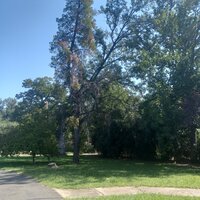
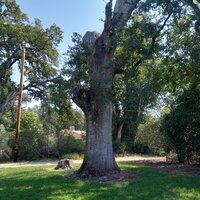
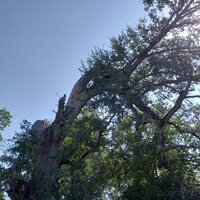
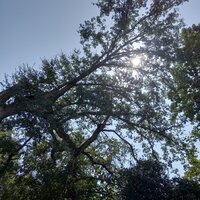
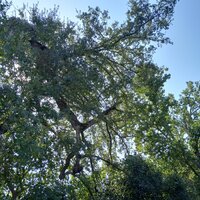
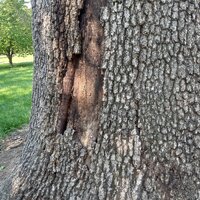
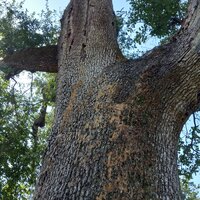
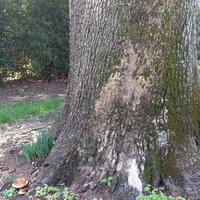
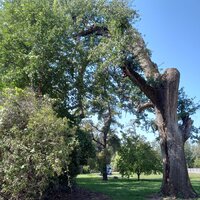
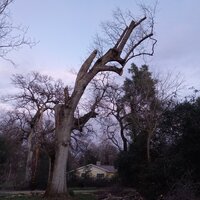
I'd like to do a retrenchment pruning on this old oak. It's obviously in a bad way. The owner's would like to retain it. There are currently no targets, but they are installing solar panels about ten feet beyond the canopy.
It's a massive White Oak. How big of cuts would you do?
 

Attachments

  • 20230923_122923.jpg
    20230923_122923.jpg
    1.1 MB · Views: 64
  • 20230923_121843.jpg
    20230923_121843.jpg
    1.4 MB · Views: 70
  • 20230923_121857.jpg
    20230923_121857.jpg
    1.2 MB · Views: 67
  • 20230923_121904.jpg
    20230923_121904.jpg
    1.4 MB · Views: 64
  • 20230923_122018.jpg
    20230923_122018.jpg
    1.5 MB · Views: 68
With the trunk in that condition I would probably take more than I'd leave, but I am far from an expert. I would be inclined to make as many smaller cuts as I could while also eliminating all the weakest, as well as longest reaching limbs. Like I said, far from an expert on the subject, but I wanted to weigh in at the start and see how close I come to the general consensus.
 
Last edited:
Can you hear if the main stem is hollow? I believe the standards for retrenchment pruning varies depending on the condition of the trunk. I know there are some pretty well-known guidelines on how much can be cut depending on if the trunk is hollow or not. Should be able to find those readily on the internet. I would like to offer my 2¢, but I can't remember what they are as I do not use that information in my work. Good luck, whatever you decide to do with that monster.
 
THere are some good California arbos here on Treebuzz. The right person will be skilled in both the art and science of trees.

You might spend some time combing the profiles.

My brother is working a contract in CA now. I'd recommend him of course. Because he has a good knowledge of the science he's from Dallas. His art skills might be less than you'll find by getting a local practitioner.

Europeans have been able to take care of some pretty dang special trees for centuries. Americans are starting to learn some of these techniques. Consider the comparison between taking care of historical buildings.
 
If the tree is being pruned in order to mitigate risk of failure/strike to targets, then those targets will define the amount of the reduction. What's left of the canopy now is very asymmetrical, so unless the targets lie on the side of the tree with the preponderance of canopy mass, you could consider letting it remain as it is, while it slowly transitions into a habitat snag.
 
Is there lift/ bucket truck access? I might base part of the cut placement on that too.
I don’t have any real experience doing retrenchment but I’m interested in what you end up doing. Any update?
 
If the tree is being pruned in order to mitigate risk of failure/strike to targets, then those targets will define the amount of the reduction. What's left of the canopy now is very asymmetrical, so unless the targets lie on the side of the tree with the preponderance of canopy mass, you could consider letting it remain as it is, while it slowly transitions into a habitat snag.
Yes this is everything-

Are we only talking about this tree because of the solar panels being installed?
 
Mostly. It is also loved by the owners.
I’d go fairly light- probably less than the 15% tip reduction which has been the general rule of thumb for retrenchments in my circle of treeple… if you have a bucket truck you can really be a cicada and take tiny pieces throughout the canopy.

There are conflicting studies as to the efficacy of this. If the tree is in decline such as this one, it’s probably just a hospice visit rather than something that will train it towards a stouter more long term form…
 
With the trunk in that condition I would probably take more than I'd leave, but I am far from an expert. I would be inclined to make as many smaller cuts as I could while also eliminating all the weakest, as well as longest reaching limbs. Like I said, far from an expert on the subject, but I wanted to weigh in at the start and see how close I come to the general consensus.
That trunk does not appear to be in bad shape... half the tree is already missing so the forces on the main stem are already significantly lowered. The branch attachmnets don't look too bad either. Given no real obstacles (targets) I would tend to go light on the pruning, though there may be some serious defects not visible from the pictures which could change that recommendation. All tip reduction. DO not touch the interior or new sprouts on the main trunk and lower stems. You could make a 10-20 cuts from 2"-3", that would take enough off to reduce forces on the stems. If you think the tree is in decline and needs to be cut back to make water transport easier, you could take a few more tips off.

I'm not intimately familiar with the species, though I think I did prune my father-in-laws oak of the same species and he seemed to think it could sustain a fairly hard prune.
 
You could make a 10-20 cuts from 2"-3", that would take enough off to reduce forces on the stems.
This is what I'm thinking.
The remaining canopy looks vigorous, but there looks like a hollow from a breakout near where the branches originate.

Also, the size of the last failure (half the tree) has me concerned.

This tree is postponed for today. It is an hour and a half from my mountain home and I'm having transportation trouble. It is still scheduled asap/no hurry (by the customer.) I have three other trees on the property, so two days of work.

More time to think about it if anyone has more advice.
 
total non-arborist here (--for the knots!),
but I, too, wonder about all the lean in one direction.
Someone remarked about less stress given loss of a
half, but I'm thinking "less counterweight/balance".

Looks as though after the initial bending rightwards
of the tree & vertical limbs there is later a major
vertical limb :: is this vying to become the tree's
main spar? --what your last photo is focusing on.
(Locally, I braced a young sycamore with a serious,
near-90deg bend of main spar, and over time it stopped
*feeding* that piece and a vertical former "branch" fattened
up to become the new main
--really striking difference, hard to believe, 5? years later!!)

.:. So, would it be best to chop that sizable vertical branch,
hoping to re-direct main-spar feeding to the initial upwards
branches, and taking a load off the leveraged out-reaching
limb (noting that there are a few other branches as this
"outreaching" point either side & below what I'm thinking
might make sense to chop.

*kN*

 
Go climb the tree for a good inspection, first, then add that info to all you are thinking about, already.

Have you lightly thumped it with a rubber mallet? Mostly I bang on a tree with my fist, but someone once told me that even monkeys use digging sticks .
That might give you some more, easy information.


What can you do for the root zone?
 

New threads New posts

Kask Stihl NORTHEASTERN Arborists Wesspur TreeStuff.com Teufelberger Westminster X-Rigging Teufelberger
Back
Top Bottom