
Oh, no!! I felt some lumps in my rope while descending.

Winchman

Carpal tunnel level member
I was about ten feet down from the top of a sixty-foot climb using my 3:1 climbing rig that is consists of two Petzl ball-bearing rescue pulleys (1 3/4" dia), a ZigZag, and two hundred feet of Samson Voyager. As usual, I had a light grip on the rope with my gloved hand below the ZZ while controlling the descent with my other hand on the ZZ release. I felt two very small lumps close together as the rope was going through my hand followed by two slight jerks on my harness as they went through the ZZ. I'm absolutely sure about what I felt.

I stopped the descent, and climbed far enough to get above that part of the rope. I couldn't see or feel anything unusual in the rope, and I felt no lumps or jerks when I resumed the descent. I carefully examined that part of the rope again on the ground, but didn't see or feel anything unusual.

I've been using this rope since I started climbing this past March, so it's probably got at least a hundred climbs on it. I started out with a prussik, but the vast majority of the climbs have been made with the ZZ. It's never been abused or shock-loaded. There's a slight bit of fuzzing on the jacket, but that seems normal. It's been switched end-to-end twice to even the wear. I weigh about 175 with all my climbing stuff, so there's hardly any load on the rope with the 3:1. It's been around the pulleys a bunch of times, though.

Well, I did a very careful inspection of the rope this morning and found the problem area.
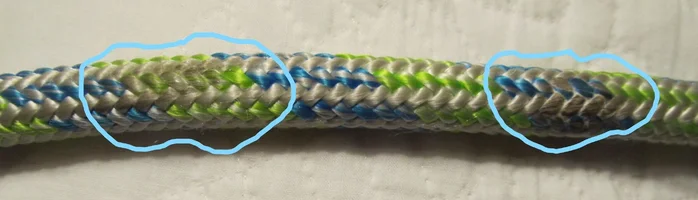
IMG_3336 (3)_LI.jpg
It was in just the right place to go through the ZZ at that point in the descent, and it's a little discolored from rubbing in the ZZ a bit harder there. The spacing is just right to give the quick bump-bump I felt. Apparently I didn't climb far enough back up to see or feel it last evening. I'm surprised I haven't noticed it before, since I use that section of rope in every climb. It's about thirty feet from the upper end of the rope that's secured to the top of the climbing rig.

Is there anything normal to account for that condition? Is it worth opening it up for inspection? Should I just buy a new rope?
 
Last edited:
I have one edelrid rope with a single lump around the center which I took out of service earlier this year. Only thing I could attribute it to it using it as a pull line while yanking over the log. I know better but I have done it a few times. Figured it may have gotten smashed on impact with the ground. Ropes are cheap compared to a day off, or worse. Treat yourself to a new climb line!
 
Usually, it's the core bunching in a small area. Try milking the rope in both directions out to about 2 or 3 feet from the lumps, feeling to see if the bumps either seem to spread out, or shift position. If so, then wash the rope and milk it full length a couple of times. This usually cures the problem.

Best way I've found for washing ropes is in a modern, low-suds machine (no center agitator) and a decent, non-detergent laundry SOAP. They're usually coconut oil based, a tad pricey, but don't hurt the rope one bit.

If you don't have this type machine, try a front loading washer in a laundromat... if you still have one in your area. They seem to be going the way of drive-in movie theatres and the dinosaurs.

The reason the rope washing helps with this is because sometimes stuff gets pushed through the jacket with regular use, and into the core, where it can cause the bunching/lumps. Sometimes, it's just a spot where the core was joined in production. Either way, the washing loosens up the fibers and gets the junk out, and helps relax the rope so that milking it can rebalance the sheath/core.
 
I really expected the rope to last longer, but I know I've already gotten my money's worth of usefulness and enjoyment out of it. Being able to use most of it for light rigging will ease the pain of replacing it.

Should I consider getting a different kind of rope. Is there something more suited to the way I'm using it?

Thanks for the suggestion, JeffGu. I'll give that a try.
 
I've been using this rope since I started climbing this past March, so it's probably got at least a hundred climbs on it. I started out with a prussik, but the vast majority of the climbs have been made with the ZZ. It's never been abused or shock-loaded. There's a slight bit of fuzzing on the jacket, but that seems normal. It's been switched end-to-end twice to even the wear. I weigh about 175 with all my climbing stuff, so there's hardly any load on the rope with the 3:1.


Is that any pitch causing the discoloration?

A hundred rec climbs should be only part of the lifespan. I had a rope that I used for years and years, that I only changed to a rigging rope because I had to use it for a pull-rope once, and it was unfavorably bouncy. Still lots of life. Some natural crotch to bail out DdRT/ MRS, but largely SRT/ SRS.
Don't cut or spur your rope, and it will last a long, long time.
 
Is that any pitch causing the discoloration?

A hundred rec climbs should be only part of the lifespan. I had a rope that I used for years and years, that I only changed to a rigging rope because I had to use it for a pull-rope once, and it was unfavorably bouncy. Still lots of life. Some natural crotch to bail out DdRT/ MRS, but largely SRT/ SRS.
Don't cut or spur your rope, and it will last a long, long time.
Looks like pitch to me.. sometimes it sticks on the gloves and can feel odd on running lines.
 
As has been mention it is likely the core bunching up.

Try switching which end of the rope you use every other climb.
 
I tied a knot several feet away and measured to the two discolored spots. Then I washed and rinsed that section of the rope with mild soap and water. After it dried I milked it and massaged it. The surface discoloration went away, but I couldn't get rid of the lumps. I wasn't able to get inside with my small fids. The 24-strand braid is really tight.

It's entirely possible that the rope got some pitch on it, since I've been climbing a lot of pine trees. That doesn't explain the lumps inside, though. I don't think the rope is unsafe by the inspection criteria, but the little jerks during a descent are unsettling.

Switching the rope end-for-end on my 3:1 isn't something I'd want to do every other climb, but I'll probably do it more often with my new rope than I did with this one.

Yep, new rope. Couldn't pass up the 10%-off coupon from Sherrill Tree that magically arrived yesterday afternoon, and I really needed to make sure my brand new credit card was working.
 
If the bumps are still there, it means the core and cover aren’t balanced and would be weaker. Cutting the end of the rope off closest to the bumps and then milking it with a friction hitch towards the end might force the bumps to straighten out. If that doesn’t work then pull the core out of the end and milk the cover back to the bumps. Once the cover is bunchy, pull on the core and hopefully straighten the bumps and then milk the cover back, probably do the whole rope while you’re at it.
 
Tony's right, so I've got another option. I don't foresee the need to climb any pine trees for a while, and I have a decent 140' pulling rope. There several tall oaks in the yard with bookmarks to nice TIPs. I'll use the new rope to play in the oaks, and save the old line in case I need to climb a pine.

Thanks for that suggestion, Brocky. I hadn't considered pulling the cover back that far (thirty feet), but it's worth trying. I really would like to see what's going on. If I'm careful taking measurements, I'll be able to find the two spots on the core once the cover is bunched up. Sounds like an interesting project.
 
I've never seen bumps develop in the core weave of a double-braid climbing line. I've retired many double braids and then put them into service for light light rigging (I said light rigging @Tony ;-) My double-braids get beat up quite well before they reach the end. Never had bumps in the core in any of them. With Winchman's light rec use of his Samson Voyager it seems improbable that he caused this to happen. Which points to ruling out manufacturing defect. For example it could have been a subtle core braid flaw that amplified with use. Might be worth cutting out the section and sending it to Samson to see what they think.
-AJ
 
Awesome thinking on Brocky's part. Being the Don Quixote type (tilting at windmills and all that) I would absolutely want to keep the 200' length, slide the entire cover back and not forgetting to secure the end of the core braid to some throwline so the cover can be reinstalled. Once the core flaw is exposed assess and decide what to do next. If it is simply "bunched" then massage it out, reinstall the cover, pull it though an open hardwood limb/trunk union or hitch whatever a few times and re-balance the cover and core.
-AJ
 
You might not have to uncover all the way to the bumps, just enough to make the cover loose by them so the core might straighten out.
 

New threads New posts

Back
Top Bottom