Oh dear!

Just received the latest issue of "Baumzeitung", the german ISA chapter's publication...

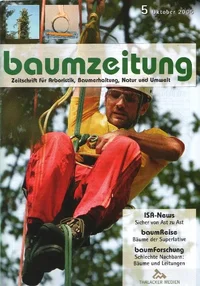
On the cover is a picture of Yannik, a french climber who took part at the german TCC in September. Lovely guy, showed some great techniques and skill during aerial rescue. But the choice of this pic for the cover of the Baumzeitung? What you can see is - to all intents and purpose- a disqualification or a warning at the very least. Hand above the friction hitch during the footlock event - or any other event involving this technique - is a no-no.

Having been involved in the set-up of the german TCC made me aware of the very different perspective you have when judging such an event as opposed to participating as a climber. It's really hard to remain focused all day long and not to miss things as the day wears on.

On the other hand, as allready remarked upon in the thread about gear inspection, as our TCC's are industry skills competitions, they also reflect the broad range of knowledge and skills of the people involved, or in some cases the lack thereof.

This is not being snide or pointing fingers, it's essentially stating a fact. I see one of big opportunities the TCC's offer us, is to improve the overall level of comprehension in the industry of the techniques and the equipment we use, and by doing so have a knock-on effect into everyday work environments.

Without a doubt, pictures such as this do not aid such efforts. OK, let's not get over dramatic: of course it's not the end of the word... it's just a pity, that a dodgy situation is depicted as opposed to use this platform to demonstrate good practice standards.

One of the lessons to my mind is that if you write an article for a newspaper, be it arborist news or your local rag that you should select images that you want to use really carefully. Does the picture really show what you want it to? Is the equipment shown being used properly and is it corectly configured? Are the techniques being shown safe? Or is it a cowboy number?
 

Attachments

  • 33492-crop0002.webp
    33492-crop0002.webp
    69.9 KB · Views: 196
Looks to me that he has completed his ascent, has his figure eight, and is preparing to come to the ground, on belay. Maybe his hand is up there too early, before resting on the eight...?
 
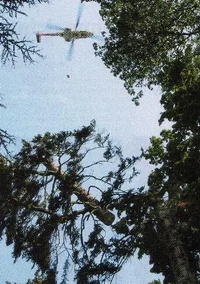
Another example of unfortunate use of images. This was in a swiss publication, a landscapers' rag, this issue was highlighting tree-care.

This take-down was done by a friend, the helicopter they were useing was a Aerospatial Super Puma with a load capacity of about 4,5 tonnes. Now that is a beefy bit they've attached to it in that picture. With a safety factor in mind of 10:1, which seems reasonable in such a situation, one would doubt that that's a properly dimemsioned bit. Being greedy.

Here also, I would dare to ask the question: Is this the image we want to present to the public. OK, it's spectacular, but is it safe ?
 

Attachments

  • 33495-helicopterfell.webp
    33495-helicopterfell.webp
    136 KB · Views: 157
Roger, I think the rules are really clear on that point: no hand above the friction hitch, end of story. I think it'd be wrong to differentiate between being on belay or having finished the ascent.

After all, we're trying to show safe work practice standards and it's clear to my mind what the issue is here. Because of the knot configuration when footlocking you can't release it in a controlled fashion like when it's used in a work positioning system. Sooooooo, no hands above the friction hitch !
 
One last one, then I'll stop boring you with my rant.

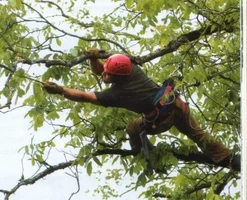
This picture was used in the same publication. It show the apprentice of one of the arb companies in central Switzerland. We work together from time to time and it's a good company, I've had the climber in question in training courses.

That's not what I'm on about, it's the quality of the image: If you look closely you'll see that the carabiner on the lanyard is cross-loaded on the nose of the krab. Not good. Why isn't something like that spotted before it goes to print? Beats me... haste, trying to make the printers' deadline or lack of knowledge - that the situation shown in the picture is actually potentially hazardous - or a bit of both. Probably the latter, methinks.

Ho-hum.
 

Attachments

  • 33498-crop0001.webp
    33498-crop0001.webp
    72.4 KB · Views: 156
[ QUOTE ]
Why isn't something like that spotted before it goes to print? Beats me... haste, trying to make the printers' deadline or lack of knowledge - that the situation shown in the picture is actually potentially hazardous - or a bit of both. Probably the latter, methinks.

Ho-hum.

[/ QUOTE ]

WE've had our shar of bad editing of pictures in professional magazines too in the US. Too bad that the editors don't understand.

Yesterday I read an article about tree climbing that had a long list of errors by the writer. When I see or read an error I ask myself if the mistake will be caught by the homeowner or only by a pro. Most of the written errors would only be understood by a pro. The pictures are too permanent.

I've written to editors and writers and gotten about a 50% return.
 
Mark, What would be the proper procedure after ringing the bell? Hard lock the eight then remove the prussik? Having never competed at the International level, I'd love some advice. Also, I do agree that one can set up his/her repel without holding above the hitch. I have set my eight, then loossened my prussik to have zero friction. come to the ground, then removed my prussik. Have I been doing wrong the whole time? photo journalist really should do more research. I think that most likely only the pros tend to notice "red flags" more often than the general public who have very little knowledge of safe or proper tree practices.
 
[ QUOTE ]
This take-down was done by a friend, the helicopter they were useing was a Aerospatial Super Puma with a load capacity of about 4,5 tonnes. Now that is a beefy bit they've attached to it in that picture. With a safety factor in mind of 10:1, which seems reasonable in such a situation, one would doubt that that's a properly dimemsioned bit. Being greedy.


[/ QUOTE ]
And that's probably 4,5 tonnes of solid weight and not a canope under the chopper that "blows itselve down again".
It must be a very "beefy" machine to do a piece like that. Probably so big that I would be afraid that the branches would break over me by the gusts of wind.

Done a tree transplant once. The tree had to go up onto a roofgarden on one of Amsterdam's big banking company's buildings.
The tree was about 30 cm (12 inch) diameter at chest hight. The whole crown had to be tight in to be as narrow as possible and most of the soil had to go out between the roots.
I can't remember what type of hely it was, but what I do remember is that it was a big sob commercial cargo one.
 
Roger,

the correct procedure after ringing the bell - or after reaching the top of you footlock come to that - would be to cinch down your friction hitch, check and then load it and only then to install your figure of eight. When that is installed, release the hitch, useing it as a back up for the figure of eight.

You should never use a figure of eight on it's own, it's not considered safe due to the fact that if you were to inadvertently release the rope with you hand under the figure of eight that's controlling the speed of descent, you'd hit the deck pronto. Ouch... or worse.

Tom,

it's a justified question whether you average punter would spot inconsitencies in pictures or text, let alone gross misquotes or misinterpretations by journalists. Yet I do think it's really important to try to be as precise as possible when considering an aritcle. This is where we reach out to the public, this is where we have the opportunity to present our industry and it really should be done carefully, not on the assumtion that people won't spot small inconsitencies. I think primarily it's a missed opportunity.

Ton,

a helicopter with a 4,5t load capacity is biiiiiiig. They don't come much bigger in civilian life and you're not in Russia. Design factors in this application are crucial, even the weight of a load within design parameters can rocket if any dynamic situation occurs, such as a reorientation of it's mass because of the way it's been attached to the line.

Which reminds me of a story I heard a while back.

A coulple of guys in Berlin bought an old russian helicopter. A seriously big machine. They used it to do comercial transport flights, installations and stuff like that.

One time they were installing big panels for the "Allianz" insurance company in Berlin, right on the banks of the river Spree. It was lighted displays with the Allianz logo on them on each side of the building. So, they'd done three sides, things were running smoothly, when the pilot - during the flight between the pick up point and the building with the fourth panel allready attached - took a look at the fuel gauge.... Whoops! , not fuel left, at least not enough to put down the sign gently... So he dumps the Allianz sign in the Spree (where it sank), and got himself on the groung PDQ!
There's a moral there somewhere. Apparently in the aftermath, when health and safety were looking into this story, they weren't very impressed - I wonder why.

They had to fish the sign out with boats and cranes. /forum/images/graemlins/grin.gif
 
They had to fish the sign out with boats and cranes.

I wonder who's insurance paid for that mess? :)

You're right. Bad writing and photo editing is a missed opportunity. Since reporters aren't arbos they write what they think is right or what the editors want.

There have been a few times when a reporter has called to ask for an interview. I explain that too often things don't come out right in print so I ask if I can work with the writer to do a technical edit. Get the facts right. I'm about 50/50 with them. The times that I didn't get the interview they found someone else and the article came out a mess. Not from who they interviewed either time, I knew the arbos. The reporter messed up. Too bad.

Take a look at this article and see what happens when no one does a techincal edit:

Out on a limb

Kermit had it all wrong: It is easy being green — all you have to do is climb a tree.

This isn't scrambling up a trunk in your backyard, like you did as a kid. Today, tree climbing involves as many ropes, harnesses, levers and other gadgets as rock climbing, only you don't need a rock face — just a strong trunk with some well-placed branches.

Tree climbing evolved as a sport in the early 1980s, with momentum gaining just recently. "It has kind of been building over the past 20 years," says Tobe Sherrill, the founder and owner of Sherrill Tree and Climbing Supply in Greensboro, N.C (www.sherrilltree.com).

Tree Climbers International, the unofficial governing body and advocacy group, says they've seen numbers increase to close to 50,000 in the last three years alone, a far cry from the hundred participants in the '80s.

The sport is akin to rock climbing in some ways. Climbers use a harness and strong rope, slung over a tree branch, to hoist themselves into the air and on to ­upper tree limbs. Ropes are placed using a ­giant slingshot, which fires a weight attached to a lead string over a branch (Sherrill patented one such device).

In tree climbing, however, there's no one belaying your line from below. Climbers use a rope pulley — a giant slip knot, really — to pull themselves up. "You're controlling yourself the whole time," says Sherrill.

Another difference: No harm befalls the tree, which can't be said of the destruction rock faces can take from climbers. A hard plastic buffer rests between the rope and the branch to avoid abrasion. "You don't use spikes or picks or anything like that," says Sherrill.

Sherrill, whose company is a leading supplier of both recreational and professional arborist climbing equipment around the country, was at the New York Botanical Garden in the Bronx last week to climb with some of the garden's staff arborists. After a brief orientation, Sherrill had Daily News photographer David Handschuh and me off the ground in no time at all. Climbing is accomplished using a device called an ascender, which attaches to your right foot and lets rope slide through in only one direction. By pulling yourself up the rope — a hefty arm workout for sure — and "pushing" the rope through the one-way lever at the same time, you have the feeling of walking an invisible staircase with one foot.

To lower myself, I unhooked the ascender and gently tugged another rope, which loosened the "slip knot" contraption above me and let me descend. Otherwise, it quickly became comfortable simply dangling in midair.

And when I grew tired of the harness digging into my groin, I simply climbed to the height of a nearby tree branch and perched on top It's a good spot for a conversation, too, as Sherrill joined me on my lofty perch to discuss the benefits of the fledging sport.

"There's been work done to prove you can break a fear of heights," says Sherrill. "You're self-belaying, so you are in control." Acrophobics can go as high as they want, even if it's just a few feet at a time, and build up as they please.
Another benefit was plainly obvious while perched amid the colorful leaf canopy: It's impossible not to appreciate trees when you're surrounded by one.

"It's getting people outdoors, and discovering what's left out there. It brings a respect and understanding," says Sherrill.

Just don't go throwing ropes over oaks in a park, as you're liable to get arrested or hurt yourself.

Aspiring climbers' best bets are to try a course at the Botanical ­Garden (go to www.nybg.org for upcoming classes), or visit TCI's Web site (www.treeclimbing.org) to find nearby classes and outings with trained experts.

-Julian Kestner
 
Ouch. That hurts. /forum/images/graemlins/crazy.gif

I like the "hard plastic buffer" bit (to avoid damage to the tree) best. Very imaginative. BTW, Where can I get one? Mind you, Tobe Sherrill is probably already on it. Keep your eyes open at TCI expo for "hard plastic buffers" at the Sherrill booth.
 
[ QUOTE ]
WE've had our shar of bad editing of pictures in professional magazines too in the US. Too bad that the editors don't understand.


[/ QUOTE ]


In the latest Tree Services magazine, the Director of Publishing Operations responded to some readers' comments about photos that the magazine had used in earlier issues showing unsafe work practices. The end of the editorial reads:

"If we really screw up and miss something big, go ahead and blast away. But let's not get all high and mighty about having every image in this magazine look like an OSHA brochure. The real world just doesn't work that way (and most of the stuff in Tree Services comes from the real world).
So, what do you guys think? Am I dodging my resposibility here? Should we publish only photos of guys dressed from head to foot in all of the proper safety gear, or should we just publish the photos and assume you folks know and follow the proper safety rules? Drop me a line and let me know your opinion."

David G. Cassidy dcassidy@treeservicesmagazine.com

p. 4, October 2005

I don't think that the editors of the other industry magazines (TCI, Arborist News, and Arbor Age) feel this way, but having just one publication with this attitude is a disservice to the industry and to the people who work hard to help instill safe work practices in everyone.
 
Wow!

Their credibility jsut slipped.

Making a mistake because of not knowing is forgiveable, making a mistake on purpose is wrong.

TCI magazine has refused ad copy because proper PPE wasn't used. That's a strong statement.

In the years before TCI magazine Arbor Age was the one and only. I remember some editorial duels about several issues. In the end, how can anyone not abide by workplace standards?

Truth be told, the OSHA/ANSI requirments for clothing and PPE are pretty easy to abide by. It's not like we have to don head to toe body armor like a SWAT team.
 
I bet Mr Cassidy will change his mind as soon as he realizes his mistake. I've sent him an invite.

Dan
 

New threads New posts

Back
Top Bottom