Oak ID

DSMc

Been here much more than a while
Location
Montana
Anyone familiar with this species of oak?

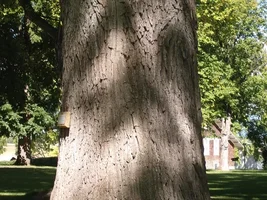
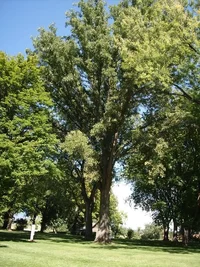
The dbh is 51", 90+ feet tall, spread 78 ft. Bark is gray and furrowed.

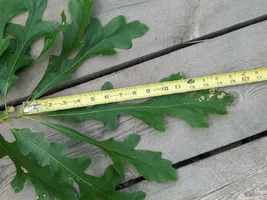
This leaf is typical of all the leaves throughout the tree. This is not an exaggerated growth pattern for this particular tree.

Dave
 

Attachments

  • 188159-Oakleaf.webp
    188159-Oakleaf.webp
    145.6 KB · Views: 221
Wouldn't be a White Oak, I dont think they grow in your area. Bur oaks grow up into the Dakotas, so that is getting closer to your area. If it is a Bur you should be able to tell pretty quick by looking at the acorn. The cap will be spinier than most others. Hence the name.
 
Thanks, guys. Didn't mean to be cryptic this morning but was in a rush to get out.

Matty, you are thinking along the same lines as us. Professor Underwood was here a couple of weeks ago and that was his take on it also. However, there are some peculiarities that makes positive ID difficult.

First being location. Our Zone 4 does not appear to be Q. Lyrata friendly. We have recorded 35 below zero several times in this tree's life time. This is a southern, wetlands tree. We are not. We have not found a mature acorn as yet. And we may not. We have only become acquainted with this tree in the last two years but have not seen an acorn larger than that in the above photo.

If this is a Q. Lyrata, has anyone ever seen a leaf this size? I am not familiar with this species so it may be common for all I know. I personally have never seen an oak with this size typical leaf.

Here are two more photos. Appreciate continued feedback.

Dave
 

Attachments

  • 188236-Oakbark.webp
    188236-Oakbark.webp
    144.1 KB · Views: 122
This is from UCONN's website, mention of a Q. macrocarpa X robur:

" 'Clemons' (Heritage®, a selection of Quercus x macdanielli) - This hybrid with English oak (Quercus robur) is a vigorous grower, unusual for an oak. It is a broad pyramidal grower that becomes an oval tree to 80' tall and 50' wide. "

http://www.hort.uconn.edu/Plants/q/quemac/quemac1.html

or could it be Q. cerris, Turkey Oak?

-Tom

(PS - It looks like the tree has a placard on it... What is that little square thing on the trunk?)
 
The tree is located in Western Montana in the Bitterroot Valley at the Daly Mansion, an historic estate. Bur oaks are native to as far west as eastern Montana and are common in our area.

This tree was planted approximately 100 years ago (plus or minus) with what we know of the history of the place. We became involved at this estate just a couple of years ago and updated a previous inventory. David noted the leaves weren't quite right for a Quercus alba, but we let it go at the time. When Prof Bob Underwood visited in July he noted also that it was not a Q. alba. He thought at first a Q. macrocarpa but then found an acorn on the ground. Although very immature, it's cap fully encompasses the acorn, he suggested Q. lyrata. The picture above shows the acorn in the left side of the photo. Whereas we have not seen a Q. lyrata acorn in person before, we have seen Q. macrocarpa. And even when immature, in our experience, they have their distinctive fuzzy cap.

The plaque on the tree is a dedication plaque "In memory of" someone. People may "adopt" a tree for memorial or other purposes.

We are going through and labeling all the trees hence the need and desire to definitively ID this (and other) trees. We have just recently been declared as an "arboretum" and, although small (just over 500 trees), we are trying to be as accurate as possible.

I must say that even though this is donated time and, therefore, is taking longer than I would like, it has been a wonderful learning experience and very rewarding.

Sylvia

 
Another possibly unique feature of this tree is its growth pattern.

White oaks, particularly the Q. macrocarpa, are prone to sucker growth on the primary limbs. This tree takes it to a whole new level. I don't think it quite shows well enough in the picture just how much leaf mass is carried in this manner in this tree. Very little branch forking. The primary canopy is carried through the tree in this form.

Also unlike other oaks I have experience with, these suckers snap off very easily. Their attachment being quite different than I am used to.

Dave
 
Sylvia - Based on your information I would agree that it is Q. lyrata. Even though it is not a Zone 4 tree and not in it native spot. I believe this because of a few reasons.
I live in extreme northwest MN (Zone 3) and we have a small area of natively, or what appear to be natively, Northern Catalpa's (Catalpa speciosa) growing. The University of Minnesota - Crookston plant propagation classes have been propagating these and they are surviving nicely. I have one in my yard. But any other Catalpa that is bought from a nursery that is not from this local parent group, will not make it through even one winter.
Because of this, could it be possible that this tree came from a parent that was borderline hardy close to your area?
Plus, it looks like that oak is in a park or courtyard that is protected by other trees, that cold make it survive some of the colder temps. And because of it being in the 'park' it could have gotten some special care early in its life to establish.

If it looks like a duck, quacks like a duck, and swims like a duck, I'm thinking it is a duck.
Interesting stuff!!
 
Feels like the white oak family and the red oak family hybridize among themselves to me. Could be something like a half blood Q.alba and a half blood Q.lyrata. Just sayin - Nature's not always so tidy. Cool tree, though.
 
Sam, this tree is definitely in a suitable microclimate. Protected on many sides by other large trees. We know from photos that the tree density at this estate in the late 1800s/early 1900s was even greater. So protection early in life is definitely a possibility.

The people who established this estate were "movers and shakers" of their time and had no problems importing whatever struck their fancy. So a nonnative tree is also very likely. We have many on the property.

The fact that this particular specimen has excelled is not unusual for this site as we have many other illustrations of excellence from other species: Tilia Americana over 90 ft tall, a windbreak of Picea abies that are from 90 to 100 ft tall, a group of Populus alba in which one that could rival the National Champion. So the growing conditions on this site are more than amenable.

I will probably be going ahead and relabeling this tree. I just wanted to be absolutely certain as I will be going against the "big boys" as some very knowledgeable people were the ones who took the inventory in 1992. No written inventory with individual species exists, that we have found, for the initial plantings.

We continue to solicit and encourage comments and observations from all. Anyone with personal experience of this tree in its native habitat or not is also encouraged. As this appears to be an especially unique tree for this area, we would like to be able to point out any unique characteristics to the species itself; such as the growth both in size and structure which seems to be unusual for this species.

Thanks for all the feedback.

Sylvia
 
If you cannot figure out the species for sure, I use a slightly different but much more accurate way of identification. My research at msu is in molecular level tree identification. I am working a lot on willows, because if anyone knows much about those they are EXTREMELY difficult to ID by branches alone. The basic procedure involves DNA extraction, electrophoresis for positive confirmation, amplification using three primer sets which are supposed to be universal for land plant barcoding (currently using primers for rbcL, ITSI and 4, and trnH-psbA) then cleaning up the mess and running a sequencing reaction. This leads to a small section of dna for each loci which can then be compared with a large library of "barcodes" that are already available. If you are interested in this for your oak, pm me. I would love to help.
Jenn
 
That sounds pretty cool. I think they decided it was indeed an overcup or a hybrid thereof but still, what a resource!

How does barcoding work for hybrids? Do you have to already have one in the library or can the DNA extraction determine the hybrid.

Seems like a lot of hybrids are unstable and just keep on morphing around.
 
I will check on what hybrids tend to do in regards to barcoding. It would be interesting to know. I know degree of hybridization is examined frequently with a different approach, looking at AFLPs. I worked with a girl who was looking at hybridzation of elms in missouri, which led to interesting findings
 

New threads New posts

Back
Top Bottom