ok... excellent... a few more responses before "hatchet day"  All seen to agree that removal seperated from heartwood is a good idea... either that, or I am the guinea-pig for a grand conspiratorial experiment
  Either way... I'm sure the tree wont survive without intervention... so...
In reply to others since my last post...
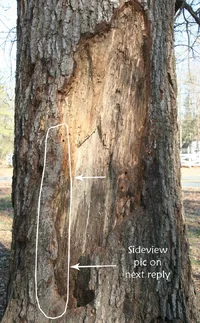
DSMc... the affected bark above the original wound (see pics at my post on 3/13 at 9:44pm) hasnt had a chance to start "curling" inward, since the progression of the fungal/insect affliction is continually spreading. What I will say, is that the areas of bark towards the center of the area of bark seperation and closer to the original wound are very much dried out... so... dead... I will use care and much observation when hacking out the areas that are close to the boundry of bark seperation. (lol...by hacking, I mean I am using a very small, carefully controlled hatchet... not a splitting maul. )
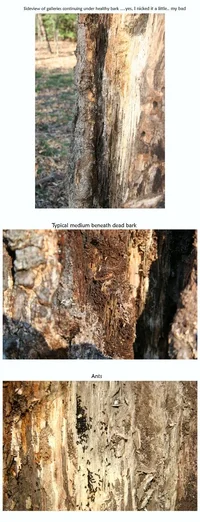
guymayor... yeah, I've learned that the infestation is probably a secondary result of, at least, the original wound (also shown in the above mentioned pics) and either the result of additional stress by either a lightning strike or what you are thinking is some other form of infection. I will say that, if you go back and look at all of the photos I attached, you will see that the major affliction as well as the black, burnt-looking legions do not extend as far as ground level. The data I am using to assess the idea of a lightning strike with is at your fingertips.. the pics posted on 3/13 at 9:38pm.. and I will mention that there a few of those type marks, each of them similar in size (see the holly leaf in lower pic @3/13-9:38), extruding from a small hole in the bark, and within apprx 3-4 feet of the ground level. Does this sound more, or less, like what you are thinking? I will check the link you offered shortly. Either way.. if you are coming out this way in about a month, I'd be very grateful for a eyes-and-hands-on... please keep an eye on this forum as the time gets closer, and maybe we can talk about a visit when that time draws nearer.. You say "up" for a visit, and at about three hours away... coming from N. Carolina, or more out towards Roanoke?
JP (aka treesandsurf)... thanxx for keeping an eye on this forum... appreciate it... the nematodes sound like the possible next step I will take after stripping the dead bark and bagging the questionable anomolies and having them analyzed. The idea of injecting a microscopic parasite into the holes to kill the bugs does sound very cool. I worked at a big tree nurserey for a couple of years (Watkins, in Midlothian, Va), and they used certain wasps as predators for certain other pests that were detrimental to the trees and shrubs... lol... unfortunately, they still could sting people! But yeah... the idea of microscopic predators that only kill the pests is extremely interesting. I just hope they die afterwards... my well is close by, and I've heard funny things about nemotodes and drinking water. Mahalo, Brah!
Ok... bottom line.. removal of dead, or seperated and failing, bark will commence tomorrow afternoon. Last call for anyone who strongly disagrees with this or anything else. After, and during, that, I will take photos of whatever I find... bugs, rot, whatever looks weird... bag specimens for analysis, then, for the moment, apply the tincture that "Dirt Doctor" suggests for open, barkless areas(see link posted on 3/13 - 9:52pm) ... then apply 10-10-10 and apprx 4" of mulch out to the drip-line.
I'm really liking this whole thing... maybe I should work towards being an arborist... or an archeologist... I'm not sure... keep you all informed asap.. And thanxx again to all for your excellent help and advice.
You all have quotes affixed to your signatures... so here's mine... for this situation...
Conquest is easy. Control is not.
~Kirk, "Mirror, Mirror"
stardate unknown
lol...
or maybe this...
Do not follow where the path may lead. Go instead where there is no path and leave a trail.
~Ralph Waldo Emerson
Soon,
~Adam
All seen to agree that removal seperated from heartwood is a good idea... either that, or I am the guinea-pig for a grand conspiratorial experiment Either way... I'm sure the tree wont survive without intervention... so...In reply to others since my last post...
DSMc... the affected bark above the original wound (see pics at my post on 3/13 at 9:44pm) hasnt had a chance to start "curling" inward, since the progression of the fungal/insect affliction is continually spreading. What I will say, is that the areas of bark towards the center of the area of bark seperation and closer to the original wound are very much dried out... so... dead... I will use care and much observation when hacking out the areas that are close to the boundry of bark seperation. (lol...by hacking, I mean I am using a very small, carefully controlled hatchet... not a splitting maul. )
guymayor... yeah, I've learned that the infestation is probably a secondary result of, at least, the original wound (also shown in the above mentioned pics) and either the result of additional stress by either a lightning strike or what you are thinking is some other form of infection. I will say that, if you go back and look at all of the photos I attached, you will see that the major affliction as well as the black, burnt-looking legions do not extend as far as ground level. The data I am using to assess the idea of a lightning strike with is at your fingertips.. the pics posted on 3/13 at 9:38pm.. and I will mention that there a few of those type marks, each of them similar in size (see the holly leaf in lower pic @3/13-9:38), extruding from a small hole in the bark, and within apprx 3-4 feet of the ground level. Does this sound more, or less, like what you are thinking? I will check the link you offered shortly. Either way.. if you are coming out this way in about a month, I'd be very grateful for a eyes-and-hands-on... please keep an eye on this forum as the time gets closer, and maybe we can talk about a visit when that time draws nearer..
You say "up" for a visit, and at about three hours away... coming from N. Carolina, or more out towards Roanoke? JP (aka treesandsurf)... thanxx for keeping an eye on this forum... appreciate it... the nematodes sound like the possible next step I will take after stripping the dead bark and bagging the questionable anomolies and having them analyzed. The idea of injecting a microscopic parasite into the holes to kill the bugs does sound very cool. I worked at a big tree nurserey for a couple of years (Watkins, in Midlothian, Va), and they used certain wasps as predators for certain other pests that were detrimental to the trees and shrubs... lol... unfortunately, they still could sting people! But yeah... the idea of microscopic predators that only kill the pests is extremely interesting. I just hope they die afterwards... my well is close by, and I've heard funny things about nemotodes and drinking water. Mahalo, Brah!
Ok... bottom line.. removal of dead, or seperated and failing, bark will commence tomorrow afternoon. Last call for anyone who strongly disagrees with this or anything else. After, and during, that, I will take photos of whatever I find... bugs, rot, whatever looks weird... bag specimens for analysis, then, for the moment, apply the tincture that "Dirt Doctor" suggests for open, barkless areas(see link posted on 3/13 - 9:52pm) ... then apply 10-10-10 and apprx 4" of mulch out to the drip-line.
I'm really liking this whole thing... maybe I should work towards being an arborist... or an archeologist... I'm not sure... keep you all informed asap..
And thanxx again to all for your excellent help and advice. You all have quotes affixed to your signatures... so here's mine... for this situation...
Conquest is easy. Control is not.
~Kirk, "Mirror, Mirror"
stardate unknown
lol...
or maybe this...
Do not follow where the path may lead. Go instead where there is no path and leave a trail.
~Ralph Waldo Emerson
Soon,
~Adam