oak borer killing tree?

Hello,

I'm new to this site and was referred by the ISA. I am not an arborist, but I'm Hoping that someone might have the time to help.

I bought my house 3 years ago, about 25 miles east of Richmond, Va., and I have noticed that the "main centerpiece" tree in the front yard has some sort of affliction. The tree is a big beautiful red oak (possibly black... sometimes I confuse the two) and is approx. 40"+ at the base and is 70'+ in height.

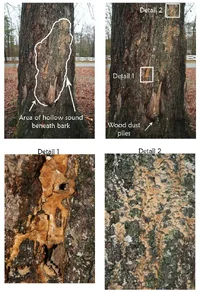
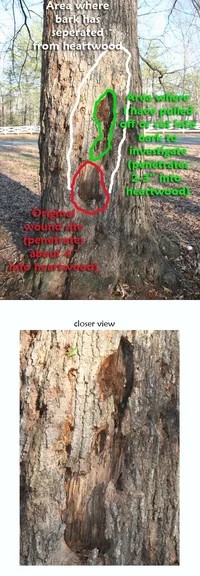
On one side of the tree, the effected area covers about 1/3 of the total circumference of the trunk and spans a height of about 4 feet, beginning at about 18' above the ground... and seems to be spreading upward at apprx a foot a year. I have attached to this posting a composite of 4 photos to help describe the problem. You might even be able to asses the problem just by the photo alone.

I first noticed the larger hole through the bark shortly after I bought the house, which appears to be a very old injury. At that time the hard fungus-looking growth was only just above that hole, within about a foot. Since then the hard fungus-like growth has spread upwards a few feet and slightly outward. As the problem has spread, I have noticed that the bark is seperating from the trunk, as there is a hollow sound when I knock on it. There are also about 20 small holes into the bark, apprx 1/8" - 1/4" in diameter throughout the effected area. Does this sound like some sort of boring insect? Another thing I have seen regularly that makes me think it's a bug, is that on the "shelf" of the larger injury hole, I often see little piles of wood dust, which I am assuming fall out from the space where the bark is seperating.... maybe frass from boring. I cut out a piece of the bark that has seperated from the heartwood, right about in the center of the hollow sounding area, and have found decaying wood that penetrates about 4" deep into the tree before hitting solid wood again. There are a myriad of insects feeding on the decay.

The internet has provided several "answers" that range from statements that insist that the tree must come down, to systemic treatments, to spray treatments, to spraying and then sealing the infected area. I see chlorpyrifos and permethrin mentioned commonly.

We had storms here a few days ago which produced 60mph wind gusts, so I'm fairly confident that it wont topple on its own anytime too soon. As arborists, I'm sure you hear whining about not having much money from people all of the time, and I'm no exception... pretty broke.. but... isnt there something I can do myself to help save this tree?

In any case, if you have any time to look at the attached photo and help me with any advice at all as to what I can do, I would be greatly indebted. I will be extremely disappointed if I cant save the only big tree in my yard.

Thank you very much for your time and any advice you might be able to afford me.


~Adam
 

Attachments

  • 121123-SickTree-composite.webp
    121123-SickTree-composite.webp
    197.4 KB · Views: 173
lol.... ok... I appreciate that extensive advice from someone with a picture of a kid with a Hyena on a chain for a pet... (cool pic, by the way.. I'm a photographer, and I'd like to know about the pic). I see you have 780 posts, which must mean you are highly involved with this site, but I still have questions.

Given the size of the tree, at over a 40" caliper, and that the rotting infestation only goes as deep as 4" into the heartwood on one small area (less than 1 sq. ft.) , doesnt anyone have the opinion that I can eliminate the moist rotting area, kill the pests, then seal the area, and nurture the tree back to health? ...or am I being ridiculously optomistic? I only ask this because I have seen information by a couple of arborists who fully insist that it can be saved with the right care.

Anyone.... do tell... I'd like any opinion of anyone who is knowledgeable. I see that over 30 people have viewed this so far... but just one reply...

Thanxx again for anyone's time to read and reply...

~Adam
 
[ QUOTE ]
lol.... ok... I appreciate that extensive advice from someone with a picture of a kid with a Hyena on a chain for a pet... (cool pic, by the way.. I'm a photographer, and I'd like to know about the pic). I see you have 780 posts, which must mean you are highly involved with this site, but I still have questions.

Given the size of the tree, at over a 40" caliper, and that the rotting infestation only goes as deep as 4" into the heartwood on one small area (less than 1 sq. ft.) , doesnt anyone have the opinion that I can eliminate the moist rotting area, kill the pests, then seal the area, and nurture the tree back to health? ...or am I being ridiculously optomistic? I only ask this because I have seen information by a couple of arborists who fully insist that it can be saved with the right care.

Anyone.... do tell... I'd like any opinion of anyone who is knowledgeable. I see that over 30 people have viewed this so far... but just one reply...

Thanxx again for anyone's time to read and reply...

~Adam

[/ QUOTE ]

Several hundred arborists on this forum and all you get is one shotgun "remove the tree" response??

Adam, seems you are either trolling (which I doubt) or an extremely diligent and thoughtful homeowner (which I suspect). What you've showed in the pictures does not look too good, but I wouldn't condemn the tree based on what I've seen yet, which isn't everything. If this truly is a 'centerpiece' tree in your front yard, spend the money to hire a consulting arborist and get expert opinion/advice on this tree.

If that isn't an option for you, at the very least get some mulch around that tree, to help the root system (this is by no means a fix).

http://www.treesaregood.com/treecare/mulching.aspx

Second, you should be taking pics of the canopy as well, showing any major dieback (where there's no new growth) throughout. If you have boring insects (which is indicated by the presence of frass which you pointed out), then that is a sign that there are other problems going on. The pest is usually secondary, now find the primary cause.

Lastly, I would consider asking Tom Dunlap or Mark to move this thread to the general discussion section as you will get more/better responses. Good luck and keep the pics coming.

Oh and BTW, don't seal anything!

jp
grin.gif
 
JP... you're "the man"! Thanx much for your reply... much more the type of useful input I was hoping for.

You mentioned taking pics of the canopy to account for major areas of dieback. I have included one pic of the entire tree so that you might get an idea of the overall tree form. (pay no attention to that powerline running in front of the tree, I have a generator if it falls on it.. who needs their electricity anyway ;) Here in Virginia, the deciduous trees are just now starting to "bud-out" and there is just now beginning to be emergence of new leaf growth... so determining die-back is difficult, but, I have closely looked over the entire canopy and I see new growth coming in everywhere there are branches. Looks healthy so far. Only the very lowest branch, which is about 5-6 inches in diameter is dead.. and I'm thinking that's a natural occurance. Also, the tree has had that lean to the left ever since I got here, and hasnt gone further. I have a way that I check it by standing in the house , looking out a certain window at the tree and lining it up with the vertical frame of the window.
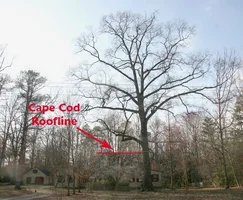
Seems that I can only attach one photo at a time, so I'll send this one, then continue in the next reply.....
 

Attachments

  • 121372-Entiretreeinfrontofhouse.webp
    121372-Entiretreeinfrontofhouse.webp
    56 KB · Views: 140
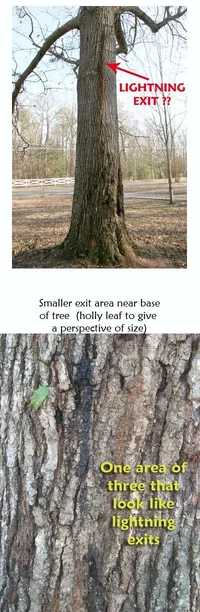
ok.... next... I have been given a clear impression that this borer dilema is a secondary result of the tree being stressed. Along with the original wound at the base of the effected area, I have come to realize that the tree has been hit by lightning.... or thats what it looks like to me. I'll attach the photo of the areas that look that way to me. With my fingernail, I scratched the burnt looking spots of the smaller burnt areasand it smells burnt...

Attaching that photo... then adding to reply
 

Attachments

  • 121376-Lightningdamagecomposite.webp
    121376-Lightningdamagecomposite.webp
    152.5 KB · Views: 124
here's another pic to refresh the image of the affected area and some details about it....
 

Attachments

  • 121379-Affectedareacomposite.webp
    121379-Affectedareacomposite.webp
    214.3 KB · Views: 137
and finally... my last post for the night (sorry about the seperate posts, could only send 1 pic at a time)

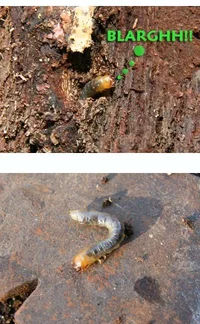
While I was digging around in the area I took a chunk of bark out to examine, I came across this little fella... (see the pic)

Also... I found an internet site run by an arborist who offers advice. "Dr. Dirt" The "seal" I was referring to was his "Tree Trunk Goop" Lots of threads on this site...

http://www.dirtdoctor.com/dallasnews.php?id=376


Ok.... thanx in advance for any replies... and thanx again, JP.

PS~~How should I go about doing what you suggested (asking Tom or Mark to move the thread?)
 
Adam,

From the pictures it does seem like a lightning strike.
The larvae is a wood boring insect possibly in the family Buprestidae. I am not an entomologist though. You can take your larvae to one for confirmation. Any universities near you?

What concerns me is the black tar like substance on the trunk. It could very well be Hypoxylon. Google it and find more info to read.

To be 100% certain take a piece of the bark with it on it to a diagnostic lab and have it Identified.

Follow treesandsurf's advice and get some mulch over the root system, out to the dripline.

In my experience Hypoxylon has been a 1 way trip to a dead tree. But maybe not always.

With a lightning strike you also need to factor in root die back and the potential of root rot.

Definitely get a Registered Consulting Arborist to assess the tree.

Good luck. and keep us posted with the outcome.
 
find a certified arborist experienced in assessment to visit your tree. The tree is worth $1000's, so if you will not spend a couple hundred to maintain the tree...The injured area is >1'; it sounds like you are not getting the size of the problem. NoBivy may be right.

it does not have hypoxylon; the black lesions are phytophthora, most likely, which is treated by a trunk drench with phosphite. First pull off dead bark and rotted wood, down to the soil line, and take another picture. do not injure living tissue.

that ridge may be from lightning but may also it may just be reaction wood from the tree twisting in events like hurricane isabel. pm me if you want details on a visit; i go to richmond now and then (3 hours away).

right now you should broadcast 10-10-10 and apply 4" of mulch.
 
hmmm.... Guymayor...

"The tree is worth $1000's, so if you will not spend a couple hundred to maintain the tree...The injured area is >1'; it sounds like you are not getting the size of the problem. NoBivy may be right."

You lost me, bud... not sure what your saying... Its not a matter of choice as to whether I can spend a few hundred bucks on the tree or not.. I simply cant right now... putting my son through college. The value of the tree is not in dollars to me, as to its worth. I'm only trying to save it. You said that the injured area is greater than 1', but what does that mean? The more I learn about the state of this tree, the greater the "size of the problem" appears to be. There is the old injury to the bark, which probably invited the borers, and now I discover the lightning strike evidence as a further stress.

Please... whoever reads this information and plea for advice, be sure to look at the attached pics on EACH of my replies. There are a number of informative photos.... some better than others...

I'm not sure where all the concern is coming from about the pic with the black BURN MARKS.. I dont think these are any sort of diseases.. just "exit burns" from the lightning. Be sure you are looking at all the pics... the first pics were taken just after a rain, so the bark is much darker... maybe thats what you are seeing. The more recent pics look better. Like I said, I scratched the 3 or 4 small burnt areas with my fingernail, and it smelled like cinders, or something burnt. Not sure why all the speculation about this. I'm fairly certain that it was a result of the lightning. I dunno... I am no arborist, but I've seen plenty of trees stuck by lightning, and seen burns at the exit area(s) near the base before. (as a sidenote, someone remind me to post the pic I got of a 60+" Beech that absolutely EXPLODED into splinters when it was hit by lightning... its a cool shot)

As for the other advice, mulching and gentle fertilizing, ..I think I will start with that for now. What I think is important, other than assisting the general health of the tree, is the situation with the borers and the area where they are working. I gave a link to the guy who has reccomended injecting nemotodes and the like(see reply above)... any suggestions or comments on this method?? Any other ideas for killing the borers?

Guymayor, if you do come to the Richmond area sometime, I'd be happy to get a look at it from you for a few minutes of your time at the price of whatever Great American Bartering System deal we could manage.. maybe a few bucks could be traded as well. I, myself, thought it might be a good idea to strip away the bark that has been hollowed out beneath it, so as to let the rotting wood dry out. Even the small chunk I took out to examine things has dried out nicely... which I figure inhibits the bugs. Anyone else got comments on that??

I know that this thread is probably getting pretty long at this point, but if anyone who wants to gain knowledge about this particular type of case has the time, please look over the replies and my attached pics in each of my replies carefully, make a reply of your own if you have advice, and maybe we can all learn how to help this type of situation.... I'm sure it's not the first... and I'm sure its something that might make you guys better money and reputations in the future.

Thanxx again for anyone's time to review and comment on this case :)

~Adam
 
By The Way..... No Bivy... your screen name shots are CRAZY! lol.. The first was the African kid with the pet Hyena on a chain with a studded face collar... and at first, I didnt realize how INSANE the GIF image of the wrestling clip was... WHAT A FACE SLIDE!! I Love the other aboristic images I am seeing, but yours are quite entertaining. :)
 
Clearly my disease id from a medium res photo are not as honed as guymayor's. It could be phytopthora (bleeding canker).
If you want to know for sure take a sample to a disease diagnostician.

The concern over the "burnt" areas is that several diseases are expressed in that manor. And when I see something like that on the trunk I look into it and find out what it is, by taking samples to the diagnostic lab at the local university. If the results come back negative for fungal pathogens I can rule that out at that time.

There is a lot going on with your tree that all the pictures in the world still will not give us the whole story.

The process of a consultation to diagnosis the tree is a complex and thorough process. Not something that can be done from hundreds/thousands of miles away. If you what answers that result in management options then you need to work out having a qualified professional to visit you and your tree.
 
Are you sure the larva are borers? It looked like the critter had prolegs which would mean caterpillar,like carpenterworm moths.

I don't know if it makes a huge difference or not. The best treatment I have heard for the moths is also parasitic nematodes (which is just cool as $hit, if you ask me).

I have more experience with pine borers, and there's not a whole lot of anything you can do for that problem but hope they don't dessimate every pine on the property. I don't know if oak borers are similar.

And I agree with the advice to take bagged samples to the nearest university, or cooperative extension. Our extension agents are fantastic; very knowledgeable and if they can't answer your questions satisfactorily, they will point you in the right direction.

It's either terminal or not. You know? So the sooner you find out, the sooner you can do the right thing about it.
 
ok, great.... so for the moment, the concensus seems to be that I should bag some samples of the burnt areas, any critters I can find, and... anything else? There are a few colleges in the area, and I'll track down the local extension agent as well.

The nematode injection idea is also mentioned in that "Dr Dirt" guys site, the link is about halfway back up to the top of the forum.

Guymayor, while I'm getting things together for analysis, you think I should strip away all of the bark that has seperated from the tree? I thought the same thing, so that the galleries, most insects, and moisture promoting further rot will be eliminated... just wasnt sure that exposing that area might not somehow be detremental. Anyone else think this is a good move, too?... or not? I'll wait until Monday or Tuesday to do it, in case someone throws up a red flag.

As far as getting an arborist out here for a hands on visit, I'm working on that. Like I mentioned, money is an issue for me, but I have a friend who occasionally works with an arborist on the weekends... trying to get him here.

Many thanxx again for all of your input(s). I feel like I'm starting to get somewhere. :) I'll keep an eye on this forum daily and post a few new new pics when I strip the damaged area.
 
Adam, You have done a nice job on decent pictures and a desire to become informed about your tree. This is a good site for that. Please understand that without actually being on site it is very difficult to make an accurate assessment. Tree biology and the interactions of environment and pathogens can be very complex. Contacting your extension office or a university to get samples analyzed is a great suggestion.

Pulling off the loose bark, also a good idea. As long as you are dealing with dead bark only, there will be no additional harm to the tree and some possible benefits.

Depending on the age of the injury, the new bark should have created a slight inward roll and the old bark should separate readily. If you start pealing off sheets that look like they have white cambium tissue attached (slippery white inner bark), you have gone too far.

If you use a friend of a friend who says he is an arborist, please check his credentials. The term arborist is getting thrown about pretty loosely these days. Just because he works in trees does not necessarilly qualify him for diagnostics.

Good Luck.

D and S Mc
 
gazer my guess at (not ID of) phytophthora is based on seeing a lot of red oaks in this area get it. good idea to ask agents but do not expect a lot; these things are hard to culture, so even if they do not ID a pathogen does not mean the tree is not diseased.

it's more important to do the right things culturally.
taking off dead bark is needed to see how bad the problem is, and it will expose the bugs to control methods. but the bugs are not the primary problem.

your diagnosis of lightning does not seem based on much data. See page 8 here http://www.tcia.org/PDFs/TCI_Mag_June_07.pdf infection from the soil is most likely; if the dead area is widest at the ground, that would be an indicator.

i sympathize; i have a kid in college too; he is working fulltime on springbreak, starting tomorrow, so he can pay most of his own expenses. I'm glad to negotiate some arrangement; will be up in a month or so.
 
[ QUOTE ]
The best treatment I have heard for the moths is also parasitic nematodes (which is just cool as $hit, if you ask me).

I have more experience with pine borers, and there's not a whole lot of anything you can do for that problem but hope they don't dessimate every pine on the property. I don't know if oak borers are similar.

[/ QUOTE ]

That is cool as $hit! I wonder if there are species of nematodes that attack pine borers and oak borers??

[ QUOTE ]
I'm glad to negotiate some arrangement; will be up in a month or so.

[/ QUOTE ]

Do it, if at all possible.

jp
grin.gif
 

New threads New posts

Back
Top Bottom