? number of spider legs = more stable.

theXman

Branched out member
Location
MD, USA
on another post about amsteel, Jeff Cockran and I were discussing what is more stable, 3 legs or 4 legs.

He is saying that all his rigging manuals and 12 rigging schools and such; all say that 3 legs are better than 4 legs.

I do not understand this and we will hopefully continue to discuss here.

I haven't researched this, but just using the models in my head; this doesn't make sense to me that 3 is better than 4.

Now, on most tree picks, I do use three, but I think 4 would be more stable.

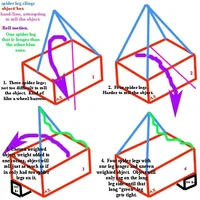
Look at my attachment. I've tried to show what I've been thinking about.

Read the colored text to understand the components in the attachment.

Hopefully Jeff will continue here. As he says he's a "certified rigger" and I want to understand.

What do you other guys think?

He was saying, "Three is mathmetically stronger than four" and if you have 4 legs, two legs could be holding all the weight, but if you have 3 legs, those three legs will have all the weight."

None of that makes a bit of sense to me! ???

4 is mathmatically stronger than 3.

and if you have 4 legs; if slings are not correctly placed or the object is weighted oddly, it will only roll until one of those other legs gets tight and stops the roll.

on three legs, if they weren't positioned correctly or the object was weighted oddly, if it rolled away from the third leg, nothing would stop it, it would flip. When using 3 legs, there is much more of a chance that the weight could be only held on just two legs, MUCH more of chance than if you had 4 legs.
 

Attachments

  • 164203-fourboxescompletecopy.webp
    164203-fourboxescompletecopy.webp
    50.8 KB · Views: 267
Tree parts are much different than fixed objects as everyone is different. If the legs are equalized AFTER the cut is made I would think the wieght would be distrubuted equally as long as the angles are simular. That should also reduce movment to very minimal. In this pic notice the leg closest to the cut. It has a steeper angle and will have more tension. This could be midagated by having longer slings on the tip end.
 

Attachments

  • 164211-DSCN3271.webp
    164211-DSCN3271.webp
    289.7 KB · Views: 219
[ QUOTE ]

He was saying, "Three is mathmetically stronger than four"

[/ QUOTE ]


You should go back and read where he said "3 is not mathematically stronger than four, but... due to the fact you can accidentally weight just two of the sling legs. in a three leg bridle this is not possible."


My opinion is that all loads should be considered differently in terms of rigging. Sometimes three might be better than four. Sometimes four might be better than three.


SZ
 
[ QUOTE ]
And I like your attachment.

The next time we remove a cube shaped tree, we will refer to your diagram.

[/ QUOTE ]

LMAO!
applaudit.gif
You are the king of one liner punch lines...
 
I used a geometric shape so that we won't be guessing as to where the weight is.

To see the "weaknesses" I thought it was better to use a shape instead of a complex limb.
 
The whole idea is based on sling anchors in relation to COG. Sling angles are based of these relations.

In Tod's picture, moving the butt sling further up the trunk decreases the angle but increases the load at the anchor. For "normal" sling angles, I generally figure with as though relation is linear, although it's not, which shows more as the angle gets flatter.

3 can be loaded on 2 just as easy as 4 can be loaded on 2.

Relatively, it's just as possible as 4 to be loaded on 1 as 3 could be loaded on 1. (A 2klbs pick with 95% of the weight on one sling), the other sling just balancing it in place.

Saying that 3 is safer than 4 because it's not possible to only load 2 is both inaccurate and dangerous to say without a list of conditions that would have to be disclaimed for such a statement to be accurate. I agree with Zimmerman, every load is different and should be treated as such.


Carl
 
[ QUOTE ]


Relatively, it's just as possible as 4 to be loaded on 1 as 3 could be loaded on 1. (A 2klbs pick with 95% of the weight on one sling), the other sling just balancing it in place.

Saying that 3 is safer than 4 because it's not possible to only load 2 is both inaccurate and dangerous to say without a list of conditions that would have to be disclaimed for such a statement to be accurate. I agree with Zimmerman, every load is different and should be treated as such.


Carl

[/ QUOTE ]

Yes.

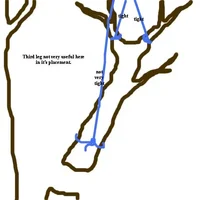
in this diagram, the third lower leg is not doing much at all. Weight is being held on the upper two legs.
 

Attachments

  • 164234-notuseful3rdleg.webp
    164234-notuseful3rdleg.webp
    17.1 KB · Views: 131
It\'s a mathematical point

Sure, you can defeat the advantage of the 3-legged sling by doing a really crappy job of arranging the legs, just as you can guarantee a 4-legged sling will only have two legs loaded by making the other two legs a mile long.

But if you assume an intelligent operator and a load whose CG can be arranged more or less in the middle of the sling attachment points, then Jeff's mathematical point holds. In the case of 3 legs, you could add or remove a few inches from any leg with very little effect on relative loads. With 4 legs, adding a couple of inches to one leg could completely unload it. Do the same to another leg and you have only two legs working. With 3 legs there is no such vulnerability. What's more, the 3-leg setup easily absorbs changes in the load, like a limb bending or a sling slipping, with almost no effect on relative loads. The 4-leg setup is extremely vulnerable to such changes because it absolutely depends on all 4 legs being exactly the right length.
 
Re: It\'s a mathematical point

[ QUOTE ]
...But if you assume an intelligent operator and a load whose CG can be arranged more or less in the middle of the sling attachment points, then Jeff's mathematical point holds. In the case of 3 legs, you could add or remove a few inches from any leg with very little effect on relative loads. With 4 legs, removing a couple of inches from one leg could completely unload it. Do the same to another leg and you have only two legs working. With 3 legs there is no such vulnerability. What's more, the 3-leg setup easily absorbs changes in the load, like a limb bending or a sling slipping, with almost no effect or relative loads. The 4-leg setup is extremely vulnerable to such changes because it absolutely depends on all 4 legs being exactly the right length.

[/ QUOTE ]

There's the disclaimer I was talking about. It's also assuming the 4 are set up equally share the load. If you have a hard time getting 3 points to enclose the COG so you add a 4th leg to catch it in case the COG falls out of the triangle, you still have 3 legs doing the work on a 4 leg set up.

Which goes back to me saying that's it's faulty (assuming) logic that shouldn't be used to validate ideas to an audience that has people grasping to understand the "basics."

"Every load is different and should be treated as such." Using generalities to explain things to beginners leads to a faulty understanding which can lead to their learning curve rising faster than most care for.
 
Re: It\'s a mathematical point

exactly! how many- unbroken in slings- are the exact same from the factory? for that matter, on some engineered picks i did, on some pre cast concrete, the rigging they sent to do the job rarely held level; do to the concrete density. meaning one side was heavier than the other. we had to add shackles and 10 ton chain falls to adjust for the weight. any rigging can be compromised by stupidity or operator error. if you jack a load on something you can unload any sling in a rigging operation. only as a rule of thumb, is three stronger and safer than four. it is unequivocally up to the rigger and the circumstance what rigging is placed and how. as far as a box goes, basket one sling from ancor to anchor on the narrow side place a snatch block in the bight, hook up your three leg bridle adjust for cg being level and away you go nice and safe. although putting on a four leg bridle that can handle the weight on two legs would be faster in that situation. i've seen the aftermath of not heeding this: a rigging foreman at barnhart was told to go pick a container with icabod, the largest stiff leg derrick on the east coast, with a 2 inch four leg bridle. he didn't he used four softies that could handle the weight mathematically. the container was full of oil. the fluid shifted during the lift weighting two or even one of the legs, who knows, the load was compromised, the rigging failed, dropping the container. the oil was everywhere and they where lucky no one was killed. the moral of the story; rig for two to pick attach four for stability. just my $.05 worth
 
Re: It\'s a mathematical point

and its cochran dick head, i know you can read please don't miss quote me and intentionally spell my name wrong.
 
Guys, on crane work, it's all about controlling the weight. If we're gonna have better control using 4 legs and no shock load to the crane, that's how we'll rig it. If 3 legs will do, fine. Weight obviously is an issue, but shock load and control are also considered.
 
Man I'm glad I never use more than 2 straps. Besides who's got time to run around the tree setting 3-4 straps, oooo the bucket boys do. silly me?? I like to have my straps set and ready by the time the ball gets back to me.

Heres where the gun fire comes about using more straps.
 
I used only two straps for years, didn't know any better. For the most part we still use one or two straps. If I really don't want the piece to move the 20' tenex comes out of the box. Only time I've ever used four straps was taking huge tops with small diameter limbs. I was afraid they would break so I put 4 just to be really safe.
 
Re: It\'s a mathematical point

Hmmmm.

I honestly did not mis-spell your name on purpose.

But I have done that to others in the past on purpose, so I guess I deserve that.

Going from one thread to the other, I didn't have your name in front of me to be sure of the spelling and I didn't for a second think that I might be spelling it wrong.
There is a family in our area with the name Cockran, maybe that's where I got that from.

It's funny, I'm actually not trying to be confrontational on this particular thread, but I keep getting accused of it.

Maybe I should just be confrontational all the time, that way at least I'll get flack for what I am trying to do.

This is all good information and I'm going to try and not get mouthy. I'm going to try to overlook that you called me a dickhead for now. Because I can see where you thought I mis-spelled your name on purpose.

Now if your willing, I'd like to continue the discussion.
 
most of the time on crane jobs we use two climber one playing the yo-yo rigger (usually my job i'm a rope stuffing fool ; ) more times than not we use 1/2 inch steel single leg and take smaller pieces and make more picks. my boss likes it that way. he says its faster. less to mess with on the ground.
 
Re: It\'s a mathematical point

[ QUOTE ]
In the case of 3 legs, you could add or remove a few inches from any leg with very little effect on relative loads. With 4 legs, removing a couple of inches from one leg could completely unload it. Do the same to another leg and you have only two legs working. With 3 legs there is no such vulnerability.

[/ QUOTE ]

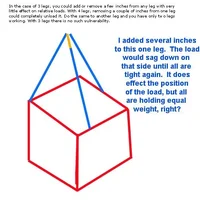
With Moray's wording here, I decided to draw and figure this point out.

first diagram, three legs, with one leg longer. Moray's words are above.
 

Attachments

  • 164285-3slingsonelonger.webp
    164285-3slingsonelonger.webp
    36.1 KB · Views: 151

New threads New posts

Back
Top Bottom