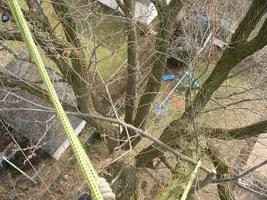
Nice Elm

hey who's the guy trying to limb walk in that picture
laugh.gif


jp
grin.gif
 
Hey Mark, what about RVT?

Whad'ya think?

Is it just fancy drop crotching/heading back?

I think so, but it is an excellent way of selling a crown reduction.

Lets face it you hardly ever find those nice natural target pruning points in just the right place to create a perfect crown reduction let alone a perfect thin.
 
As I mentioned before, if the tree is in good health, then I prefer to leave as much live growth as possible. I don't allow customers (like this one) to think that I can "thin" the tree enough to prevent wind damage or get more sun on the lawn.

However, if there is a need to reduce long extending limbs that show signs of failing, or the tree has die back, then yes, I agree with removing some branches. I am very careful about what I choose to remove. I believe that the best course of action then is to remove smaller portions close tothe ends of the branches rather than interior branches or larger portions.
 
In a scenario where the tree needs pruned to reduce the wind sail/lever arm effect, I prefer this combination of thinning and reduction, I also try to steer clear of removing any inner branches(this was not always the case).

I do however remove large structural limbs if I feel that they maybe structurally poor(included bark etc), it really depends on tree species and where the final pruning wound is located, avoiding a large wound in a structurally significant area of the main stem is also in my mind when carrying out a pruning operation on a large mature tree. I might sub-dominate one of the stems on a twin stemmed included bark union.

I do like the way the guy describes Reduction Via Thinning and it's long term benefits for both tree and client.
Its also interesting to see that he includes a copy of the article outlining RVT in his quotation for the work.

I think having properly written documentation on what your doing to the tree and why you are doing is an excellent addition to a quotation.

More arborists should do this.

But I do agree that the Elm looked great. And if any tree needed a lighter touch it was that one. It looked as though you guys were never there.
 
[ QUOTE ]
It looked as though you guys were never there.

[/ QUOTE ]

That is usually what I try for. I like it when a tree "just looks cleaner" and doesn't have huge cut marks around the base where everyone driving by at 50 MPH can notice that there was work done.
 
I wish I had a huge Amer. elm in my yard , I'm stuck with all Ash and Poplars . Some people have some cool trees and thier yards and you wonder if they appreciate a tree that large .
 
I think that this tree needs to be topped........ that might reduce the windsail......

No really, that was a bad idea(trying to reduce windsail that is..... oh topping too!) did anyone see Dr. Gilman's study on reducing windsail? After I listened to one of his presentations, and then talked to him about the subject, I will never try to reduce windsail again...... ok 1 exception, Bradford Pear.... this engineered "disposable" tree needs lots of help, and some unorthadox pruning to keep it upright.

Mark, I think that you were right on with your treatment.... Great job!
 
Thats a great old tree just like our Live Oaks here on the island and the Live Oaks have spreads of anywhere from 50 to 100 feet and you can have two climbers in the tree and not touch each other for days.
 
thats right Tom..... I bought a house with two Bradford pears in the front yard..... I cut one down and the other i pruned the heck out of.... every year i pruned all of the "V"'s and left all of the "U"'s 7 years later, it is a pretty nice tree..... but how many of these get this type of treatment?
 
[ QUOTE ]


What, not even using Reduction Via Thinning technique?

[/ QUOTE ]

Could you provide an example of this technique, Grover? I'm intrigued, but I don't want to go through the application process to download the article.


[ QUOTE ]

I always avoid thinning out the inner canopy. If the tree has one that is.

Removal of the inner canopy can lead to decreased stem taper by reduction of secondary thickening due to lack of immediate food source, this then in turn can lead to branch failure or branch death.

[/ QUOTE ]

Any pruning may lead to decreased secondary growth. Primary growth is stem elongation and necessary for trees to live. Secondary growth is the thickening of the stem, and not always necessary in all species for tree survival (ring porous trees such as oaks are one exception). For most trees, stem death would occur due to a lack of primary growth, not secondary growth.
 
my word...biggest american/brandon elm here in calgary is about half the size of the lead on that tree :) That tree is just breathtaking. Its an unfortunate part of our profession that most of the clients dont recognize the importance of the minimalistic prune. They tend to want to see evidence of the work done, but there are always clients that have a genuine desire to maintain the health and vigour of the tree. When you do things right, people won't notice that you've done anything at all, and the right clients will be very happy with it.
 

New threads New posts

Back
Top Bottom