

Hi guys, been a little while since I have visited being that my computer crapped out on me for a little while.
My question is not actually for myself but for a friend who is a hunter. He is wanting to rig a static line in a ladder tree stand so he can ascend and descend as well as bowhunt without ever being untethered. Pretty smart if you ask me as most hunting accidents involve climbing a tree.
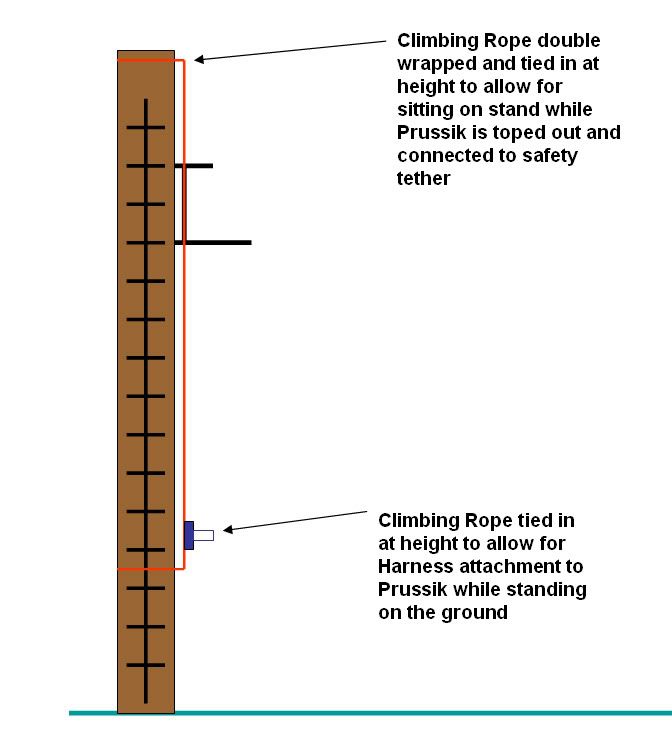
Anyway, he made up a diagram of what he is wanting to do and asked me for some input. I am not an expert at SRT as most of my climbing is done on a doubled rope. He is wanting to rig a static line, anchored at both ends and use a harness with just a plain Jane prussic knot to ascend and descend on. My book "On Rope" describes this as self lining and shows the climber using a Gibbs ascender in conjunction with a shoulder strap drag line. I advised him that a prussic is mainly used for descent on a doubled rope and is only mentioned as use for a back up on a single line. I also told him he will have to use one hand to break the knot while using a prussic. I can find no mention of using a solitary prussic (except for warning against it in most climbing applications) for ascent or descent in On Rope or anywhere else and have never tried it myself.
I thought I would bring the question here and get some input from some experienced SRT climbers.
Here is the diagram of what he is trying to do. Thoughts, opinions, advice is welcome. I am trying to keep him from killing himself. My fear is that in the event he becomes unconscious he would be suspended upside down or not be able to get back to the ladder and have problems reaching the ground.
My question is not actually for myself but for a friend who is a hunter. He is wanting to rig a static line in a ladder tree stand so he can ascend and descend as well as bowhunt without ever being untethered. Pretty smart if you ask me as most hunting accidents involve climbing a tree.
Anyway, he made up a diagram of what he is wanting to do and asked me for some input. I am not an expert at SRT as most of my climbing is done on a doubled rope. He is wanting to rig a static line, anchored at both ends and use a harness with just a plain Jane prussic knot to ascend and descend on. My book "On Rope" describes this as self lining and shows the climber using a Gibbs ascender in conjunction with a shoulder strap drag line. I advised him that a prussic is mainly used for descent on a doubled rope and is only mentioned as use for a back up on a single line. I also told him he will have to use one hand to break the knot while using a prussic. I can find no mention of using a solitary prussic (except for warning against it in most climbing applications) for ascent or descent in On Rope or anywhere else and have never tried it myself.
I thought I would bring the question here and get some input from some experienced SRT climbers.
Here is the diagram of what he is trying to do. Thoughts, opinions, advice is welcome. I am trying to keep him from killing himself. My fear is that in the event he becomes unconscious he would be suspended upside down or not be able to get back to the ladder and have problems reaching the ground.


