New to spider legs

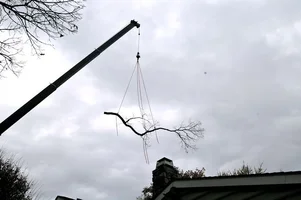
Heavy wood = trunk wood. I use the spider setup on the limbs/leaders then switch over to a eye and eye sling for the trunk wood. The 3/4 Tenex TEC has a 22,400 Lb. Avg. break strength. I don't take pieces so massive that I am above the working load limit of one spider leg, the others are mainly for balance.
 
Hey Jeremy, I like the looks of those 3/4" Tenex TEC slings. I was wondering if you spliced those up yourself or purchased them somewhere.

I was also wondering what lengths you use for the slings too?
 
[ QUOTE ]
A rigged limb....

215038-Picture-032.jpg


[/ QUOTE ]

Awesome Dude!!!
Very nice set up.
 
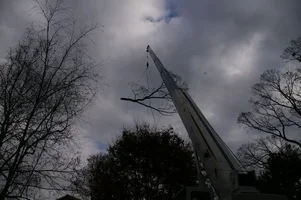
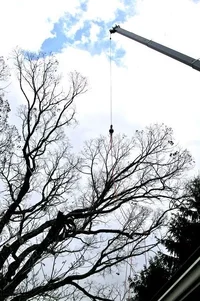
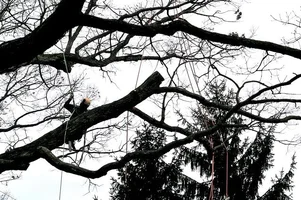
Here is some compiled video of a large white oak removal. The slings are 5/8" Tenex, each about 32' long. I spliced them specifically for this job and left them long. You can always shorten. It's a bit more difficult to lengthen!!

A 20 to 25 foot sling would be a good general purpose length IMHO. I like Tenex. It's strong, relatively inexpensive and if you get damage the inspection process is straight forward. However, snagging is an issue and the next set of slings I splice will be 3/4" Double braid.

The heaviest piece other than trunk wood on this removal may have been 2400 to 3000 lb., if memory serves me correctly. Most were in the 1500 lb range due to landing zone. A few times we tied extra slings just because they were there and we were experimenting.


Tony
 
[ QUOTE ]
Hey Jeremy, I like the looks of those 3/4" Tenex TEC slings. I was wondering if you spliced those up yourself or purchased them somewhere.

I was also wondering what lengths you use for the slings too?

[/ QUOTE ]

I ended up ordering the slings from Knot and Rope Supply. They are 18, 20 and 25 foot. I plan on adding a 30 to the mix soon.
 
I can see where spider legs may come in handy but at times they look really cumbersome. with some of those smaller pics it would have been easier to tip tie close in with one nylon choker and notch cut as the operator lifted. then it would have leveled out easy breezy. just my 2 cents.
 
You can balance them sure but what about rolling a bit.Im not talking about the whole load flipping, just a little clockwise or counter clock wise rotation. Since the straps are only adjustable by taking wraps to shorten them, I think spider legs might be better for zero movement. I also think that a little movement isnt all that bad as long as its anticipated and doesnt put anyone at risk. Just noobs observation.
 
I've found butt tying to be helpful. It eliminates all movement and surprises, then it becomes a tag line for the ground crew. I don't have the option of positioning my rigging point as you can with a crane, so I'm usually off center and going to get a twist so butt tying is worth the time. I've been using the mini port-a-wrap for this.
 
If they are rolling then they are not balanced, and wraping isn't the only way to shorten them. Remember the place to put the sling isn't nearly as important as where the hook is placed, you can wrap the slings to make a major adjustment to the length of the sling and move the sling closer or further away from the hook to make a minor adjustment.

The easiest way to make sure the pick won't move after the cut is to place the hook over the Center of Gravity of the pick, sling it whatever way you have to, have the operator pretension the line, then grab the slings and feel the tension by shaking them, you can tell if one is looser than the rest, have him give you a little slack and side that sling a little farther away from the hook. Pretension, check again, then move down to the cut.

 

New threads New posts

Back
Top Bottom