













Acerxharlowii
Branched out member
- Location
- Greensboro
Ordered tonight!! Boom, thanks Richard!!
Follow along with the video below to see how to install our site as a web app on your home screen.
Note: This feature may not be available in some browsers.
These are cool I've got nothing against them but my rrp also had no spring, I can't really think of any way it's likely to fail works smooth, I can drop a slic pin but it looks like you could drop one as well, the other climber on our crew dropped his hitch cord the other day and had to spend 10 minutes looking for it. Either is fine it's just largely just preference, that said doing multiple small prunes like 10 trees in a day speed of setup matters to me and 3 slic pins for me is way faster than having to set up a hitch....and because I know someone will write, just go with a, fill in the blank mechanical...
I don't have "big top exposure", I don't worry about something collapsing in a 3:1 or other other MA, or re-direct or dragging my tail over a branch. I don't have a spring to break, get weak, stick or otherwise fail to engage when I need it.
Hitch cord for me most of the time.

Fair enough but let me make a couple of points.These are cool I've got nothing against them but my rrp also had no spring, I can't really think of any way it's likely to fail works smooth, I can drop a slic pin but it looks like you could drop one as well, the other climber on our crew dropped his hitch cord the other day and had to spend 10 minutes looking for it. Either is fine it's just largely just preference, that said doing multiple small prunes like 10 trees in a day speed of setup matters to me and 3 slic pins for me is way faster than having to set up a hitch.

... IMO every good multicenter must have a spring or method to automatically engage the rope and a climber should be aware of what it is and how it works. Mechanicals have a mechanical spring, on a hitch based system, the "spring" is in the way the hitch is tied...
I can appreciate not being enamored.I'm not entirely enamored with your "spring" interpretation or the requirement of it for engagement with a mechanical and particularly with a hitch.
'Friction' alone is more than sufficient in initiating engagement. Any rope-on-rope contact 'will' have a frictional component in a well executed hitch system. This same 'contact' as a way of starting engagement, is also true with mechanicals as well.
Where a 'spring or spring-like' action is needed is, when in our quest for friction-free advancement, we purposely remove that contact.
I think we agree. However a device applies "frictional contact", it has to have some variable to keep it in contact. Some tension to adjust to say a slight variation in rope size or shape, just something. That to me is most easily explained as a "spring" whether it be metal, textile or something else that can hold and apply variable tension.Thanks for the descriptive and visual presentation of your reason for using the word "spring" as a descriptor for engagement. It is nice to be able to discuss things without it turning into an argument.
My point was, however, that if the hitch or climbing/clamping device has the adjustability to ensure frictional contact, a spring would only be a performance assist rather than a critical component.
Of the examples of straight through climbing devices shown, only the Unicender has fixed, non-adjustable rope openings. The Akimbo, RR, RRP and, of course, a hitch can be set for continuous contact with the climbing line while at the same time, still releasing enough for slack removal and low friction ascents.
Well to be exact it is not a Quickie and not a shackle but is called a Swing Arm, minor difference I know but it is different.Having not used that system I couldn't say. Looks slick, really cool design. Do you have any frustration with the sit back from the pivoting of the quickie?

The sit back is negligible. Works like a charm! I started thinking about what I was connecting to the swing arm. I have my chest or over the shoulder lanyard. But I was also attaching my knee ascender bungee. In pondering that away from the climb, I think I was working against the self-orienting system. Next outing, I’ll connect to a different spot.Well to be exact it is not a Quickie and not a shackle but is called a Swing Arm, minor difference I know but it is different.
About sit-back, I find it not to be an issue. I make my ascent then sit back, so a few inches out of 50 feet is not significant. If it bothered my I will take the Swing Arm and move the body up and push the hitch up and illuminate all sit back before I 'sit-back'. What always bothered me is having slack on a carabiner attachment during SRT ascent, sitting back to discover the carabiner is sideways or reversed or moved in some other manner. That is my life support and while an SRT device is being tending, for most climbers, it is slack. Having to use keepers or captive eye carabiners to keep things from being side loaded bothered me.
The Swing-Arm is designed to be unaffected by being unloaded. It self orienting, will not go sideways, or have a gate that gets cross loaded.
Not long ago somebody on here made a thread about an Incident they had with their rrrp. Long story short he was out on a limb walk and lost balance and fell to the opposite side of the limb that his tail was on which caused the device to collapse and engage a descent.These are cool I've got nothing against them but my rrp also had no spring, I can't really think of any way it's likely to fail works smooth, I can drop a slic pin but it looks like you could drop one as well, the other climber on our crew dropped his hitch cord the other day and had to spend 10 minutes looking for it. Either is fine it's just largely just preference, that said doing multiple small prunes like 10 trees in a day speed of setup matters to me and 3 slic pins for me is way faster than having to set up a hitch.
I almost use a secondary lanyard/flip line when limb walking as well, oftentimes I'll switch out to my camp giant once I'm in the canopy as well it's just really easy to work with.Not long ago somebody on here made a thread about an Incident they had with their rrrp. Long story short he was out on a limb walk and lost balance and fell to the opposite side of the limb that his tail was on which caused the device to collapse and engage a descent.
I believe no injury just an unexpected spooky descent to the ground.
I believe he was a certified arborist with his own accredited business.
It may have even had an article in the tcia


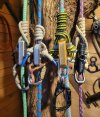

And i thought i had a gear addiction!
I'm a connoisseurAnd i thought i had a gear addiction!

thoughts on the FX?I'm a connoisseur
Dang look at the 2. tinyyyy. Looking forward to more reports on the xf as well.























