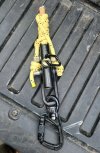
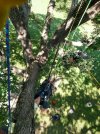
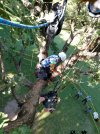
New HitchHikerXF

I feel compelled to mention that my development of the HitchHikerXF was with the complete knowledge of the original inventor Paul Cox. He came up with the ingenious design of the two opposing planes that develop what I call the proportional friction. I put my own inventions into the concept and have spent hundreds of hours drawing and developing this design. Royalties have been paid. I am indeed grateful for people like Paul that give so much to the industry. I don't own a Raptor because my ass needs the exercise but he has done amazing work with that concept and was probably the instigator of it all.
 
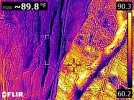
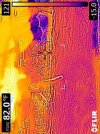
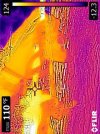
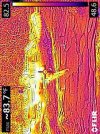
Preliminary heat photos taken with an FLIR E6. There are many and I'll get a detailed description and report but it was fun to take a look today. Two separate descents from about 70', one on RIT and the other on BOA. The display shows the temp at the cross hair and the scale is at the right with actual temperatures in the photos depicted by color. Notice that the highest temp in this set was from my gear sitting on the ground. I think I'll shoot at night to isolate the friction better.
 

Attachments

  • FLIR0013.jpg
    FLIR0013.jpg
    22.3 KB · Views: 22
  • FLIR0033.jpg
    FLIR0033.jpg
    39.6 KB · Views: 17
  • FLIR0034.jpg
    FLIR0034.jpg
    40.7 KB · Views: 18
  • FLIR0041.jpg
    FLIR0041.jpg
    29.2 KB · Views: 17
  • FLIR0040.jpg
    FLIR0040.jpg
    29.3 KB · Views: 17
  • FLIR0039.jpg
    FLIR0039.jpg
    28.6 KB · Views: 15
  • FLIR0038.jpg
    FLIR0038.jpg
    23.8 KB · Views: 16
  • FLIR0037.jpg
    FLIR0037.jpg
    34.4 KB · Views: 16
  • FLIR0036.jpg
    FLIR0036.jpg
    41.3 KB · Views: 14
  • FLIR0035.jpg
    FLIR0035.jpg
    39.6 KB · Views: 22
Good evening.

I am pleased to report that I took the HitchHikerXF for its maiden voyage this afternoon. I'm also pleased to report that it performed as promised.

I have had the opportunity to enjoy the Petzl Zig Zag, the Rope Wrench, the Akimbo, Rope Runner Pro. The HitchHikerXF was fluid, instilled confidence, and was superb at both climbing moving rope and stationary rope climbing.

I'm a recreational climber, and I like to move between DRT and SRT. The HitchHikerXF moved seamlessly between the two.

Thank you Richard for bringing the HitchHikerSF to market. A job well done!
 
Last edited:
Good evening.

I am pleased to report that I took the HitchHikerXF for its maiden voyage this afternoon. I'm also pleased to report that it performed as promised.

I have had the opportunity to enjoy the Petzl Zig Zag, the Rope Wrench, the Akimbo, Rope Runner Pro. The HitchHikerXF was fluid, instilled confidence, and was superb at both climbing moving rope and stationary rope climbing.

I'm a recreational climber, and I like to move between DRT and SRT. The HitchHikerXF moved seamlessly between the two.

Thank you Richard for bringing the HitchHikerSF to market. A job well done!
How do you like it compared to the RRP? Any experience with sap yet?
 
Good morning, Mike.

Quite frankly, I don’t have complaints about any of the devices I’ve owned.

As an example, I think the Petzl Zig Zag has been the smoothest. Quite silky actually. However, not being mid-line attachable presented challenges from time to time. If Petzl can figure that out, watch out!

As far as the Rope Runner Pro goes, super fine engineering and control. It is a large piece of gear in your “face”, and getting around limbs when the rope is pressed against it was noteworthy.

I really like the compact nature of the HHXF, the fluidity of moving between moving and stationary. I like the compact nature and the swing arm moving a knot away from the prusik (so smart!).

I have not had a sap experience, but given the design, it doesn’t seem like it will be finicky. It has a “bring it” design quality in a compact design.
 
Well, just a quick 1st climb on the captive eye. It's nice, didnt take too long to dial in the hitch,shorten up the legs and all good. Very impressed with tending whilst ascending, seems to be a lot smoother than the HHx . I think we are going to get along fine :)
Thank you again Richard for all your work and exemplary service
 
I have not put the HHxf to work yet — but we did get to know each other a little bit; sharing a romantic sunset above the local graveyard.

My early take from a slow rec climb:
  • I loving the Catalan hitch (completely new to me) so far with 5 wraps on the provided "9mm RIT" and a newish "drenaline" (I'm about 165lb/73kg). I also find it easy to tie.
  • The adjustable friction knob is awesome on descents. I'm still experimenting with it. I was quickly reminded that I forgot to disengage it when i tried to tend slack on a limb walk. doh. I think it will remove any hitch-melting-guilt of absolutely bombing down descents once I'm more comfortable with it.
  • Personally, midline attachment in-tree will require some more practice, as I was fumbling around while getting a feel for how the parts interact in hand during my first couple installs.
  • Low profile-Coming from a rope wrench as my only other SRT experience, this thing make me feel at home as if I'm just climbing with a hitchclimber pully and hitch; love it - no more huge carabiner jammed with hitch/pulley/tether fighting for real estate.
  • Tending was mostly painless using my lanyard thrown over my shoulder.


Aside to Richard: I've been studiously watching as many of your youtube vids as I can. I want to say I love your attitude and patience towards climbing. Your thoughtfulness and absolute love of climbing is easy to see. Your content on anchor testing is straight wisdom that is worth its weight in gold for a novice climber like me (1 year part-time+rec climbing). I paraphrase one of your quotes from memory: "We put our rated gear on unrated tree limbs" - I love that. A reminder to pay attention and take a minute to really test the TIP with a sustained load. Thank you for the educational content - I'm looking forward to more.

PS: Im in disbelief that the Climbing Innovations hat fits me! fathead approved

 

Attachments

  • 20220316_190219_HDR.jpg
    20220316_190219_HDR.jpg
    540.2 KB · Views: 59
I have not put the HHxf to work yet — but we did get to know each other a little bit; sharing a romantic sunset above the local graveyard.

My early take from a slow rec climb:
  • I loving the Catalan hitch (completely new to me) so far with 5 wraps on the provided "9mm RIT" and a newish "drenaline" (I'm about 165lb/73kg). I also find it easy to tie.
  • The adjustable friction knob is awesome on descents. I'm still experimenting with it. I was quickly reminded that I forgot to disengage it when i tried to tend slack on a limb walk. doh. I think it will remove any hitch-melting-guilt of absolutely bombing down descents once I'm more comfortable with it.
  • Personally, midline attachment in-tree will require some more practice, as I was fumbling around while getting a feel for how the parts interact in hand during my first couple installs.
  • Low profile-Coming from a rope wrench as my only other SRT experience, this thing make me feel at home as if I'm just climbing with a hitchclimber pully and hitch; love it - no more huge carabiner jammed with hitch/pulley/tether fighting for real estate.
  • Tending was mostly painless using my lanyard thrown over my shoulder.


Aside to Richard: I've been studiously watching as many of your youtube vids as I can. I want to say I love your attitude and patience towards climbing. Your thoughtfulness and absolute love of climbing is easy to see. Your content on anchor testing is straight wisdom that is worth its weight in gold for a novice climber like me (1 year part-time+rec climbing). I paraphrase one of your quotes from memory: "We put our rated gear on unrated tree limbs" - I love that. A reminder to pay attention and take a minute to really test the TIP with a sustained load. Thank you for the educational content - I'm looking forward to more.

PS: Im in disbelief that the Climbing Innovations hat fits me! fathead approved
Thank you for that report. I love how you understand the hitch with the number of wraps and interaction to the climbing line you are using. Dialing a hitch for good tending on ascent and limb walks then just enough so it does not creep, it is not difficult but when I get to that place, I know it's right. One of the great things about a hitch based system is the simple versatility and ultimate control it gives the climber. Your explanation, "...just climbing with a hitchclimber pulley and hitch". PERFECT! It is just that, so NOT complicated and it works.
Again, good to see and you make the hat look SO good!
 
Because friction hitches are so numerous and subject to enormous creativity I will plan on a video of how they relate to the HitchHikerXF. As I have said numerous times, one of the beauties of a hybrid system is that the hitch is your life support. The HHxf merely makes that life support hitch usable and functional regardless of climbing technique.
So almost 10 years ago I did a video on how to remember a few popular hitches. Many of these can me modified and used on the HHxf but will perform differently. It is important to know this and use whatever WORKS for you.

Until them, here is a link to that old video, note the chapters in the remarks so that you can skip to the ones that interest you.
 
Last edited:
That is the Knut H not the Catalan shown in your picture.
came across this document recently and made me think of this thread.

https://www.linkedin.com/pulse/knots-mechanics-genealogy-climbing-hitches-arborists-based-restrepo

if you scroll down to the knut h section, there is a picture and description saying it is specific to the hitch hiker. Immediately following is the description of the catalan (aka arbsession). The diagram is from 2018. Take a look and you'll see what Brocky keeps saying.
 
I wish we were discussing hitches and how to tie them, what their good qualities are for given devices such as this HHxf. Why a spliced or sewn termination is useful or why it is not, especially for the HH. How to get the proper tension into a hitch so that the "spring" function is there to engage the hitch when needed. How a climber builds the preferred amount of tension for engagement into a hitch verses the amount of tension not wanted during ascent and tending. Or how just being focused on great tending may create problems for fall prevention. Or how you balance those for your style of climbing. How with a non sew/spliced eye the hitch cord can be easily adjusted an inch or two to even out the wear points. How it is difficult to create a given amount of tension with a sewn or spliced eye and how the cost for those is different. How different hitch materials react with climbing lines. Hitch cord diameter verses climbing line diameter. The balance between just enough to hold a climber in place and not enough that causes creep. How many wraps are required for a climbers weight and do more or less wraps make a hitch lock-up or create creep. What is the benefit of a double overhand stopper knot on one side and a Stevedore on the other. That list goes on but here we are.

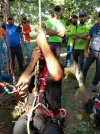
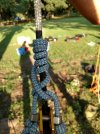
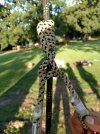
Below photos are from a August, 2018 North American Open Masters (NAOM) competition I attended and an arial rescue workshop that was presented. Remotely tending a victims hitch was presented along with counter balance and other useful techniques for rescue. In that demonstration it was shown how certain mechanical devices react to an overhand knot or micro pulley for remote tending, some strong cautions about how those are done was given. It was demonstrated that the typical hitch used on the HitchHiker at that time would easily collapse and send the victim to the ground, being chased down the rope by a micro pulley. The presenter showed a hitch he called the Catalan. It had a "C" shaped wrap that laid flat against the climbing line at the base of the hitch that changed the action of the hitch when remote tending was used. The "C" shape made the name easy to remember. But it was difficult to tie and properly tension on a HHx as the last leg did not go directly to the eye of the Dogbone. One will note that the commonly used hitch for the HH was simple wraps up and then a return directly to the other eye of the Dogbone. Having that leg go directly to the Dogbone was very helpful in tying and getting the tension of the hitch tight, as mentioned above. Our friend JB did some innovative concepts with rubber tubing to get more "spring" action into the hitch for engagement without having to create excess tension for tending. Later here on here at TreeBuzz it was shown that the Catalan that I learned could be combined with the straight down leg of the original HH hitch. It was in my mind a modified Catalan. The "C" wrap at the base provided good hitch engagement and the straight down or return leg allowed it to be tied easily and control the exact amount of tension that is applied to the hitch for that particular climber. It seemed to be perfect to call it a modified Catalan but there was a desire to call it some kind of a Knut. There is NO Knut form factor in this hitch!

I don't need this drama and I don't care what someone wants to call a hitch! There are thousands+ ways to tie a hitch and as many combinations of letters to give them all names. Go for it.
The hitch discussed does NOT have the form factor of a Knut! It is not tied like a Knut. Putting an "H" on it does not change that. The Knut does NOT have a "C" shape laying flat against the climbing line. If you tie a Knut on the HH it becomes difficult to tension the down leg. If a hitch is modified to work on a particular, device at least have some continuity in the naming or just flat out name it after yourself if that is what a person is after. The HHxf does not limit a person to the hitch of choice for life protection nor does it require a person to use a particular name for a hitch. But in the case of this thread, this device and in the manual written for it, it will be referred to as a Catalan for short or modified Catalan. If I am ever asked where it came from I will give credit to those who have had a hand in creating it and abbreviate it with the acronym TMCBBOTBBSTMFBJANAOM hitch.

P.S. The Innovation' © hitch referred to in that article is different than the Innovation hitch referred to for the HHxf. That hitch was created with a couple of "Distel tucks" at the top to attempt to create the spring tension that JB created with the rubber tubing.
 

Attachments

  • IMG_20180831_113712407_HDR.jpg
    IMG_20180831_113712407_HDR.jpg
    99.4 KB · Views: 39
  • IMG_20180831_093555735_HDR.jpg
    IMG_20180831_093555735_HDR.jpg
    97.5 KB · Views: 38
  • IMG_20180830_185003887_HDR.jpg
    IMG_20180830_185003887_HDR.jpg
    59.9 KB · Views: 39
  • IMG_20180830_184957970_HDR.jpg
    IMG_20180830_184957970_HDR.jpg
    59.9 KB · Views: 40
  • IMG_20180830_155921604_HDR.jpg
    IMG_20180830_155921604_HDR.jpg
    107.8 KB · Views: 45
  • IMG_20180831_175358465_HDR.jpg
    IMG_20180831_175358465_HDR.jpg
    108 KB · Views: 46

New threads New posts

Kask Stihl NORTHEASTERN Arborists Wesspur TreeStuff.com Teufelberger Westminster X-Rigging Teufelberger
Back
Top Bottom