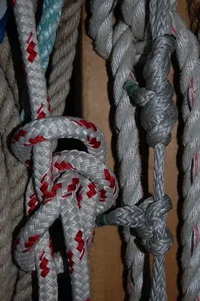
My way of trying a running bowline.

[ QUOTE ]
[ QUOTE ]
Does anyone tie a running bowline the same way I do?

[/ QUOTE ]

I tie it the same way, it is the same way I was taught to tie it also... must be a ohio thing

[/ QUOTE ]

LOL Must be I take it. What part/town of Ohio do you live in?
 
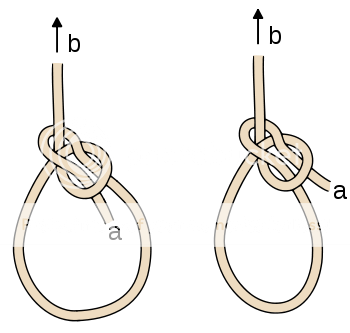
here is the right and wrong way to tie a bowline.
the one on the right is wrong(also known as a cowboy bowline) and the one on the left is the correct way to tie it.

The difference is,
cowboy bowline has the working end go around the standing part on the side closest to the loop and results with the working end outside the loop. In contrast, a regular bowline has the working end finishing inside the loop.

bowline.png
 
Tying the knot the wrong way lowers tensile and allows the knot to come undone on its own. Like many things that are close but not quite correct, it will work, sort of, but could be a key component in a much larger failure.
 
Yeah I tie mine like ricky. Thats how Kristian (whiz)taught me. ALL muscle memory you never stop moving until its done. I can easily tie a running bowline with one hand like that. A really handy skill to have in certain situations!
 
i like the tie it to two trucks, pintle to pintle test .. see who's knot wins.. its on the ground and no one gets hurt.... well everyone gets hurt ,, even if its feelings? "i tie knots better then you"
 
The left or right.... neither is wrong. They're both bowlines. And Ive never seen the "cowboy bowline" come untied.
And I guarantee you the tensile is not greater for one vs the other.
 
[ QUOTE ]
i like the tie it to two trucks, pintle to pintle test .. see who's knot wins.. its on the ground and no one gets hurt.... well everyone gets hurt ,, even if its feelings? "i tie knots better then you"

[/ QUOTE ]

can someone please do this? I have always wondered what difference if any results from the two knot configurations
 
So, this thread is reminding me og the 'Wesspur catalogue pic' - No agreement on which of two ways is 'correct'.

I have studied my running bowline (tie it w/o thinking) and I definately tie a cowboy bowline... I have to re-train my hand to flip the tail inside the loop!

I ask this question because I want to know if it is possible to have the cowboy knot slip out. I have lowered thousands of pieces of wood (with crew members below!) in 13 years. Never had a problem, never had a knot fail.

ZEB! - Maybe you could chime in and better explain your above posts? I keep wondering if anyone has had a 'cowboy' bowline come undone...

thanks!
 
I've been doing some research. I've always heard that it is not as secure of a knot and that the tensile retention is lower. Of the two issues, stability if the knot is of most concern. Anecdotal evidence is that the cowboy bowline has come undone on some folks. Ashleys book of knots for example also says the same things about the knot. Doing some web based research, one link made the statement that both ways had similar tensile retention in break tests. Bottom line is that I don't know. Some pretty reliable sources make the claim that the "cowboy" bowline is an incorrect knot.
The way I tie it is the granny knot flipped with the wrist and it always finishes on the inside, the "right" way.
Mark Adams might be the one to ask the question of. He is the treebuzz resident knot expert/historian.

What do you say Mark?
 
Here is some data to varify what the cowboys already know from years of experience. Check out page 6 of this:

http://www.caves.org/section/vertical/nh/50/knotrope.html

If the link does not work here is what the test concluded:

"The standard Bowline was selected for the test, but the Cowboy or Dutch Bowline was also tested to see if there was a difference. The numbers were almost identical."

Strength of a knot, bend, hitch is directly related to bend radius. Does how you finish a bowline change the bend radius?

Here's another thing the cowboys have learned from years of practical experience. If you use a Bowline midline, finish the knot with a bight of rope (cowboy or standard) and then even out and clip both the knot is stronger (larger bend radius...4 strands passing through the loop) and easier to untie after extreme loading (5:1 towed with big truck, etc)
I would attach a pic if I had the necessary skills.

It's good to know the fine details, but it's also good to know which one matter and which ones don't.

http://gallery.me.com/msauls/100172
 
[ QUOTE ]
Thanks, Zeb.

I too looked thru the internet... would be interested to hear Mark Adams two cents. See below link to Wiki

http://en.wikipedia.org/wiki/Cowboy_bowline


[/ QUOTE ]

The (now current) Wikipedia text fairly well states the case for
these two versions of the bowline. Note the vulnerability of the
"right" way to pull untied if *ring-loaded* (pulling the eye apart).

As for strength differences, that shouldn't be a concern (i.e., they
should all be amply strong, or you've seriously misjudged the load
and your rope!), but some tests have found then equal. And who
knows how the particular knots were set --one can put the tail in
a heckuvalot more places than on one side or the other of a plane,
anticipating the draw of the mainline.

In heavy trawler docklines, one can see the "correct" bowline
capsized; the "cowboy" version resists this capsizing better, too.
(And, so far as historical accuracy goes, I don't know of any sure
connection to Dutch or cowboys; "left-handed" is given in the
sense of "inferior", in Ashley.)

For added security, one can simply take the tail around the knot
body (i.e., make a loop like what the tail goes in/out of) and
bring it out a 2nd time; or make an "around the tree ..." maneuvre
around one leg of the eye (that that flows into the loop, not the
tail) and tuck it back through the central loop (putting a 3rd dia.
of material there, which nicely approximates roundness).


*kN*

[hmmm, 1st attempt has no image file ? ]-:

 

Attachments

  • 283111-knots-Janus_cowboy_bowline-DSC_5556-MM.webp
    283111-knots-Janus_cowboy_bowline-DSC_5556-MM.webp
    56.5 KB · Views: 64
If you look at a Bowline as SheetBend to self to form eye, then would setup just like SheetBend, tail inside.

Also, on olde ship docks, there was fear that the Bitter End of bowline if left outside of the Eye was unprotected and could get hung / or 'grabbbed' by other 'device' and invert the knot to capsize lacing and drop load. This would, be by inverse of slip knot method of tying Bowline.

DBY tied by Slip Knot Method
 
lewser.gif
Good to see ya Spyder, of course you would chime in this discussion, you are the bowline guru.
bowdown.gif


And yes the "outside bowline" is considered inferior safety-wise in most circles, for varying reasons, mostly due to the potential for catastrophic inversion.
 

New threads New posts

Back
Top Bottom