Meriplus giganteus

<u>Meriplus giganteus</u>

Type of rot - White rot(attacks lignin)also soft rot - Brown with white pockets

Location on tree - Lower stem base, rott plate, underside of roots(decay)

Arboricultural significance - Brittle fracture of the roots close to the stem. Windthrow, Dangerous

Hosts - Beech, Oak, Poplar rarely conifers

anyone have any experience of this fungi?
 
Saw this or the remains of it on Swedish Whitebeam(Sorbus intermedia) the other day, never seen it on these trees before.
It was in a public park growing over a well used walkway.
The fruiting body(conk)was big.

It is surrounded by about 10 other Swedish Whitebeams.

Should this tree be removed?
 
[ QUOTE ]
do you have a photo, not familiar with it!

[/ QUOTE ]

Mike, great photos here!
Check out the devastating effects on the giant Beech - scroll down, picture 3

Meripilus
 
Back on a subject that I love to talk about, I´ll copy down some notes from when I was back in college a few years back. Thought I would just share this with you all, these notes were taken when in discussion in our pathology class.

Host: Fagus sylvatica spp. Also observed upon Quercus, Tilia, Sorbus, Platunus acerfolia.

Description: Sporophores are usually very large, tiered frongs at base area, fan shaped, fawn to chesnut colouring.

Upper surface grainy with many irregular shaped pores which are off white, bruising black. (c.f Grifola frondosa) The stipe emerges from the the spore tubes(white, later darker)

Fruiting occurs from July to (generaly) October. The fruit body is very suseptable to frost damage.

Decay: Simultaneous (degrades cellulose and lignin) white rot, which can colonise as a soft rot or maintaian soft rot at early stage.

Initial colonisation is in the the central area of the root (especially the deeper rot anchorage roots) Later decay progresses radially ultimately disturbing xylem.

Significance: Rootplate probably compromised with high potential for sudden and catastrophic failure. Fell/Dismantle.

Hope this helps some people out.

Scotty

I have seen this in The UK, Holland and here in Germany. Pre-dispositionary factors (PDF, anything that may predipose the host to infection or disease) also have to be looked at when looking into the causel agents of how the host may have gotten this unforeseen causel agent.
 
[ QUOTE ]

1. Upper surface grainy with many irregular shaped pores which are off white, bruising black. (c.f Grifola frondosa)

2. Fruiting occurs from July to (generaly) October. The fruit body is very suseptable to frost damage.

3. Pre-dispositionary factors (PDF, anything that may predipose the host to infection or disease) also have to be looked at when looking into the causel agents of how the host may have gotten this unforeseen causel agent.

[/ QUOTE ]

hi Spiderman,

Point 1. Meripilus bruise black when touched yes, what does c.f. Grifola frondosa mean - does it bruise black as well.


Point 2. I have seen Meripilus as late as late Nov- caused by mild winter

Point 3. Please tell me more about this spiderman
 
Hey Axeknot,

I forgot to write down the abbreviation meaning for c.f. it means "Common With" Grifola frondrosa does not bleed black, though some people mistake it for Meripilus, thoughs to the untrained eye that is.

Point 2: yes you are correct that mild weather will let the species carry on into a later month depending on weather conditions. I have seen it in November also here in Germany, 3 years ago.

Point3: Spiderman has hopefully answered your Q&amp;A´s I am off to find Kirstun Dunst now...

Scotty
 
[ QUOTE ]
Pre-dispositionary factors (PDF, anything that may predipose the host to infection or disease) also have to be looked at when looking into the causel agents of how the host may have gotten this unforeseen causel agent.

[/ QUOTE ]

No, this Scotty! Tell me more please 'PDF'

I'm glad there is someone else on Treebuzz who realises the importance of fungi and trees
 
Ok AxeKnot,

Yes it is good to see that we can talk on this subject properly, most people I know just blank it as it just goes over there head, so they switch off. Its just not about tree climbing this industry, we on the ground can care for tress´also.

Ok my brains once more redigging out my short spell at college.

When I am talking about a PDF, what I am really talking or writing about is the location in which the tree may be in, which it may have obtained the unforeseen causel agent. e.g. if the tree has been disturbed by say landscaping, such as root severance in the making of rockeries, new path/driveways etc... In a report (the objective part) this would be clearly stated as a PDF Predisposionary Factor.

Scotty
 
We reduced a beach a few years back a monster!!the tree before the reduction had a lot of die back wich we put down to trenching work for cables down one side...three years later the tree blew over in not so high winds no major roots intact and a lot of meripilus brackets present ...the home owners gardener had been pulling the brackets off for four years and never though to tell us or the home owner! ...I think every mature beach down that road sufferd the same fate and got meriplus from the roots been damaged most showed no sighns for about 3-5 years wich is a shame as cable tel should of been made to compensate for the damage they caused...all cases of the fungus on fagus slyvatica ive seen can be traced back to root damage at some point in usualy the last 5 years and i will always recomend the tree felled
 
Your a fun Guy, sorry.

How tall was the Tulip tree Guy, I hope your not trying to save the tree at the expense of safety.

Check out the Meripilus link above below Mike Poor's 1st post.
 
Rough measurement was 118' but it was getting dark when i laid the ropes out. Well over 100 anyway.

Note "target rating not high", and there was another one that size right next to it, and the owner wanted it to stay. Risk is a tricky thing, true, and safety is first, true, but I ain't condemning every tree with a shroom--wrote this 5 years ago and it still stands (sorry if dupe):

FUNGAL STRATEGIES OF WOOD DECAY IN TREES


In 1878, in Germany, as I learned in Forestry 101, the modern science of tree care was born with the publication of Robert Hartig’s text on tree disease. This landmark book described the parasitic mode of life of Armillaria on Scots pine and documented the breakdown of cell walls by Phellinus pini. In 1863, Schacht had described the invasion of cell walls by fungal hyphae. Lacking the tools necessary for a closer analysis, but building on Schacht’s work, Hartig postulated that enzymes secreted by fungal hyphae dissolved lignin and caused secondary cell walls to collapse. As a result, wood would become worthless, and trees would fall down.

In 2000, in Germany, the science of tree care took a great leap forward. Building on the work of Hartig, Shigo and many others, Francis W.F.M.R. Schwarze, Julia Engels and Claus Mattheck published Fungal Strategies of Wood Decay in Trees. Now available worldwide, and made readily accessible to English speakers thanks to the superlative translation work of William Linnard, this book shows the reader an entirely new way of looking at decay in trees. By understanding fungus-tree interaction more completely, the tree manager can make decisions about how to handle infected trees with more certainty.

More certainty is certainly needed today. Many authorities tell tree managers that infections by Armillaria, Ganoderma, Inonotus and other fungi are considered sufficient cause for immediate removal of the tree for fear of failure. However, based on over ten years of research, Schwarze tells us “…the mere occurrence of a fungus fruit body on a tree does not indicate the extent of the decay…Degradation processes, host differences and environmental conditions are too diverse…decays often affect only a small amount of wood in the tree, so that stability and safety are not impaired.”

The book begins with a review of wood anatomy, focusing on the layered structure of the cell wall. Readers of Mattheck’s earlier work will recognize the hedgehog demonstrating the mechanical stresses within the tree. By listening to this “body language” spoken inside the tree, the diagnostician may “hear” the decay spread--and sometimes stop. With magnification up to 1000x, the reader is able to see clearly the action of the fungus in the cells, and the reaction of the trees to the attack.

Fungal pathology is reviewed next; the brown, white and soft rots. Much advanced information on soft rots, which were first described by Schacht in 1863, is presented. For instance, research by Schwarze et al prove what Sinclair, Lyon and Johnson saw indications of in 1987—that Hypoxylon deustum (a.k.a. Ustulina deusta) causes a soft rot in the sapwood of various trees. This is just one example of a pathogen shifting strategies, from saprophyte to parasite, or from enzyme-secreting to hyphae-growing that the authors note, especially on moisture-stressed trees.

Chapter Three, the heart of the book, is devoted to Fungus-Host Combinations. For a diagnostician of limited understanding, such as the reviewer, the illustrations here tell the tale of fungal pathology better than a thousand words. First, electron micrographs take the eye into intercellular and intracellular space, where the chemical battles take place. Then, three-dimensional anatomic drawings paint a distinct picture of the disease and the defense. Finally photographs, of standing trees and cross-sections, show what we all see in real life when a rotting tree is cut down and cut up.

By pulling the eye and the mind from the inside of the tree to the outside and back again, the book allows the reader to exhaustively examine what takes place when fungus and tree combine. Still, as Schwarze says, “it requires an effort to understand these…’trials of strength’…the only sensible approach to predicting the future expansion of a decay…” Or termination of a decay process; for he and others have observed, “many trees, old and young, in which a decay has been successfully compartmentalized”. The authors note why “stress treatment” fertilization of struggling trees often backfires—decay fungi thrive on excess nitrogen.


Chapter 4 begins with the compartmentalization model, and verifies that theory with microscopic assessment. Since most fungi which endanger trees’ stability work from the inside out, the ways that trees resist that outward spread are reviewed at some length. Xylem rays can be the trees’ Achilles Heels, the pathogens’ paths of least resistance. Similarly, xylem cracks produced by rapid drying after removal of a branch are “motorways” for infection, so the authors suggest that “the use of wound sealants could be quite successful against wound parasites. However there is still a great need for research here.” When large branches must be removed, experimenting with sealants seems preferable to opening the heartwood to decay. For information about the NEWTS—Network of Experimental Wound Treating and Sealing—contact the author.

Throughout the book, we are reminded that the tree’s vitality and its energy reserves are the most important factors in making a prognosis. Since fungal spores are present throughout the air, soil and water that surrounds the tree, it is the arborist’s first and constant task to make trees stronger and more resistant to any attack. If fungus gets a foothold in a tree, following the discoveries within Fungal Strategies of Wood Decay in Trees can lead to a program for managing the tree to resist decay and retain and increase its value.

 
sorry guy but i disagree..... meriplus does not cause so much heart wood deacy,infact a tree can apear to be very healthy... its the fact that it destroys roots that can not be seen or measured unlike heart wood decay that is the problem ...other fungi i agree with mattheck and the point your making i agree on, but on mariplus no way! you can not compramise human safety if the tree poses a unseen or unmeasurable risk.
 
[ QUOTE ]
Pruned a liriodendron with a Meripilus conk. I prescribed 10-15% reduction and soil work.

[/ QUOTE ]

Why 10-15%?

Why specifically a reduction?

Soil work?
 
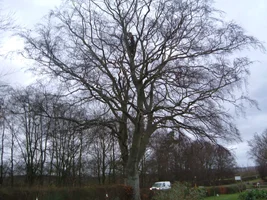
most of my work is on beech trees so i come across meripilus a great deal.....one of the big 2 when it comes to beech. heres a couple of pics of 1 i took down today
 

Attachments

  • 66417-b1.webp
    66417-b1.webp
    611.3 KB · Views: 99

New threads New posts

Back
Top Bottom