Mechanical Advantage Challenge

Re: Upside down slingshots

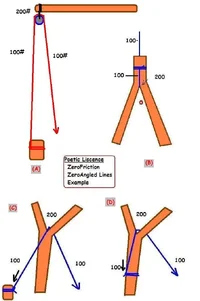
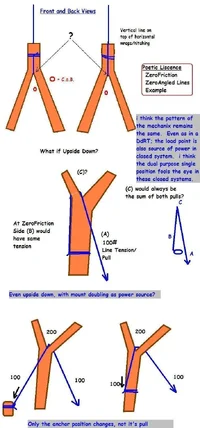
i offer a simpler proof. i think splitting the hairs and seeing how this works, can help define other things more simply.

In the DdRT setup; i think the eye is fooled; hard to see the 2/1 as the load position serves 2 purposes. i think this is similar; another closed system.

i ask, how can the tension between A + B = the load; If A does not equal the load, the load must fall. If no friction; B must = A; C must be the sum of all pulls of A + B(per angle of loading); which must be more than A; IFF be is positive, non-zero number. :: C must be more than load; as it is at any other angle etc. of the same pattern i think.
 

Attachments

  • 10481-More Mayhem.webp
    10481-More Mayhem.webp
    103.8 KB · Views: 79
Re: Upside down slingshots

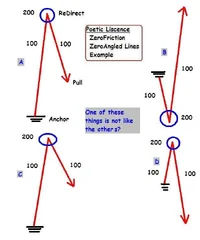
A view of recognizable similar patterns i think. The Title is: "Which ones are Wrong"
 

Attachments

  • 10484-Which ones are Wrong-B.webp
    10484-Which ones are Wrong-B.webp
    47.5 KB · Views: 69
Re: Upside down slingshots

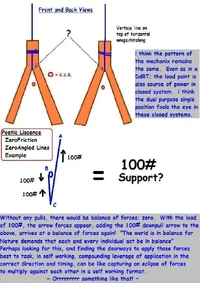
A reasonable explanation on where the extra 100# on redirect in puzzle could come from, go and permit 200# force up on a 100# load and the load not lift.

i think this is more reasonable solution than that the same pattern of forces just not working this one time.
 

Attachments

  • 10489-Return to Beneath the Planet of Mayhem Strikes Back Meets Jason.webp
    10489-Return to Beneath the Planet of Mayhem Strikes Back Meets Jason.webp
    117.7 KB · Views: 55
Re: Upside down slingshots

Ken: this is what you should do. Go to some store, buy some fish weighing scales-the type to hang and weigh game fish after catching a fish. You'll need at least 3 scales. This will give you 1 scale for each point, like in your pictures, that you're trying to measure.
Set the fish scales at each point and apply pressure. When you look at the scales, you'll find without question, what the forces are at each point, like in every picture you drew. Your questions will then be answered, but it'll cost you about 15-20 bucks for the scales.

BTW, hijacking rescueman's thread is rude.

Joe
 
The best I can do is describe my solution. I would use a total of 4 pullies and 1 prusik cord besides the rope. I'll use r-man's initial diagram to # the pullies from 1 to 3, starting from the pulley closest to the load as being 1, to the pulley closest to the anchor being 3. I'll substitute a double sheave pulley at the anchor and label it 4. I'd reeve the lines through the pullies by dead ending the line to pulley(p)2.

x at p2
lines goes through p1
through p4
through p2
through p4
through p3 which is attached with a prusik to line of p2 which moves towards p4.

Joe
 
Joe,
I think your system would work, but it's a complex MA system (pulleys moving at different speeds and/or different directions) and if I figured it right it would yield 9:1 MA.

Keep it simple. What makes a piggy-back (or pig rig) system so clean is that each element is a separate MA system that is merely linked so that the output of one is the input of the next.

This is why there is no need of another pulley at the anchor - each element is fixed to the anchor point and there is no continuous rope from one system to the next to the load.

- Robert
 
IF you need such a high Ma Put a winch on it saves time and f**king around with pulleys. Although a highly interesting subject 8-1 and 9-1 pully riggs have very little use in this industry. By the time you've set it up the tree would be done....

didj
 
Whut if ya kain't afford no high priced, fancy azzed wench; or can't git'er into the chosen position to suit y'or needs? Or even wonder about magnifying the magic powers of'er influence if'n ya had one to play wit'?

i think that 2Handing a 6:1 Spanish Burton might work to get 8:1 as a possible solution'ere.
 
I am in the high belife that if a rigger becomes fluint with tech rigging, an 8:1 or 9:1 or even up to a 15:1 (not to go over that) is easy and can be fast to put together. Now you will need some extras, ie. pickits for extra anchors if you need them. But when put in a position where you have nothing to anchor to besides a open field It will still all be possiable. Only using one rope will be a challange unless you have a crap load of footage. The optimal way is to have the line to the load be locked off to the rigging ( rigging having its own dedicated rope). At that point if you run out of rope to pull on you can lock it off and extend your rigging back out.
 

New threads New posts

Back
Top Bottom