
Navigation
Install the app
How to install the app on iOS
Follow along with the video below to see how to install our site as a web app on your home screen.
Note: This feature may not be available in some browsers.
More options
You are using an out of date browser. It may not display this or other websites correctly.
You should upgrade or use an alternative browser.
You should upgrade or use an alternative browser.
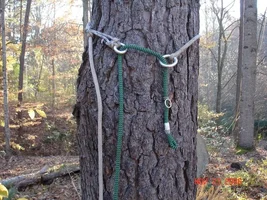
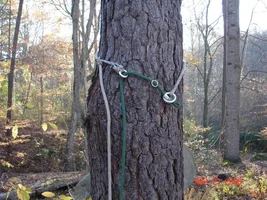
Mark Chisholm Tie in Technique
- Thread starter TC
- Start date


- Location
- Bloomington, Indiana

- Location
- Bloomington, Indiana

- Location
- Bloomington, Indiana
- Location
- Bloomington, Indiana
- Location
- Bloomington, Indiana
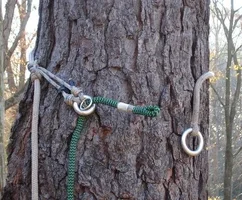
I thought you were going to show us how to 'safely' retrive it with some clever use of a throwline that won't get stuck or in the way?
I can stop scratching my head now; it can't be safely retrieved off a decent girth spar.
Which is unfortunate if your by the side of a road or over a green house I suppose.
I can stop scratching my head now; it can't be safely retrieved off a decent girth spar.
Which is unfortunate if your by the side of a road or over a green house I suppose.

TreeCo
Carpal tunnel level member
Thanks Mahk.


- Location
- Bloomington, Indiana
[ QUOTE ]
...a low stretch line doubled will give unacceptably high forces from as little as 50cm of fall (I tested this in a doubled system 3 times and came up with between 1000 and 1200Kg anchor forces from a 100kg dummy). This is because a doubled line in this situation has half the stretch for the same load than a single line anchored.
[/ QUOTE ]
Any references on this?
...a low stretch line doubled will give unacceptably high forces from as little as 50cm of fall (I tested this in a doubled system 3 times and came up with between 1000 and 1200Kg anchor forces from a 100kg dummy). This is because a doubled line in this situation has half the stretch for the same load than a single line anchored.
[/ QUOTE ]
Any references on this?
Yes, its in the prusik research, which I think I sent you a copy of. But, I know, there is a lot of data in that project that is presented on dry bread. I have a great media guy, who is also a qualified mountain leader (understand where we're coming from). So I'll see if he can whistle out a few colour graphs to share.
The computer is my nemesis.

I seem to remember Mark Chisholm commenting about this on TB a looong time ago - Big Guy?
Because its only arbs and steeplejacks that tend to use doubled lines these days, I don't know if any other specific info is available.
The next closest thing would be mountaineering rope use articles. I'll do a google search, see what I can find.
The prusik research was done with a qualified rope access trainer and qualified manufacturing engineer (designs access gear). Also an experienced mountaineer. he wasn't surprised by the results. He was surprised how well the prusiks performed though, acting as an energy absorber on choked single line to keep fall forces to about 700Kg.
Interesting stuff.
The computer is my nemesis.
I seem to remember Mark Chisholm commenting about this on TB a looong time ago - Big Guy?
Because its only arbs and steeplejacks that tend to use doubled lines these days, I don't know if any other specific info is available.
The next closest thing would be mountaineering rope use articles. I'll do a google search, see what I can find.
The prusik research was done with a qualified rope access trainer and qualified manufacturing engineer (designs access gear). Also an experienced mountaineer. he wasn't surprised by the results. He was surprised how well the prusiks performed though, acting as an energy absorber on choked single line to keep fall forces to about 700Kg.
Interesting stuff.

- Location
- Home of the New Jersey Devils
I have to agree with Paolo here. If I fall into a dynamic line the stretch will absorb the energy. If I use two of the same lines, they share the load and stretch less, thus adding force to the load (me). I don't think that having more rope out (as in two) would lessen the force on the load, rather increase it. If there was more rope out as in 40' instead of 20' in between me and the anchor, then it would help. What do you think of this?

If you think about it, two half-inch ropes have nearly the same cross-sectional area of one three-quarter-inch rope. You'd best figure on the elongation specifications of the larger rope of the same construction when using a doubled line.
[pi is a common factor so can be left out of the comparison]
radius equals diameter divided by two:
(.5 / 2) = .25
squared:
.25^2 = .0625
times two 'cause two ropes:
.0625 × 2 = .125
square root:
.125^.5 = .354
times two for equivalent diameter:
.354 × 2 = .708 (slightly more than 11/16)
[pi is a common factor so can be left out of the comparison]
radius equals diameter divided by two:
(.5 / 2) = .25
squared:
.25^2 = .0625
times two 'cause two ropes:
.0625 × 2 = .125
square root:
.125^.5 = .354
times two for equivalent diameter:
.354 × 2 = .708 (slightly more than 11/16)
I agree Mark, having more rope out should help, as could a springy anchor. But I don't think much; the tests I did were a douled system with 18 meters of rope out (about 9 meters from dummy to anchor doubled). Tied as a VT system, with 50cm of slack in each line. Still very high fall forces.
I like your interpretation Glens, thats a good way of putting it across. I even kept up with the math!

Raises the question of whatto do about it; climb on stretchier 9mm lines doubled? I don't think so.
I use a single line when a fall is not unusual - like spar work, and keep slck out of my system when climbng doubled.
Its also why I advocate 1891 Type'A' ropes rather than 'B'. That means the Fly, rather than the Blaze. Plus the Fly is a true kernmantle rather than double braid, which may affect ascender sheath tear in a fall. The lower stretch of the Blaze might be compensated on SRT with so much rope out, but I'm stillnot sure about the sheath tear.
I like your interpretation Glens, thats a good way of putting it across. I even kept up with the math!
Raises the question of whatto do about it; climb on stretchier 9mm lines doubled? I don't think so.
I use a single line when a fall is not unusual - like spar work, and keep slck out of my system when climbng doubled.
Its also why I advocate 1891 Type'A' ropes rather than 'B'. That means the Fly, rather than the Blaze. Plus the Fly is a true kernmantle rather than double braid, which may affect ascender sheath tear in a fall. The lower stretch of the Blaze might be compensated on SRT with so much rope out, but I'm stillnot sure about the sheath tear.
- Location
- Bloomington, Indiana
I went over the ‘ropes and friction hitches’ paper.
It seems my initial thought about a doubled line was wrong. But, I don’t think that this necessarily makes it unsafe to use a doubled line when working on a spar, and this was also stated in the paper.
Glens explanation using the cross sectional area of the line(s) helped to clarify (at least for me) why a doubled line can create more force than a single line for a given distance of fall. L2’s paper mentioned that an additional reason for the lower force on a single line may be the fact that the climber’s full weight falls onto the friction hitch, thus causing the hitch to slide farther and absorb more of the impact (so would there be slightly more force if a Gri-Gri or Cinch were used???).
From the paper:
In the ‘Doubled Rope Drop Tests’ for a ‘fall factor 2’ fall, the forces “…are very high and appear to be likely to cause damage to the climber” (p.33). In the ‘Single Rope Drop Tests’ for a ‘fall factor 2’ fall, “The recorded forces were almost 50% (on average) lower than the doubled rope ‘fall factor 2’ falls” (p. 35).
The above are for falls of ‘fall factor 2’. For falls of ‘fall factor 1’:
For the ‘Single Rope Drop Tests’ for ‘fall factor 1’ falls, it is stated “Both cord types held the fall with similar results to the doubled rope drop test for falls of ‘fall factor 1’” (p. 34).
It seems that, for a doubled rope, the forces jump dramatically from a ‘fall factor 1’ fall to a ‘fall factor 2’ fall. This is particularly important to remember when working the upper part of the canopy because it is common, and often unavoidable, that the climber is at or above their TIP—and often at some horizontal distance from the TIP.
I think it would be very unlikely that a climber would be above their tie-in-point (the choked climbing line) when working down a spar, however, and thus they would not be subject to a ‘fall factor 2’ fall. Either the choked line would be at the climber’s waist (with no slack in the line) or the climber would be below the choked line and sitting on the friction hitch with a taut climbing line. The paper states several times that there should be minimal slack in the climbing line. I think this is correct and in both instances just mentioned (the choked line at the climber’s waist and the climber sitting below the choked line) there is minimal or no slack in the line.
Most of the paper seems to consider that the climber is tied-in to a limb and is working the canopy. In a few places the paper specifically mentions working on a spar and in the ‘General Conclusions’ it states “…when topping down a pole…the lifeline should be chokered (either doubled or single) around the stem at waist height in order to avoid a factor 2 fall” (p. 38). The paper does not say, but I think, that if the climber is sitting on the taut climbing line below where the line is choked (doubled or single), then the climber is not likely to incur a fall of ‘fall factor 1’ or ‘fall factor 2’.
Neither a single nor a doubled line is a perfect system for working a spar. Each system has its benefits and its drawbacks, and either may be preferable in certain situations. But, if setup and used properly, I think that both systems are safe.
L2:
If your media guy can provide them, I’d like to see the colo(u)r graphs.
I don’t remember that the paper mentioned using a lanyard or redirect when the climber is at/above and away from the TIP. Was this beyond the scope of the work?
It seems my initial thought about a doubled line was wrong. But, I don’t think that this necessarily makes it unsafe to use a doubled line when working on a spar, and this was also stated in the paper.
Glens explanation using the cross sectional area of the line(s) helped to clarify (at least for me) why a doubled line can create more force than a single line for a given distance of fall. L2’s paper mentioned that an additional reason for the lower force on a single line may be the fact that the climber’s full weight falls onto the friction hitch, thus causing the hitch to slide farther and absorb more of the impact (so would there be slightly more force if a Gri-Gri or Cinch were used???).
From the paper:
In the ‘Doubled Rope Drop Tests’ for a ‘fall factor 2’ fall, the forces “…are very high and appear to be likely to cause damage to the climber” (p.33). In the ‘Single Rope Drop Tests’ for a ‘fall factor 2’ fall, “The recorded forces were almost 50% (on average) lower than the doubled rope ‘fall factor 2’ falls” (p. 35).
The above are for falls of ‘fall factor 2’. For falls of ‘fall factor 1’:
For the ‘Single Rope Drop Tests’ for ‘fall factor 1’ falls, it is stated “Both cord types held the fall with similar results to the doubled rope drop test for falls of ‘fall factor 1’” (p. 34).
It seems that, for a doubled rope, the forces jump dramatically from a ‘fall factor 1’ fall to a ‘fall factor 2’ fall. This is particularly important to remember when working the upper part of the canopy because it is common, and often unavoidable, that the climber is at or above their TIP—and often at some horizontal distance from the TIP.
I think it would be very unlikely that a climber would be above their tie-in-point (the choked climbing line) when working down a spar, however, and thus they would not be subject to a ‘fall factor 2’ fall. Either the choked line would be at the climber’s waist (with no slack in the line) or the climber would be below the choked line and sitting on the friction hitch with a taut climbing line. The paper states several times that there should be minimal slack in the climbing line. I think this is correct and in both instances just mentioned (the choked line at the climber’s waist and the climber sitting below the choked line) there is minimal or no slack in the line.
Most of the paper seems to consider that the climber is tied-in to a limb and is working the canopy. In a few places the paper specifically mentions working on a spar and in the ‘General Conclusions’ it states “…when topping down a pole…the lifeline should be chokered (either doubled or single) around the stem at waist height in order to avoid a factor 2 fall” (p. 38). The paper does not say, but I think, that if the climber is sitting on the taut climbing line below where the line is choked (doubled or single), then the climber is not likely to incur a fall of ‘fall factor 1’ or ‘fall factor 2’.
Neither a single nor a doubled line is a perfect system for working a spar. Each system has its benefits and its drawbacks, and either may be preferable in certain situations. But, if setup and used properly, I think that both systems are safe.
L2:
If your media guy can provide them, I’d like to see the colo(u)r graphs.
I don’t remember that the paper mentioned using a lanyard or redirect when the climber is at/above and away from the TIP. Was this beyond the scope of the work?
Phew! Sometimes I wish you were in the same town so we could just discuss these things over a beer!
A lot of what you mentioned was beyond the scope of the research, but I included them for discussion because I felt they were important. I was refering to usual slack when using a doubled rope, positioning below the TIP. So technically a factor 1 fall, but with the equivalent of a 3/4" rope (thanks glens)! On a spar, the same scenario if not choking it single. Fall Factors are just concepts, not force measurements. No slack, no force, no worries.
The prusiks did act as energy absorbers on a single line drop, reducing forces below 8kN I think. I think the Technora prusiks did incease the force by about 15%(and turned into coat hangers!). The prusiks didn't act as an energy absorber on a doubled line.
The comments about single lines on spars, was because, depending where you tie in, you could generate those forces e.g. I think there is a bigger risk of cutting a line from gaffing out, so I prefer to choke my line a little lower than waist height. If you look in my avatar, you can see how a 50cm fall is perfectly possible. I'll have to check, but I'm sure the single line drop tests were much lower than the doubled line with 50cm of slack (50cm each leg).
I never intend to stipulate how anyone should do something on TB, but I am keen to expose as much of the facts as possible to help others make an informed decision.
At the end of the day, we have to choose between the devil and the deep blue sea quite often, with no back up. We need a versatile approach to problem solving, whilst adhering to the KISS philosophy of life of work at height.
I'm fairly certain the Grigri won't act as an energy absorber.
This thread is along the same lines:
http://www.treebuzz.com/forum/showflat.php?Cat=0&Number=63926&Main=63819#Post63926
A lot of what you mentioned was beyond the scope of the research, but I included them for discussion because I felt they were important. I was refering to usual slack when using a doubled rope, positioning below the TIP. So technically a factor 1 fall, but with the equivalent of a 3/4" rope (thanks glens)! On a spar, the same scenario if not choking it single. Fall Factors are just concepts, not force measurements. No slack, no force, no worries.
The prusiks did act as energy absorbers on a single line drop, reducing forces below 8kN I think. I think the Technora prusiks did incease the force by about 15%(and turned into coat hangers!). The prusiks didn't act as an energy absorber on a doubled line.
The comments about single lines on spars, was because, depending where you tie in, you could generate those forces e.g. I think there is a bigger risk of cutting a line from gaffing out, so I prefer to choke my line a little lower than waist height. If you look in my avatar, you can see how a 50cm fall is perfectly possible. I'll have to check, but I'm sure the single line drop tests were much lower than the doubled line with 50cm of slack (50cm each leg).
I never intend to stipulate how anyone should do something on TB, but I am keen to expose as much of the facts as possible to help others make an informed decision.
At the end of the day, we have to choose between the devil and the deep blue sea quite often, with no back up. We need a versatile approach to problem solving, whilst adhering to the KISS philosophy of life of work at height.
I'm fairly certain the Grigri won't act as an energy absorber.
This thread is along the same lines:
http://www.treebuzz.com/forum/showflat.php?Cat=0&Number=63926&Main=63819#Post63926
- Location
- Bloomington, Indiana
[ QUOTE ]
...but I am keen to expose as much of the facts as possible to help others make an informed decision.
[/ QUOTE ]
OK, so here is some info, with very little additional comment.
From L2s paper (double quotes "....." indicate the text is repeated verbatim from the paper):
In the ‘Doubled Rope Drop Tests’ for a ‘fall factor 2’ fall, the forces “…are very high and appear to be likely to cause damage to the climber” (p.33). In the ‘Single Rope Drop Tests’ for a ‘fall factor 2’ fall, “The recorded forces were almost 50% (on average) lower than the doubled rope ‘fall factor 2’ falls” (p. 35).
The above are for falls of ‘fall factor 2’. For falls of ‘fall factor 1’:
For the ‘Single Rope Drop Tests’ for ‘fall factor 1’ falls, it is stated “Both cord types held the fall with similar results to the doubled rope drop test for falls of ‘fall factor 1’” (p. 34).
"Maximum peak force recorded"
---for falls of 'fall factor 1' with a single rope: 700Kg
---for falls of 'fall factor 1' with a doubled rope: 892Kg
"Minimum peak force recorded"
---for falls of 'fall factor 1' with a single rope: 624Kg
---for falls of 'fall factor 1' with a doubled rope: 641Kg
NB--various combinations of friction hitches, split tails, and climbing lines were used, and these were not always duplicated from one type of test to another.
Most of the paper seems to consider that the climber is tied-in to a limb and is working the canopy. In a few places the paper specifically mentions working on a spar and in the ‘General Conclusions’ it states “…when topping down a pole…the lifeline should be chokered (either doubled or single) around the stem at waist height in order to avoid a factor 2 fall” (p. 38).
[ QUOTE ]
No slack, no force, no worries.
[/ QUOTE ]
I'll buy the beer.
...but I am keen to expose as much of the facts as possible to help others make an informed decision.
[/ QUOTE ]
OK, so here is some info, with very little additional comment.
From L2s paper (double quotes "....." indicate the text is repeated verbatim from the paper):
In the ‘Doubled Rope Drop Tests’ for a ‘fall factor 2’ fall, the forces “…are very high and appear to be likely to cause damage to the climber” (p.33). In the ‘Single Rope Drop Tests’ for a ‘fall factor 2’ fall, “The recorded forces were almost 50% (on average) lower than the doubled rope ‘fall factor 2’ falls” (p. 35).
The above are for falls of ‘fall factor 2’. For falls of ‘fall factor 1’:
For the ‘Single Rope Drop Tests’ for ‘fall factor 1’ falls, it is stated “Both cord types held the fall with similar results to the doubled rope drop test for falls of ‘fall factor 1’” (p. 34).
"Maximum peak force recorded"
---for falls of 'fall factor 1' with a single rope: 700Kg
---for falls of 'fall factor 1' with a doubled rope: 892Kg
"Minimum peak force recorded"
---for falls of 'fall factor 1' with a single rope: 624Kg
---for falls of 'fall factor 1' with a doubled rope: 641Kg
NB--various combinations of friction hitches, split tails, and climbing lines were used, and these were not always duplicated from one type of test to another.
Most of the paper seems to consider that the climber is tied-in to a limb and is working the canopy. In a few places the paper specifically mentions working on a spar and in the ‘General Conclusions’ it states “…when topping down a pole…the lifeline should be chokered (either doubled or single) around the stem at waist height in order to avoid a factor 2 fall” (p. 38).
[ QUOTE ]
No slack, no force, no worries.
[/ QUOTE ]
I'll buy the beer.
- Location
- Bloomington, Indiana
Seems cleah from heah...


